Why Real Change Is Harder Than You Think (And Where It Actually Begins)
When a person becomes aware that they want a change in their life, the first step has already been taken.
There is awareness that something needs to change.
In the second phase, the question becomes how to actually do it.
And this is where things get difficult.
You realize you want to change something.
You want to lose weight.
You want to exercise more.
You want to change your job.
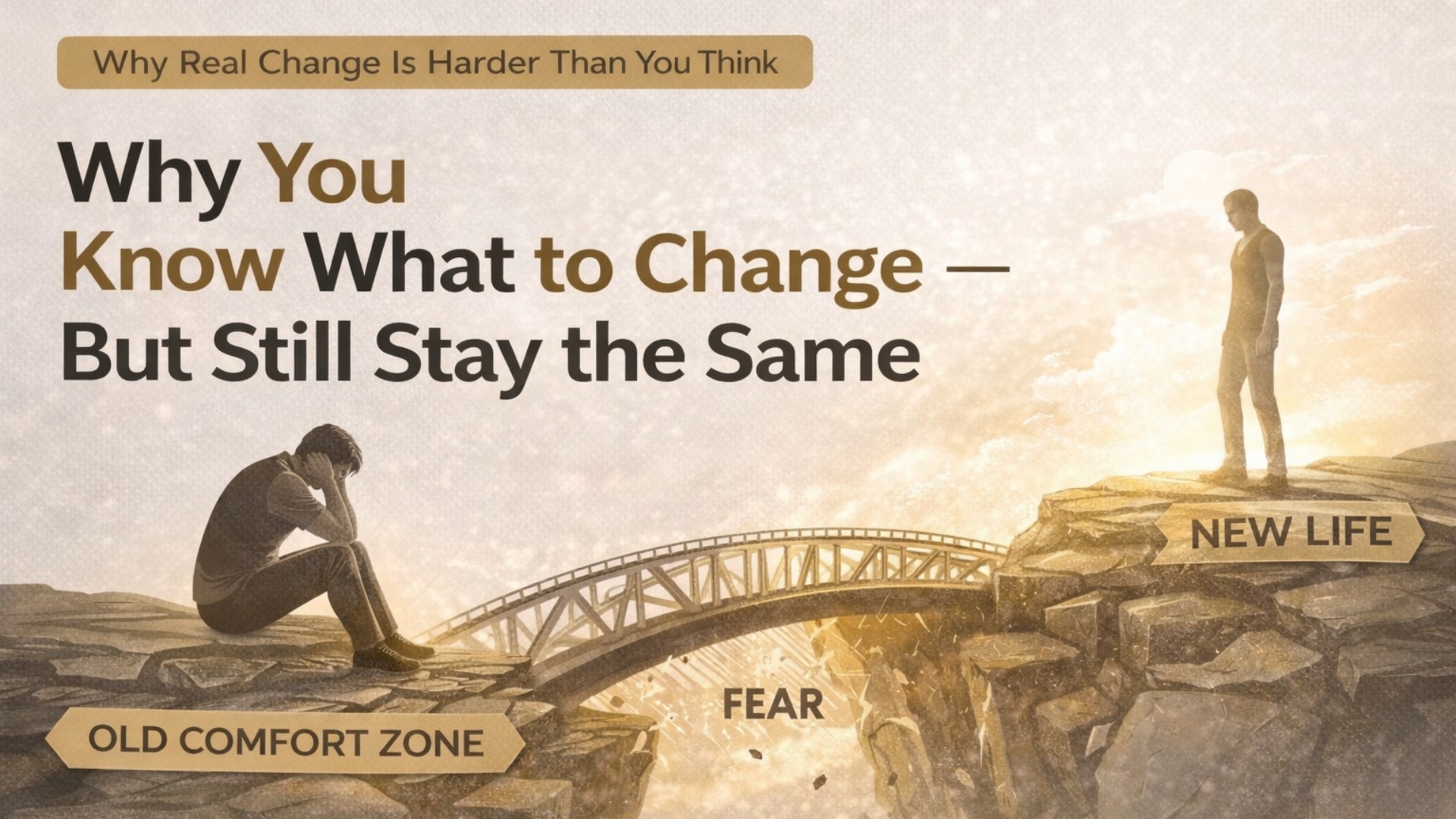
But at the same time, you suddenly see that even though the old situation was uncomfortable, annoying, and something you no longer want, it was still within your comfort zone.
And that is where the real struggle begins.
The comfort zone, even when it is not good for you, is familiar.

And moving from that familiar discomfort into something unknown is not simple.
You go from something you know, even if it is unpleasant, into something you do not know at all.
And you do not know if it will be better or worse.
This is exactly where people say:
I know better.
But I still do the same.
The transition itself is very difficult.
It requires stepping out of what is known into something uncertain.
And because of that, real change is much harder than it seems at first.
Prefer to listen instead of read?
Why Your Brain Prefers Familiar Misery
A focused conversation on why the mind holds on to what feels familiar, even when it’s not good for you, and what it actually takes to move beyond it.
How to change thought patterns
If you have ever asked yourself, “How do I change my mindset?” or “Why is change so hard even when I know what to do?”,
Then it is important to start with something very clear.
Training the mind is not a simple matter.
And it is not for everyone.
The fact remains that everyone can, at least to some extent, recognize their thought patterns and influence their decisions with some effort.
But going deeper, changing patterns, habits, and ways of thinking, requires much more than understanding.
It requires time.
Consistency.
And a willingness to face things that are not always pleasant.
This is also the reason why many people feel stuck.
They ask these questions:
“Why can’t I change even when I know what I’m doing wrong?”
“Why do I keep repeating the same patterns?”
How do I change my thought patterns?
The answer is not a lack of intelligence or awareness.
It is that knowing and changing are two very different things.
TRY THIS:
In theory, things connected with the mind often seem simple.
You read about them.
You understand them.
And everything appears clear.
But in practice, it is completely different.
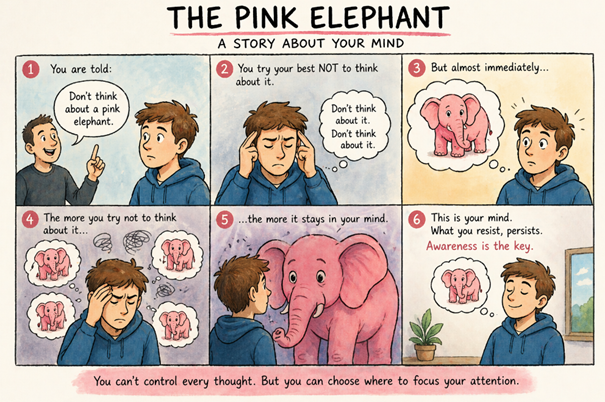
A simple example would be telling yourself not to think about the pink elephant we talked about in the article “Why Do I Overreact So Fast – And Why I Can’t Let It Go“
The moment you say it, the thought appears.
The mind does not respond well to prohibition.
It responds to focus.
This is why the mind is not trained by telling it what it should not do.
It is trained by directing it somewhere else.
By shifting attention, not by suppressing it.
And this is where the real work begins.
How to change mindset – Awareness Is the First Step (But Not Enough)
The first step in training the mind is awareness.
To recognize that thoughts exist.
That they are not the same as you. Thoughts are not you; you can see them outside yourself.
FAST EXERCISE:
Please do this first. You observe which thought comes first. Stop for a second and wait. When the thought comes, ask: why this thought and not any other?
Remember:
Thoughts influence your emotions and your actions.
Without this step, nothing changes.
But awareness alone is not enough.
Many people become aware of their patterns and still remain in them.
They see what they are doing.
But they continue doing it.
This is where people often become frustrated when they can’t influence their thoughts. Usually they are not even aware of the can.
Awareness opens the door.
But it does not walk you through it.
It allows you to see the process.
But it does not automatically change it.
That change requires repetition.
Patience.
And time.
The Patterns You Don’t Even See
A large part of what drives your behavior is patterns that you do not even notice. They are built over the years, through family, environment, work, relationships, and personal experiences.
These patterns become automatic.
That is why people ask: “Why does this keep happening to me?”
or
“Why do I react the same way every time?”

The answer is that these patterns are deeply embedded. They are not surface-level habits. They are part of how your mind has learned to function, shaped slowly over time through repetition, emotion, and experience, until they begin to feel natural and unquestionable.
Before you can change a pattern, you must first recognize it.
And this is not always easy.
Many patterns feel natural.
They feel like:
“This is just how I am.”
But very often, this is not who you are.
It is what you have learned.
The Attachment That Controls You (And Why It Is Hard to Let Go)
At some point, you begin to notice that certain things have a stronger hold on you than others.
This can be money.
Success.
Relationships.
Recognition.
Or a sense of justice.
And this is where things become more personal.
Part of what makes these attachments so persistent is physiological, how unexamined internal pressure keeps old patterns in place is the missing layer in almost every framework that focuses only on behavior and mindset.
How unexamined internal pressure keeps old patterns in place?
MY STORY
From my own experience, I needed a long time to recognize how strongly I was attached to material things.
Not because I needed them to survive.
But because of what they represented.
Effort.
Value.
Social status.
Identity.
I remember a situation where I had to let go of a significant amount of money.
Rationally, I knew it would not seriously affect my life.
But emotionally, it felt as if something was being taken from me.
Not the money itself.
But the meaning behind it.
The sense of injustice.
The money was mine. I earned it hard. That’s why it hurt so much.
It felt almost like part of me was being torn apart.
It felt like dying.
That was the first time I was aware of my Ego.
That was the aha moment for me.
OH, this is my ego.
This is me?
But it felt like someone was taking my money.
But the money, the attachment to the matter, was part of me.
So it felt like “I” was torn apart.
From that moment on, I started looking at I-ness from a different angle.
I thought I didn’t have an ego problem.
But now I know what that even meant.
This is where many people struggle.
They ask, “Why can’t I let things go?” or “Why am I so attached to certain outcomes?”
The answer is that these things are connected to deeper layers of identity and belief.
It is part of us.
Which is why it is not simple to let go.
Why Letting Go Feels So Hard
Why Letting Go Feels So Hard
You can see this in simple examples.
STEP ONE
Try to get rid of things you do not use. Like old:
Clothes.
Objects.
Equipment.
Many people find this surprisingly difficult.
Not because they need these things.
But because they feel attached to them.
STEP TWO
If you can, try to get rid of the things you haven’t used for 6-12 months. And then you will see what hard is.
Those are good things that are just out of use (clothes, shoes, phones, camera, etc.)
STEP THREE
And if you get even deeper, throw away something that means something (a gift, a bracelet, a letter, a sculpture, etc.), because it doesn’t serve its purpose anymore.
Then you will see what attachment is and how it works inside of you.
ULTIMATE STEP
I once heard that if you want to be liberated, get rid of the things that matter most to you.
BUT BE CAREFUL
You are not allowed to do all this at once, because you will miss the point. The point is, can you do it forcefully? The point is to do it with awareness, in small steps, with small pain, and by letting go.
And that is real change, growth, and detachment.
And it takes time, so do it gradually.
The same applies to clinging to people.
Relationships that are no longer beneficial, but are still maintained.
Not because they bring value.
But because they are familiar.
Or were once important.
This is why people ask:
“Why is it so hard to let go?”
The answer is not practical.
It is psychological.
It is a part of who you are.
What Actually Changes You (And What Doesn’t)
Many people believe that change comes from understanding.
Once they understand something, it will change.
But that is rarely the case.
Change comes from practice.
From repetition.
Gradually working through patterns, one by one.
Not all at once.
Not quickly.
But consistently.
You cannot write down ten things you want to change and expect them to disappear in a few weeks.
Each pattern requires time.
Sometimes months.
Sometimes years.
From my own experience, real change only began when I consistently observed my patterns and worked on them over time.
Not perfectly.
Not without failure.
But continuously.
The key is not perfection.
The key is direction.
And the willingness to stay on that path long enough for change to actually happen.
That direction needs a vehicle, and why consistent action matters more than motivation is the reason the people who change are not the ones who wanted it most, but the ones who showed up most consistently.
Why Change Takes Time (And Why Most People Quit Too Early)
Change is not a single decision. It is a process that unfolds over time.
Many people underestimate this part. They believe that once they recognize a pattern, it should disappear.
But that is not how the mind works. Patterns are built over years, sometimes decades. They are reinforced through repetition. As a result, they cannot be removed quickly. That is why people often feel, “I know what I need to change, but nothing is really changing.”
But that is not how the mind works.
Patterns are built over years, sometimes decades.
They are reinforced through repetition.
As a result, they cannot be removed quickly.
If it took you years or decades to evolve some habit or pattern, it will take you 3-8 years to undo it or, better yet, replace it with a good habit.
And you will have to plan it, work on it daily in the beginning, then weekly, monthly, and so on.

The aim is to change the pattern or bad habit, not to erase it.
Like computer hardware, it must be overwritten with data to be erased.
A good example of this is attachment to material things.
As I mentioned before, it took me a long time to recognize how deeply this was rooted in me.
It was not about the object itself.
It was about what the object represented.
Effort.
Value.
Identity.
The same pattern repeated itself in other situations as well.
Customers refuse to pay for my legal work
For example, when I helped someone with a legal matter and did not define the price in advance.
Later, when the person refused to pay, the first impulse could easily turn to anger, judgment, or conflict. Get in a fight with him.
But in that moment, the real issue was not about the money.
It was about my value system.
It was about noticing the thoughts that were starting to appear, the justification, the sense of injustice, the need to prove something.
And instead of following those thoughts, I had to consciously redirect them.
Not perfectly, but enough to not fall into the same pattern again.
All I was doing was replacing my mind with positive thoughts that were good for me.
I thought to myself.
I know it hurts, but this is good for me.
My ego and value system are hurt, but I know I am ok; my value and worth are not represented by this man, whose actions were wrong. It is not about him.
He is just the teacher in disguise.
It was never about him. It was all my internal thoughts and emotional process.
Once I got over this feeling and pain, I was able to let go.
Who are the people that hurt you?
People who hurt you are just “fish in the ocean.”
They do not matter. There are too many of them, and when you catch one, the millions will follow. You can never catch them all.
But here is what you can do: change how you approach and deal with them, and see that they are just doing their own thing, surviving in their own way.
They are not important; if it weren’t them, it would be someone else.
What I did then
And then, when such people hurt me in a way, I would shift my mind to something else.
First, you need to calm down. don’t react. That would be the first mistake.
And don’t go there when the same or similar thoughts appear.
So, in my case,
I repeated the sentence:
It is not about them. It is all my thinking and reacting. Don’t react.
I did this several times throughout the day, as bad thoughts came up.
I did transfer my bad thoughts as much as possible.
And every day it was less thoughts and emotions.
Usually, smaller matters resolve from grand to medium in a few days.
This is where change actually happens.
Not in big decisions, but in small moments.
In the moment when you notice a pattern and choose not to fully follow it.
This is also where many people fail, because they expect immediate results.
But the process is slow.
It requires repetition.
It requires patience.
And it requires that you continue even when it feels like nothing is happening.
CONCLUSION: Why can’t I change?
In short. It takes time.
I would gladly say it doesn’t, but it does. The bigger the challenge, the harder it is to change it.
From my own experience, this work takes years.
Not weeks.
Not months.
Years.
BUT….
FIRST
It is worth it, because you will win in the long run.
SECOND
You don’t have to hurry. All you’ve got is time in this world.
Don’t be impatient.
THIRD
Small steps, but never quit or give up.
And the world of change will be at your door.

Because
In the end, the goal is not to become someone completely different overnight.
The goal is to gradually become more aware, more stable, and more aligned with the person you want to become. And that only happens if you stay on the path long enough.