Most people think they understand stress.
They use the word every day.
But very few people have actually experienced it consciously.
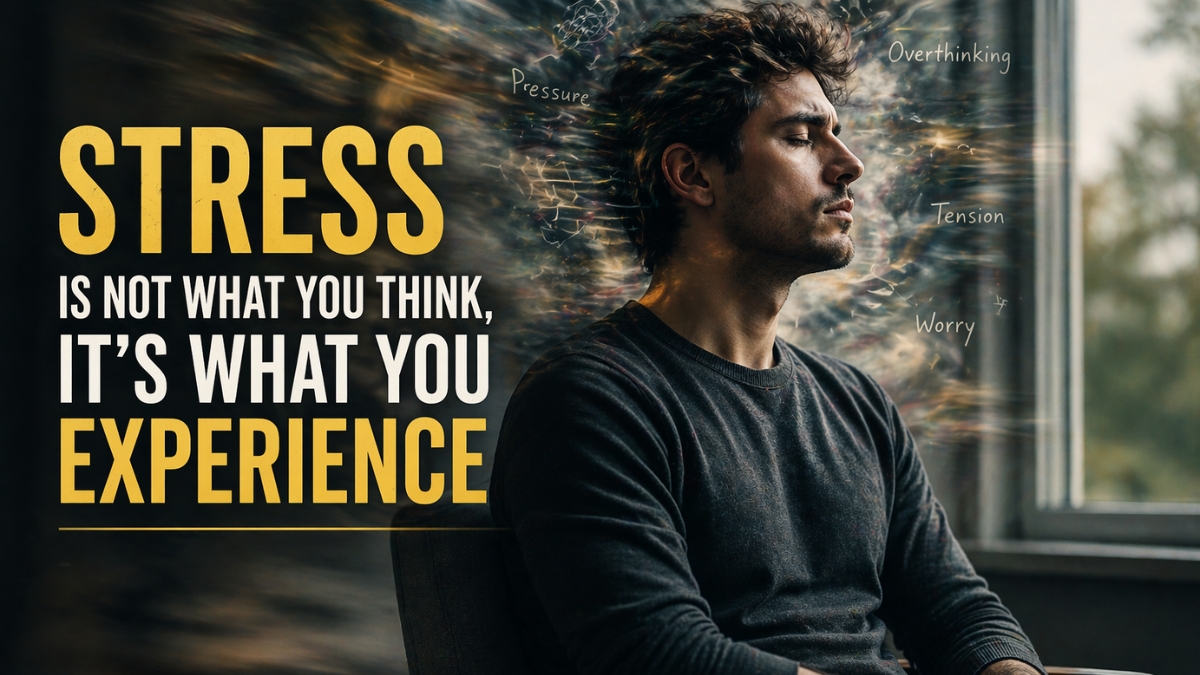
Not as a concept, but as something that takes over your body, your thoughts, and your behavior.
For a long time, I was convinced I had no stress at all.
I was wrong.
Most people think stress is something external, something that happens because of situations or pressure.
But in reality, stress is a physical and emotional experience happening inside the body.

Why Most People Misunderstand Stress
There is probably no longer an adult in the modern world who does not know what stress is, or who is not at least vaguely familiar with the term.
In all probability, however, this term has been distorted and manipulated to the point of absurdity. If you asked a thousand people what stress is, or what the definition of stress is, you would probably get almost that many answers.
Part of why stress is so misunderstood is that its most common driver goes unrecognized – how a mind that won’t stop thinking amplifies stress from the inside, long before any external pressure appears.
How a mind that won’t stop thinking amplifies stress?
I remember almost thirty years ago, when I was still working in the police. I had just been promoted, completed the higher police school, and achieved my first promotion, which I was very proud of.
At that time, as a group leader, I was working with colleagues when I received a call over the police radio station telling me to urgently call the unit.
At that time, mobile phones did not exist as they do today. We are talking around 1998/1999.
So my colleagues and I went to a nearby restaurant, and there I asked for a telephone.
My boss asked me whether I would attend an anti-stress seminar for managerial staff.
I immediately understood that the question was not really a question, but more a rhetorical form of an order.
It was clear to me that I had found myself in the role of a so-called Russian volunteer, meaning I had been selected.
I soon realized that, out of the three bosses above me, none of them wanted to go, so I became the next most convenient option.
Hand on heart, at that time, I was a little over twenty-three years old. I had four years of experience in the police and less than a year of leadership experience.
I remember my expression when the boss asked me whether I would go to that seminar, and I almost laughed to myself.
What stress, I have no stress at all.
What Stress Actually Feels Like in Real Situations
It is interesting that this “having no stress” story stayed with me for many years.
Approximately ten years later, when I began working as a lawyer, I became all too aware of this stress thing. Probably the years themselves had already brought their own weight, and work in the legal profession is, in any case, a class of its own when it comes to stress.
At that anti-stress program, which lasted the whole weekend, we did things that were, interestingly enough, far from anything known or pleasant to me.
These were relatively difficult exercises, confrontations with unpleasant and awkward situations.
It was anxious, distressing, and very uncomfortable.
One of the exercises was for you to come to the front of the whole group of participants.
There were about sixty of us.
We were sitting on the floor in one large room.
Each person had to stand up and step in front of the crowd.
The lecturer first asked you how you felt, and most of us said that we felt very uncomfortable.

Then she asked you where in the body you felt it.
I admit that the whole thing was very overwhelming, very tense, and very stressful.
And that was the point.
To get us out of our comfort zone.
If I had not felt stress before, I certainly did when facing that many people watching me on the podium.
I remember standing.
My left leg was shaking so hard that I wanted to run out of that room.
I was experiencing enormous shame.
If you want to understand this more deeply, listen to this audio:
How Awareness Reduces Stress
Then something interesting happened.
We (each one of us separately) were given the task of looking all the participants in the eyes. You were standing in front of 60 people. All alone, everybody watching.
The exercise was such that you first looked all the participants in the eyes once.
You had to look each one in the eye for a second or two.
Then you did a few exercises, a few jumps, or some other simple stress-relieving exercises, whatever suited you.
Then you talk to the lecturer a little, and you calm your body.
And when you had calmed down, you looked those same participants in the eyes once again.
The difference between the first and the second rounds of looks was one in a thousand.
In the first situation, when you were scattered, the stress was so intense that you were consumed by nothing but yourself the entire time.
With your heart rate, with your breathing, with your shaking, and with your discomfort.
We all had similar issues.
The feelings were so overwhelmingly intense that it is almost impossible to describe.
In the second round, when you calmed down and saw that these were completely ordinary people who wished you well and wanted you to succeed in that situation, the whole situation changed by a thousand percent.
You connected with your audience.
Without any problem, you stopped at each participant and looked them in the eyes for a second or so, even with a smile.
How one simple exercise, which we all did for about five minutes, changed my understanding of stress, anxiety, and uncomfortable situations.
Why Stress Feels So Intense (And What Changes It)
The second exercise we had was even more unusual.
I warmly recommend this exercise if you ever have the chance to do it somewhere in a group, at home, or with friends.
You will all feel equally awful, and in the end, you will all be great winners.
The lecturer seated us in pairs, and those pairs were random.
We sat cross-legged on the floor, facing one another, at a distance of approximately 2 feet (50 centimeters).

I remember that there I first sat opposite one of my former bosses, who was much older than I was.
I felt very uncomfortable with him because he was a rather awkward man, not exactly the most emotionally intelligent one, at least not for those times.
But he was extremely teachable and open.
He was twenty ranks above me in the police hierarchy, had completed law school, and I respected him immensely.
He was one of my best bosses, now looking back.
I was, of course, afraid to face him in such an uncomfortable situation.
It was precisely with him that I sat in the first face-to-face encounter.
Even though I myself was under enormous stress and discomfort, I could see that he felt equally uncomfortable.
That gave my brain an interesting piece of information.
Apparently, both of us were in the same situation. It wasn’t important that he outranked me by a great deal.
It did not help me very much, but it still let me know that we all had the same problem.
Then the next task came.
Why Eye Contact Triggers Stress
We had to look each other in the eyes at that distance for five minutes.
It was a crazy five minutes.
It was uncomfortable and awkward.
The exercise continued in such a way that we held out our hands, with both hands, and again looked into each other’s eyes.
Then we swapped partners. I was so thankful, but the awkwardness didn’t end.
I have to say that it was somehow easier for me to hold hands with women; probably it was the whole gender thing.
Interestingly, in the middle of the exercise, I remembered one man whose hands sweat so much more than mine.
I knew I wiped my own hands before so that, while sitting and holding hands, I would not experience additional shame from sweating.
Fortunately, there were no major problems there, though there were many fears connected with it. He wasn’t so lucky, and he probably felt embarrassed.
When Stress Peaks the Most
That wasn’t it.
The next level was this.
While looking into a person’s eyes and holding their hands, you had to say to them, “I belong to you.”And with that, it somehow became clear that our greeting was no longer hi or hello, but I belong to you, often even with a hug.
What These Experiences Reveal About Stress
Later, I realized that we took two major lessons from these exercises.
The first was overcoming discomfort, anxiety, and the strong urge to escape that uncomfortable situation.
The second was that it created a very strong bond within the group.
This surprised me greatly, as I was able to connect with complete strangers in a very short time on a deep level that is difficult to describe.
We had a reunion about a month later.
When we met again after a month, we hugged and said, “I belong to you.”
You didn’t say hi.
How are you?
There was simply no need.
We hugged and said I belong to you.
The sincerity, the smiles, and the warmth I experienced then with those people cannot be described in words.
This anti-stress seminar also left a deep mark on my life, something I had hardly been aware of until writing these lines.
Many of the techniques I learned there I later carried forward unconsciously.
I used that technique and the experiences I gained there very skillfully throughout my life, and I still use them.
What Stress Really Is
At that time, I did not fully understand what stress really was.
I experienced it.
I felt it in my body.
But I did not yet have the framework to explain it.
“That is the moment you realize that stress is not just something you think about, it is something you experience in your body.”
That weekend did not give me answers.
| It gave me a first glimpse of the internal system behind why stress becomes chronic – not the situation, but the pattern the body builds around it over time. The internal system behind why stress becomes chronic. |
It gave me something more important.
It showed me that what we call stress is not just external pressure.
It is a reaction.
A system.
A process happening inside us.
Only later did I begin to understand what was actually going on.
To understand this more clearly, here is a simple breakdown of how stress actually works:
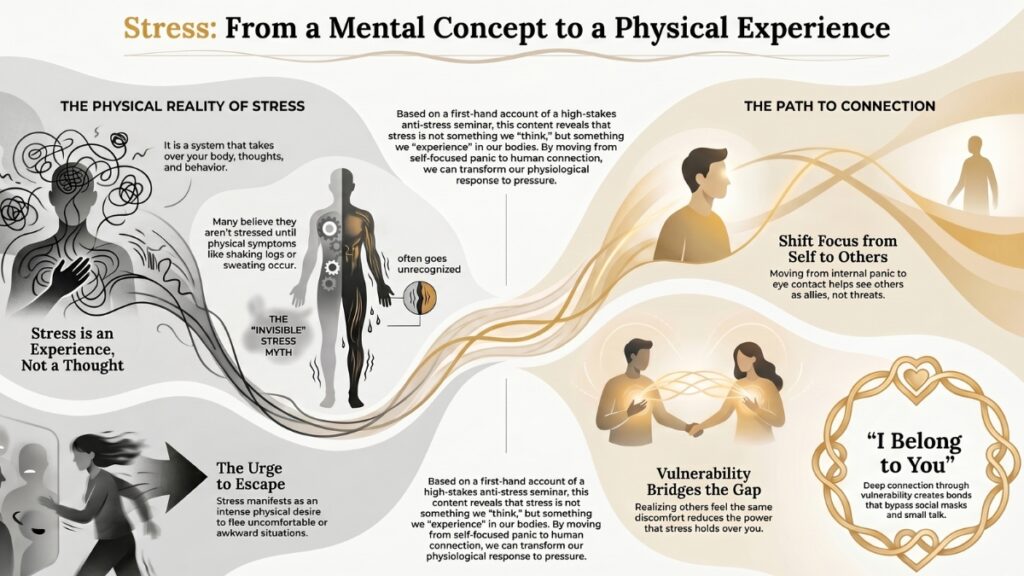
This is why stress is not something you think about, but something you experience in your body.
“Stress is not just something you think about, it is something you experience in your body.”
Why Understanding Stress Changes Everything
Understanding stress changes how you experience everything.
You stop fighting situations and start observing your reactions.
And in that moment, something shifts.
Stress does not disappear.
But it no longer controls you in the same way.
That shift also changes how you work, because how stress quietly destroys the ability to focus is the professional consequence most high-performers only recognize when it is already too late.