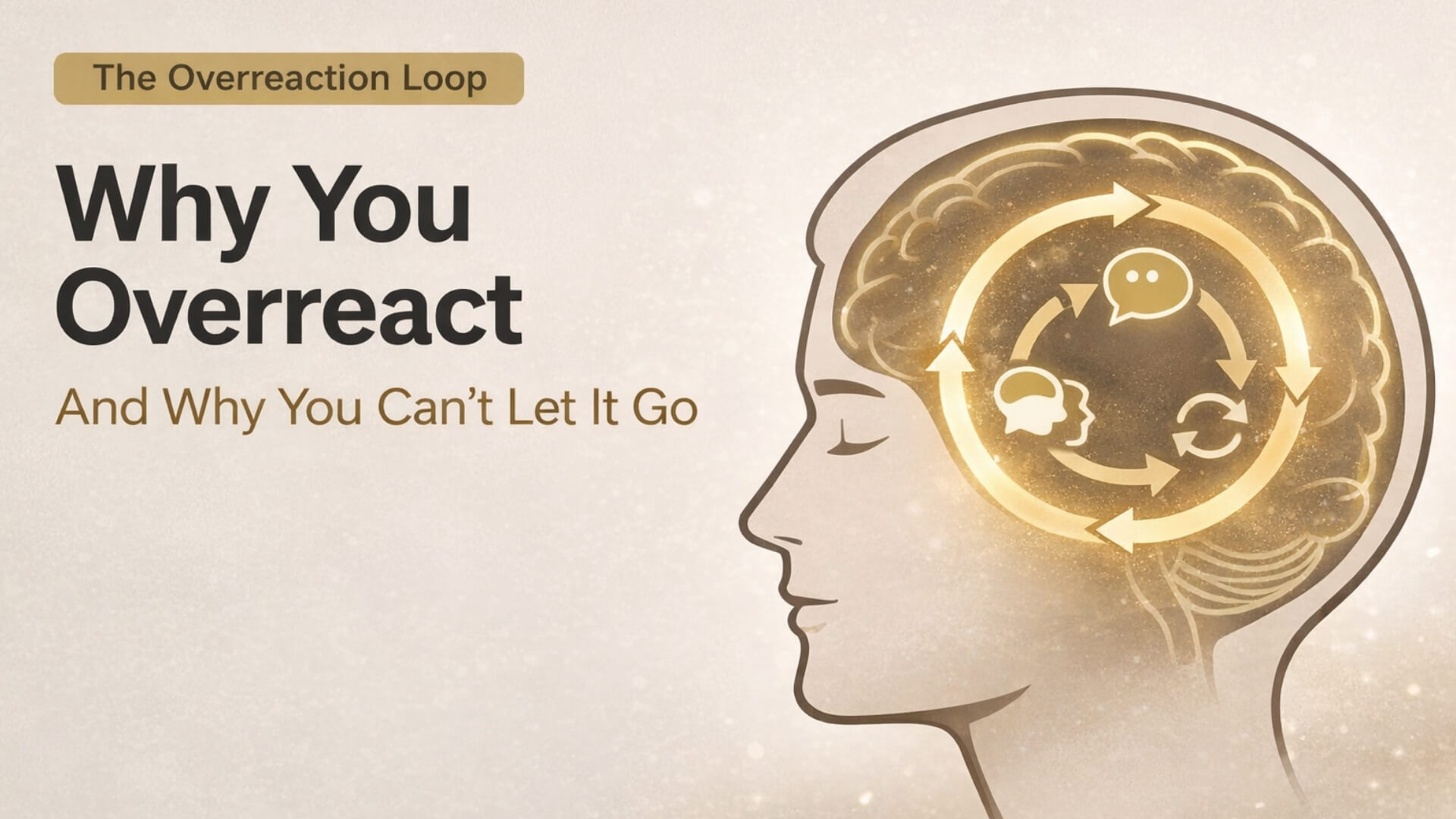
People believe they are in control of their thoughts, reactions, and decisions.
It feels that way.
You think something, you decide something, and then you act.
It looks clean. Logical. Almost rational.
But if you pause for a moment and look honestly at your own experience, something else becomes clear.
Many of your reactions happen before you even have time to think.
You snap.
You react.
You raise your voice.
You send the message.
And only after that comes the thinking.
Regret.
Analysis.
Overthinking.
You replay the situation again and again, trying to understand what happened.
“What should I have said?”
“Why did I react like that?”
“Why couldn’t I stay calm?”
And the more you think about it, the more it feels like something is off.
Because in those moments, you are not really in control in the way you think you are.
We usually try to understand situations from the outside.
We analyze what the other person said.
What they did.
What the situation looked like.
But very rarely do we start where it actually matters.
Inside ourselves.
This is also why it helps to understand how the mind works before trying to control your reactions.
For example, imagine you are in a meeting or a conversation.
Someone interrupts you and says that what you are saying is wrong or irrational.
In that moment, something shifts.
You feel it immediately.
You get offended.
You react.
You either push back or shut down.
And whatever you do, the situation doesn’t end there.
It stays with you.
You think about it later.
You replay the conversation.
You imagine better responses.
Sometimes for hours.
Sometimes for days.
To a certain extent, this reflection can be useful.
You don’t want to repeat the same mistakes.
But most people approach it in the wrong direction.
They focus on what they should have said.
Instead of understanding what actually happened inside them.
The real question is different.
Where exactly were you hurt?
Why did it affect you?
What did it trigger?
Because very often, the situation itself is not the real cause.
It is only the trigger.
What you feel in that moment is often connected to something much older.
A pattern.
An experience.
A memory.
Sometimes something that is ten, twenty, or even thirty years old.
Once you begin to see that, something changes.
You create distance from the situation.
You start to recognize that not every reaction belongs to the present moment.
And that awareness is where real clarity begins.
Most people believe they think first and react second.
In reality, it is often the opposite.
The reaction comes first.
The thinking comes later.
Trying to explain, justify, or repair what has already happened.
That is why so many people ask themselves:
“Why do I overreact so easily?”
“Why do I get triggered so fast?”
“Why can’t I control my reactions?”
These are not abstract questions.
They are real experiences.
And if you have ever replayed a situation in your head, wishing you had acted differently, then you already know exactly what this feels like.
The truth is simple.
Your mind is not a single, controlled system.
It is layered.
Built over years of experiences, patterns, emotions, and learned reactions.
And in certain moments, those patterns activate faster than your conscious thinking can keep up.
That is why awareness is the first step.
Not control.
Because right now, if you are honest, you don’t fully control your reactions.
But the moment you start seeing that your reactions come before your thinking, something shifts.
That is where real work begins, and where learning to train the mind becomes essential.
Let me give you a simple example.
If someone insults you, the reaction is not always about the words themselves.
Some people are not affected at all.
Others react immediately.
From my own experience, I noticed that certain words never affected me much.
Growing up, arguments were common, so those patterns lost their impact.
But in other situations, especially during my time in law enforcement, I reacted differently.
Disrespect toward the role, especially when it carried underlying aggression, would trigger a much stronger response.
Over time, I realized something important.
The reaction was not about the moment itself.
It was about what that moment touched.
And this is where most people misunderstand their reactions.
They believe they are reacting to the present situation.
But very often, they are reacting to something much older.
Why You React Emotionally So Fast (And Why You Lose Control in Seconds)
If you have ever asked yourself:
“Why do I react emotionally so fast?”
“Why do I lose control so quickly?”
“Why can’t I stay calm in the moment?”
then you are already close to the core of the problem.
These reactions do not come from nowhere.
They are not random.
And they are not simply a matter of discipline or character.
They are part of how your mind and body are structured.
The First Reaction Is Automatic
Very often, the reaction begins before you even become aware of it.
Something happens.
A sudden movement in traffic.
A sharp tone in a conversation.
An unexpected situation.
And your system responds immediately.
This first response is not rational.
It is instinctive.
It is connected to what we can simplify as the survival part of the brain, often referred to as the amygdala.
Its role is not to think.
Its role is to protect and react.
In situations that feel even slightly unpredictable or threatening, this system activates automatically.
Adrenaline rises.
Your focus narrows.
Your body prepares for action.
This is why people later say:
“I don’t know what happened. I just snapped.”
And then they ask themselves:
“Why do I get triggered so easily?”
The truth is that in that first moment, there is very little space for conscious control.
Why the Brain Triggers Before You Think
A simple example is traffic.
Someone cuts you off in a way that feels unsafe.
In that second, your system reacts.
One person freezes.
Another reacts with anger.
A third panics.
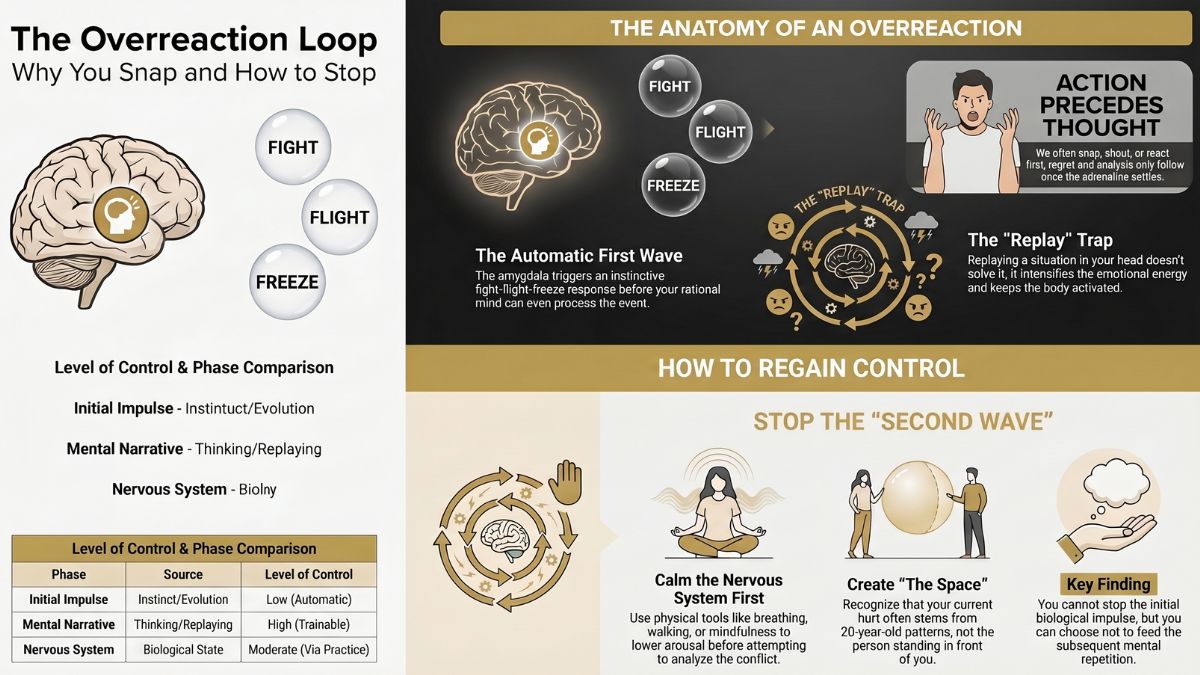
This is the classic fight, flight, or freeze response.
And it is important to understand that this first wave is not something you can easily control.
It is deeply rooted in your biological structure.
That is why trying to stop the first reaction completely usually fails.
It happens too quickly.
Before your rational thinking fully enters the situation, the body has already responded.
This is also why so many people feel confused afterward.
They ask:
“Why did I react before I even had time to think?”
Because that is exactly what happened.
The body reacted first.
The mind followed later.
This explains why you react emotionally so fast, even when you know you shouldn’t.
Where Control Actually Begins
You judge yourself.
This is the stage where many people begin to ask:
“Why do I lose control of my emotions?”
“Why do I react before I think?”
The key distinction is this:
The first reaction is automatic.
But the continuation is not.
Every thought adds another layer to the original reaction.
The situation itself may have lasted only a few seconds.
But in your mind, it can continue for minutes.
Sometimes hours.What happens next is where things become more important.
The adrenaline slowly begins to settle.
But your mind continues.
You start thinking.
You replay what happened.
You analyze the situation.
You imagine what you should have done.
You judge the other person.
And with every repetition, the emotional intensity grows.
This is the part most people do not recognize.
They think they are still reacting to the situation.
But in reality, they are now reacting to their own thinking about the situation.
That is where influence begins.
Not in stopping the first wave completely.
But in noticing the second wave and learning not to feed it further.
From my own experience, both in everyday life and in professional environments such as law enforcement, courtrooms, negotiations, and other high-pressure situations, I have seen how extreme these reactions can become.
The same person who appears calm and reasonable in one situation can become aggressive, loud, and completely irrational in another.
And in a different context, when they feel observed, judged, or evaluated, their behavior may change again.
This shows something important.
Reactions are not fixed.
They depend on context, perception, and internal patterns.
The key is not to suppress the first reaction.
That usually creates even more tension.
The key is to recognize it.
And then gradually learn not to strengthen it with everything that comes after.
You cannot always stop the first wave.
But you can begin to stop the second one.
And that is where real control actually begins.
Why You Snap Before You Even Think (And Why It Feels Automatic)
If you have ever asked yourself:
“Why do I snap so quickly?”
“Why do I react before I even think?”
“Why do I overreact, especially with people close to me?”
then you are already noticing something important.
These reactions do not feel like a decision.
They feel automatic.
As if something in you reacts first, and only afterward comes the awareness of what just happened.
How Triggers Activate Old Patterns
Very often, there is an external trigger.
A sentence.
A tone of voice.
A look.
Or even just a feeling that something is not right.
But your mind does not start from a neutral position.
It starts from everything that has already been written inside you.
From past experiences.
From learned behavior.
From patterns that were built over years.
That is why people ask:
“Why do I get triggered so easily?”
Because the reaction is not only about what is happening now.
It is connected to everything that happened before.
If we look at the process more closely, it becomes surprisingly clear.
First, something is perceived.
Then it is interpreted.
Then it becomes personal.
And only after that comes the reaction.
These steps happen extremely fast.
So fast that they feel like one single movement.
Why Close Relationships Trigger Stronger Reactions
This becomes even more visible in close relationships.
If someone you don’t know says something slightly negative, you might ignore it.
But if the same thing comes from a partner, a friend, or a family member, the reaction is often much stronger.
Why?
Because the closer the relationship, the deeper the patterns.
There is more history.
More meaning.
More emotional investment.
In those moments, your mind does not just hear the words.
It interprets them.
“This is disrespect.”
“This is unfair.”
“This is not okay.”
And very quickly, a story is created.
You analyze what was said.
Then you analyze it again.
And then once more.
Within seconds, you arrive at a conclusion.
And that conclusion triggers emotion.
Anger.
Hurt.
Frustration.
Helplessness.
This is why people ask:
“Why do I snap at people I care about?”
“Why do I overreact in relationships?”
The answer is not that you are choosing to hurt yourself or the other person.
It is that the reaction is already in motion before you become fully aware of it.
The Moment Where Awareness Appears
The key point here is not to deny the reaction.
And not to pretend that you can stop it instantly.
The first impulse is often too fast.
Too deeply rooted.
But something important still exists.
A small moment.
A small space.
The moment you begin to see what is happening.
The moment you recognize:
“This is a pattern.”
That space is small at first.
Almost unnoticeable.
But it is there.
And inside that space lies the difference between:
automatic reaction
and conscious response
You may still feel the impulse.
You may still feel the emotion.
But you no longer have to follow it blindly every time.
From my own experience, especially in environments where communication is intense, such as police work, legal settings, and negotiations, I have seen how quickly situations escalate when people react from these patterns.
One sentence leads to another.
Tone rises.
Positions become rigid.
And within minutes, the situation is no longer about the original issue.
It becomes a conflict driven by reaction rather than understanding.
The shift does not happen by force.
It begins with recognition.
You start to see that what feels like “you” is very often a pattern playing out.
And the moment you start seeing that, you create space.
Why You Keep Replaying Situations in Your Head (And Can’t Let It Go)
If you have ever asked yourself:
“Why do I keep replaying conversations in my head?”
“Why can’t I stop thinking about something that already happened?”
“Why do I overthink everything after a conflict?”
then you are experiencing one of the most common patterns of the mind.
The situation is over.
The conversation has ended.
Nothing is happening anymore in reality.
And yet, in your mind, it continues.
Why Your Mind Repeats the Same Situation
This is where many people feel stuck.
They try to move on.
But something keeps pulling them back.
You replay what was said.
You replay how you reacted.
You imagine what you should have said.
You imagine better outcomes.
And then you do it again.
This is why people ask:
“Why do I replay situations in my head again and again?”
Because the mind does not simply register an event and move on.
It tries to process it.
Understand it.
Resolve it.
But instead of resolving it, it repeats it.
This is why people who struggle with overthinking after conflict often feel stuck in the same loop.
If we connect this with everything we described earlier, the process becomes clear.
First, there is a trigger.
Then comes the reaction.
And after that, the thinking begins.
The problem is not the reaction.
The problem is the repetition.
Visually, this is what happens:
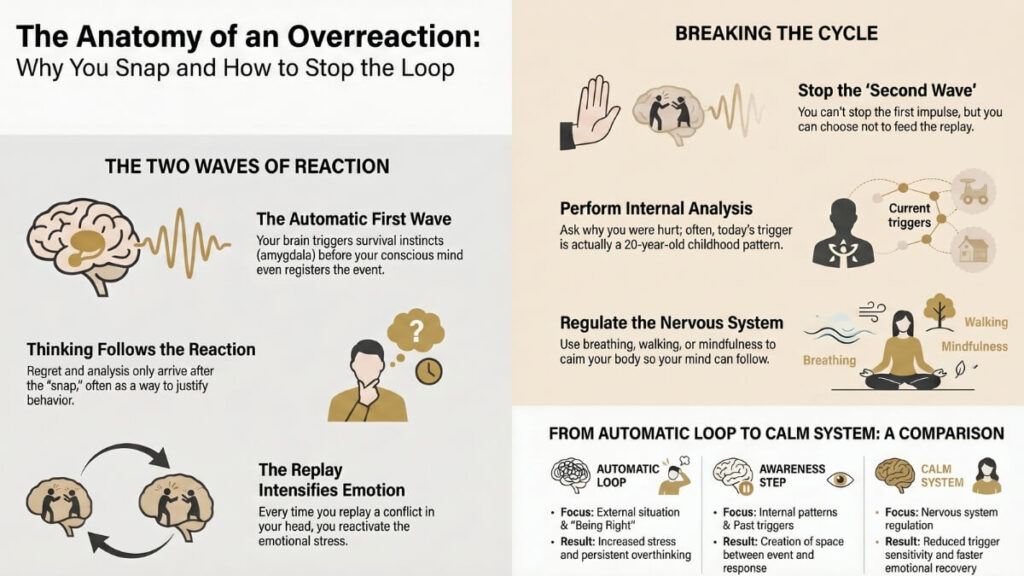
How Overthinking Makes It Worse
Most people believe they are “just thinking.”
But something else is happening.
Every time you replay the situation, you are not neutral.
You are reliving it.
You feel it again.
You react again.
You intensify it again.
This is why something small can become something very big in your mind.
Because every repetition adds emotional energy to the original event.
This is also why people say:
“Why can’t I let it go?”
“Why can’t I stop thinking about it?”
The answer is simple.
But not easy to accept.
The situation is no longer happening.
The mind is keeping it alive.
Why Letting Go Feels So Difficult
A very typical example is a conflict.
At work.
In traffic.
In a relationship.
The event itself lasts a few seconds.
Maybe a few minutes.
But in your mind, it expands.
You go back to it later.
Then again in the evening.
Then the next day.
Each time, it feels real.
Because your mind recreates it.
From my own experience, especially in emotionally intense situations, I noticed how easy it is to fall into this loop.
The mind keeps returning to the same event.
Trying to find a better outcome.
Trying to fix something that has already passed.
But there is no resolution in that loop.
Only repetition.
How to Break the Mental Loop
The key point here is simple.
The event is over.
The continuation exists only in your mind.
And every time you replay it, you are not solving it.
You are strengthening it.
That is why the first step is not to find the perfect answer.
It is to recognize the pattern.
To see:
“This is the same loop again.”
And then interrupt it.
Not by force.
But by not following it every time it appears.
You shift your attention.
You move to something else.
You engage in an activity.
You redirect your focus.
At first, this feels difficult.
Because the mind wants to return.
Again and again.
But over time, something changes.
Each interruption weakens the loop.
Each moment of awareness creates distance.
And slowly, the intensity decreases.
The thoughts appear less often.
And eventually, they begin to lose their hold.
Letting go is not about forcing yourself to stop thinking.
It is about not feeding the repetition.
You may still notice the thoughts.
But you do not have to follow them every time.
And that is where the process begins to change.
Why You Can’t Calm Down After a Conflict (And What Keeps it Alive)
If you have ever asked yourself:
“Why can’t I calm down after a conflict?”
“Why do I stay emotionally activated long after it’s over?”
“Why do I feel stuck in the same emotion for hours?”
then you are already close to understanding the deeper mechanism.
The problem is not only the reaction itself.
The problem is everything that continues after it.
Why Your Nervous System Stays Activated
After the initial reaction, whether it is anger, stress, or frustration, the body naturally begins to return to balance.
Adrenaline drops.
The immediate danger is gone.
The situation ends.
But your mind does not stop.
This is where most people unknowingly keep the reaction alive.
They replay the situation.
They analyze it.
They justify it.
They resist it.
And every time they do this, the emotional response is reactivated.
This is why people feel:
“I can’t calm down.”
“I can’t let it go.”
“I’m still stuck in it.”
Not because the situation is still happening.
But because the mind keeps returning to it.
The body would calm down on its own.
But the mind keeps interrupting that process.
How Thinking Keeps the Emotion Alive
If we connect this with everything we discussed earlier, the process becomes clear.
First, there is a trigger.
Then comes the automatic reaction.
After that comes the thinking.
And finally, the repetition.
It is this repetition that keeps the entire experience alive.
Without it, the reaction would pass much faster.
But because the mind keeps returning to the same event, the nervous system is constantly reactivated.
That is why even hours later, or the next day, you can still feel the same emotion.
From my own experience, especially in high-pressure environments, I noticed how difficult it is to simply stop this process.
The mind wants to return.
It wants to resolve.
It wants to be right.
And it keeps pulling you back into the same loop.
This is why people ask:
“Why can’t I calm down after an argument?”
Even when there is nothing left to resolve in reality.
What Actually Helps You Calm Down
The key shift here is not to force yourself to calm down.
That usually creates more tension.
The shift is to understand what is happening.
To recognize that the reaction has already passed.
But the mind is continuing it.
Once you see that, your approach changes.
Instead of trying to solve the situation, you focus on calming the system.
This can be very simple.
Breathing slowly.
Going for a walk.
Shifting your attention.
Talking to someone.
But there is one important detail most people miss.
If you talk about the situation, don’t stay in it too long.
Mention it.
Express it.
Then move on.
Because if you keep analyzing it in conversation, you are continuing the same loop.
Sometimes the best support is not advice.
It is simply being heard.
And then shifting to something neutral or positive.
That alone can help your nervous system begin to settle.
Where Real Change Begins
The goal is not to eliminate reactions completely.
That is unrealistic.
The goal is to stop feeding them after they happen.
This is where awareness becomes practical.
Not theoretical.
You begin to notice when the mind returns to the same situation.
You begin to see the loop.
And slowly, you stop engaging with it every single time.
This does not happen overnight.
If you have spent years reinforcing these patterns, the mind will continue to return.
But something important has already changed.
You are no longer fully inside the reaction.
You are observing it.
And that is the beginning of control.
Because once you stop feeding the reaction, the nervous system finally gets the chance to calm down.
And over time, something even deeper begins to shift.
Prefer to listen instead of read?
Here’s a deeper breakdown of why you overreact and how to stop the mental loop.
The reactions themselves become less intense.
Less frequent.
Less automatic.
Because the system is no longer constantly reinforced.
What This Means for You (And Where This Leads Next)
If you take one thing from this, let it be this:
You are not only reacting to what happens.
You are reacting to how your mind processes what happens.
And in many cases, the second part is stronger than the first.
The reaction itself is fast.
Automatic.
Often difficult to control.
But what happens after that?
That is where your influence begins.
Where Your Real Control Actually Is
Most people try to solve this in the wrong place.
They try to control emotions directly.
They try to stay calm.
Suppress reactions.
Avoid situations.
But that rarely works long term.
Because the core problem is not only emotional.
It is mental.
It is in how the mind:
interprets
repeats
and holds onto experiences
Once you begin to reduce the second reaction, the thinking, the replaying, the intensifying, something important starts to change.
Your primary reactions begin to soften as well.
Because your nervous system is no longer constantly activated.
Over time, it becomes harder to trigger you.
Not because you are forcing control.
But because the system itself becomes calmer.
And that changes everything.
Why Awareness Changes Everything
Most people never create this separation.
They fully follow every reaction.
Every thought.
Every loop.
And as long as that happens, the mind stays in control.
But the moment you begin to observe it, something shifts.
You are no longer completely inside the reaction.
You are seeing it.
That small difference is the beginning of real change.
Not perfect control.
But direction.
And direction is enough.
Where This Leads Next
Understanding this is the first step.
But it naturally leads to a deeper question:
If these patterns are automatic…
If they repeat themselves…
If they are built over years…
Then how do you actually change them?
How do you move from awareness to real transformation?
Because knowing what is happening is not the same as changing it.
This is where the next step begins:
Why You Know What to Change – But Still Stay the Same
That is where we go deeper.
Into how patterns are changed.
How the mind is trained.
And how this process becomes structured and sustainable over time.
CONCLUSION
You don’t need to eliminate reactions completely.
That is not realistic.
What you can do is this:
Shorten the loop.
Reduce the repetition.
Stop feeding the reaction after it happens.
That alone changes more than most people expect.
Because as long as every thought is followed, every reaction reinforced, and every situation replayed, the mind continues to lead.
But the moment you start observing instead of reacting automatically, something begins to shift.
And that is where real work begins.
The awareness you just built here is the starting point.
But awareness without practice tends to fade.
If you want to train your mind to actually slow down, not just understand why it should, the 21-Day Meditation Journey was built for exactly this.
Twenty-one days of structured daily practice that shortens the loop, reduces the repetition, and starts building the internal stillness that reading about it cannot give you.