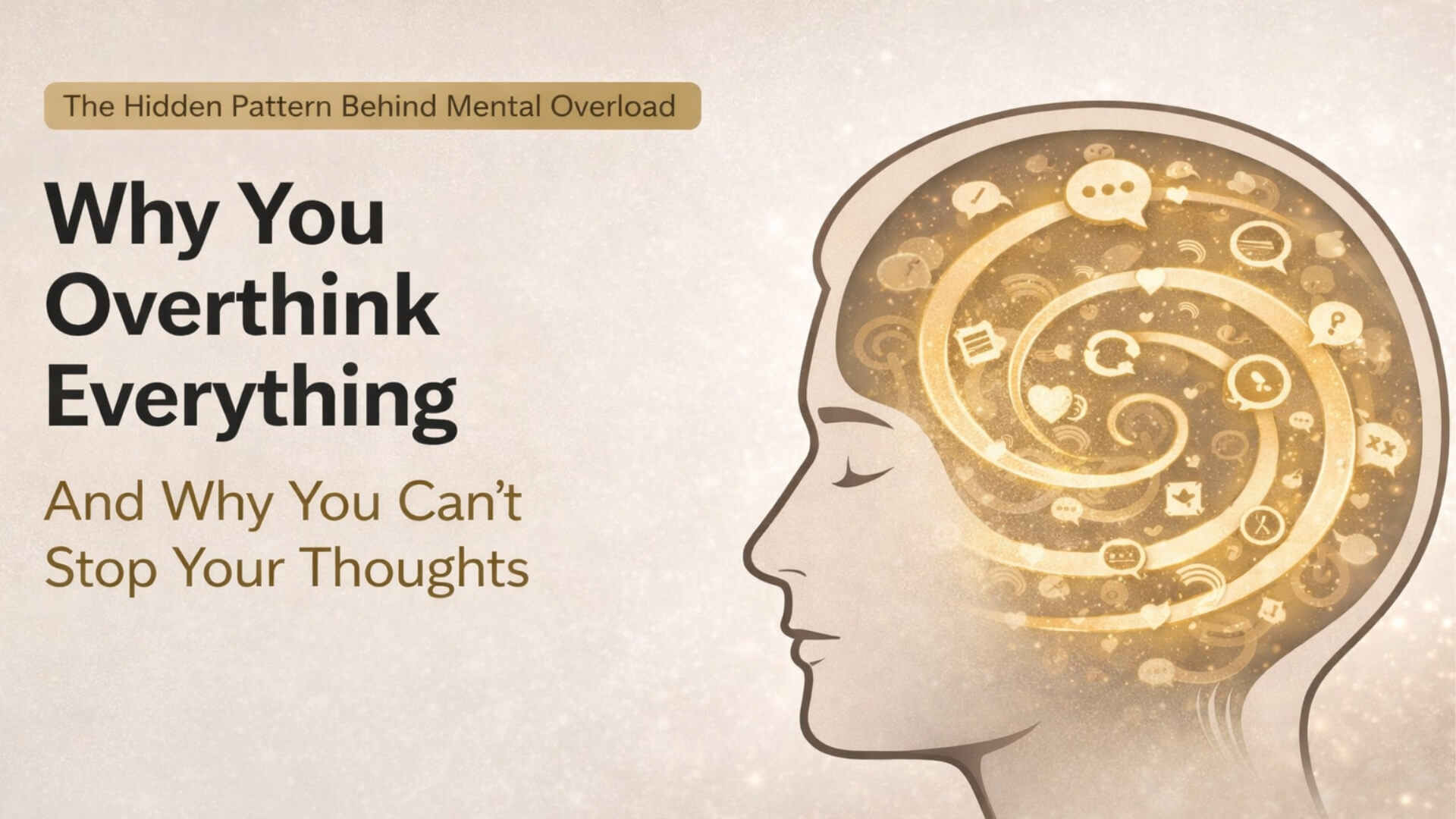
Why You Feel Like You Can’t Control Your Thoughts (And Why Your Mind Won’t Stop Thinking)
There are moments in life when everything is technically fine.
You are not in danger.
Nothing urgent is happening.
No real problem needs to be solved.
And yet, you keep asking yourself Why You Feel Like You Can’t Control Your Thoughts. One thought leads to another.

You replay conversations.
You imagine scenarios that haven’t happened.
You analyze decisions that are already behind you. And at some point, a simple question appears:
Why can’t I stop thinking?
So Why You Feel Like You Can’t Control Your Thoughts?
Most people assume this is a matter of discipline. They believe they should be able to control their thoughts as they do their actions.
But that is where the first misunderstanding begins.
You don’t experience your thoughts as something external.
You experience them as you.
And because of that, it feels natural to assume you are creating them.
But if that were true, a very simple test would always work.
Just stop thinking.
Right now.
Do not reduce it.
Do not slow it down.
Stop it completely.
Even for ten seconds.
What most people discover in that moment is uncomfortable. The mind does not obey that easily. Thoughts continue to appear, sometimes faster, sometimes even louder.
And this is the point where frustration usually begins.
“If I can’t control my own mind, what does that mean?”
For many people, this question never gets answered. They simply return to their
routines and continue living with a constant background noise in their head.
But if you stay with the question a little longer, something important starts to reveal itself.
The problem is not that you think too much.
The problem is that you assume thinking is fully under your control.
And it isn’t.
At least not in the way you believe.
Your mind is not a simple tool that you switch on and off. It is a system shaped over the years, influenced by your environment, your past, your experiences, and countless inputs you were never fully aware of.
Which means:
What do you think?
When you think it.
And how strongly it affects you.
Is only partially in your hands.
And that realization changes everything.
Because the question is no longer:
Why You Feel Like I Can’t Control My Thoughts
But rather:
“What is actually creating them?”
The Illusion of Control: Why Your Thoughts Don’t Feel Like Yours
There is an old saying: “As the mind, so the person. If you feel bound, you are bound. If you feel liberated, you are liberated.”
It sounds simple.
Almost elegant.
But in real life, it is anything but simple.
Let me make it more uncomfortable.
Imagine two people in the same place.
One is a prison guard.
The other is a prisoner.
They walk the same corridors.
They see the same walls.
They live within the same physical limits.
And yet, one feels free.
And the other feels trapped.

The difference is not in the space.
It is in the perception.
That is where most people resist.
Because your mind immediately says, “That’s not true.”
And physically, that is correct.
But take a step back.
How often do you actually use the full range of your freedom?
Most people live within a very limited radius: home, work, a few familiar places,
repeating the same routines.
And it does not feel like a prison.
Because the mind has accepted it as normal.
Now compare that to the prisoner.
The restriction is more visible.
More defined.
But the mechanism is the same.
The mind interprets the situation.
And creates the feeling.
Once that feeling is created, it becomes your reality.
This is where the illusion begins.
You believe your thoughts reflect reality.
In many cases, they reflect conditioning.
What you were taught.
What you repeated.
What you absorbed without questioning.
And this is the uncomfortable part.
A large portion of what you think is not originally yours.
It is inherited from parents.
From school.
From society.
And from the environment you grew up in.
Layer by layer.
Over the years.
Until one day it feels like identity.
And this is exactly where I made a mistake for a long time.
I believed I was in control of my thinking.
Not only that.
I was proud of it.
I analyzed everything.
Personal situations.
Business decisions.
Financial moves.
Sports performance.
And even the behavior of people around me.
My mind was constantly running.
From the outside, it looked like a strength.
I was fast.
I saw patterns quickly.
I found solutions.
That is one of the reasons I was a good lawyer, negotiator, and later also a coach.
Give me a situation.
And I can break it down in minutes.
Identify weak points.
Find leverage.
Offer a solution.
It felt sharp.
It felt powerful.
And if I am honest, it also fed the ego.
People came for advice.
They listened.
They said, “That’s a great idea.”
And for a long time, that was enough.
But there was a problem I did not see.
The mind that was solving everything was also constantly creating pressure. It never stopped. Even when nothing needed to be solved. Even when rest would have been the better decision.
And that constant analysis came with a price.
Tension.
Fatigue.
A background noise that never fully disappeared. There was also something more
subtle. Most of my solutions were only half-useful.
They were logical.
Structured.
And made sense to me.
But they were built on my way of thinking.
Not on the other person’s reality.
I remember a situation from my years as a lawyer.
A colleague came to me with a case. Within minutes, I saw gaps in both sides’ reasoning. And suggested a solution. He was enthusiastic. “This is excellent.” But then he had to present it further.
To the client.
To the judge.
To the opposing side.
And at each step, something changed. The idea was interpreted. Adjusted. Diluted.
The final execution was weaker than originally intended. At the time, I thought the
problem was in communication. Later, I realized something else.
The solution was never fully transferable.
Because it came from my mental framework. Not from theirs. That was the first crack
in the illusion. I started to ask a different question.
Do I really think because I choose to?
Or because I am used to thinking this way?
And that question is far more dangerous than it looks.
Because once you ask it seriously, something shifts.
Not every thought is a decision.
Some thoughts are habits.
Some are reactions.
Some are simply echoes of the past.
| Seeing this clearly is important, but why understanding the problem isn’t the same as changing it is the harder truth that comes after the clarity arrives. |
Where Your Thoughts Come From (And Why You Think the Way You Do)
If you really want to understand how your mind works, you have to step away from the idea that it is completely independent. Because it isn’t.
A useful way to see this is through a simple image, a wave and the ocean. A wave can
look powerful, unique, even separate. It can appear large or small, calm or aggressive.
But in reality, it is never independent.
It is shaped by the wind, by currents, by depth, by forces it does not control. It does not
choose its form freely. It responds.

Your mind works in a similar way.
You experience your thoughts as something
personal, something individual, something that belongs to you.
But a large part of what appears in your mind is a response to influences you did not
consciously choose.
Your upbringing, your environment, your culture, your past experiences, all of these
shape the way your mind operates long before you start questioning it.
And because this process happens gradually, over the years, it becomes invisible.
It feels natural.
It feels like this is just who I am.
That is where most people stop.
They never question the structure behind their thinking.
They assume their reactions are logical, their opinions are fully formed, and their
decisions are independent.
But if you look closely, you begin to notice patterns.
Similar situations trigger similar thoughts.
The same types of people create the same emotional responses.
The same internal dialogues repeat themselves.
That is not a coincidence.
That is conditioning.
Conditioning
And this conditioning is especially strong
in people who never examine their own thinking.
You have probably encountered them many times, people who are absolutely convinced they are right, who do not question their reactions, who repeat the same patterns for years, and see no issue with it.
Sometimes they are in positions of authority,
a boss, a senior colleague, a parent, or a
partner.
From the outside, dealing with them can be frustrating.
But the more important question is this.
Where do you do the same?
Because the uncomfortable truth is this,
you are not outside of this system.
You are part of it.
Just like the wave is part of the ocean, your thinking is part of a larger structure of
influences. And once you start to see that, a different kind of question appears.
Not, what do I think?
But, where is this thought coming from?
This is where real work begins. Not in trying to control every thought, but in learning to
observe them, to break them down, to ask better questions.
Is this something I chose, or something I absorbed?
Is this useful, or is it just familiar?
Most people never go that far. They stay on the surface. They react, they repeat, they
reinforce the same patterns.
But if you slow down enough, something important starts to shift.
Thoughts are not as solid as they appear. They come, they stay for a moment, and then
they go.
And the less meaning you attach to them, the less power they have over you.
Why You Overthink Everything (And Why Your Mind Keeps Replaying Situations)
Overthinking does not start as a weakness.
It starts as a strength.
You learn to think faster than others, see patterns, connect information, and anticipate outcomes.
In many professions, such as law, business, negotiations, and leadership, this ability gives you an edge. It certainly did for me.
For years, even decades, I believed that constant analysis was one of my greatest advantages.
I would break down situations quickly, personal, business, financial, and even sports. Not only my own, but also the situations of people around me. My mind was running almost non-stop, like an internal program that never shut down.
From the outside, it looked impressive.
I was efficient.
I found solutions quickly.
I understood complexity.
People came to me for advice, colleagues, friends, and partners. And most of the time, I delivered. I could see gaps in reasoning, propose strategies, and offer direction.
That is one of the reasons I was successful as a lawyer, and later as a negotiator and coach.
But there is a point where strength quietly becomes a problem.
And most people don’t see it when it happens.
Because the same mind that solves problems also starts creating them.
At first, it is subtle. You think a bit more than necessary. You replay conversations. You prepare for scenarios that may never happen.
Then it becomes a pattern.
You analyze everything.
Every decision.
Every conversation.
Every possible outcome.
And at some point, you cross a line.
You are no longer using your mind.
Your mind is using you.
I remember very clearly when this idea was first pointed out to me. A friend mentioned a concept he came across in a book, paralysis by analysis.
My first reaction was resistance.
Almost offense.
How could something that helped me so much be a problem?
But the more I looked at it, the more I saw the truth in it. The constant thinking was not neutral.
It came with a cost.
Mental fatigue. Internal tension.
A feeling that the mind never truly rests.
Even when nothing is happening, something is always running in the background.
There was also another problem.
Many of my solutions, although logically sound, were not fully effective in reality.
They made sense in my head.
They were structured.
They were clear.
But they were built on my way of thinking.
When others tried to apply them, something got lost.
I saw this repeatedly in my legal work.
A colleague would bring a case. I would quickly identify the weak points and propose a solution.
He would be enthusiastic.
But then the idea had to move further.
To the client.
To the court.
To the opposing side.
And at each step, it changed.
It weakened.
It lost precision.
At the time, I thought the problem was communication.
A lack of knowledge.
Later, I understood something else.
The solution was never fully theirs.
It came from my mental framework.
Not from theirs.
And that realization changes how you see overthinking.
Overthinking is not just about having too many thoughts.
It is a system that keeps reinforcing itself.
The more you rely on it, the more it runs.
And the more it runs, the harder it is to stop.
And eventually, you reach a point where you cannot simply decide to switch it off.
You try to relax.
To focus.
To be present.
But the mind keeps going.
And that is the moment when many people start asking,
Why can’t I stop thinking?
Not realizing that the very system they trained for years
is now running on its own.
Why Your Mind Never Rests (Racing Thoughts, Night Thinking, and Mental Overload)
At some point, a different kind of question appears.
Not how do I stop thinking?
Where are these thoughts coming from in the first place?

This question changes everything.
Because as long as you believe that every thought is consciously created by you, you
will try to control it directly.
But once you start observing more carefully, you notice something else.
Many thoughts appear automatically.
You didn’t invite them.
You didn’t plan them.
And yet they are there.
The more I observed my own thinking, the more I realized that a large part of it was not
originally mine.
It came from the past.
From childhood.
From the influence of parents, school, friends, and the wider environment.
Ideas, beliefs, reactions, and emotional patterns were all built gradually, layer by layer.
And because this process started early, long before any real awareness, it became
invisible.
It felt natural.
It felt like identity.
| This is also why understanding how overthinking feeds the stress response matters – the two systems are running on the same fuel. How overthinking feeds the stress response? |
A useful way to understand this is to imagine a blank system at the beginning.
Like an empty sheet of paper.
Or a new computer without data.
When you are born, your mind is close to that state.
Then the first inputs appear.
A name.
A language.
Basic reactions.
Early experiences.
Over time, more and more information is added.
Experiences.
Emotions.
Interpretations.
Conclusions.
By the time you reach adulthood, an enormous amount of data has already been
written into your system.
Why You React Before You Think
Most of this information is not stored in the part of the mind you can easily access.
It sits deeper.
In what we call the subconscious.
You are not actively thinking about it.
But it is still there.
Influencing how you perceive and react to situations.
This is why people often act in ways that don’t fully make sense to them.
On a rational level, they understand one thing.
But emotionally and physically, they react differently.
You can see this clearly in more extreme examples.
Someone who has experienced intense stress or danger in the past can react very strongly to a similar stimulus years later.
A loud sound.
A sudden movement.
A specific situation.
The rational mind knows there is no real danger.
But the body reacts as if the threat is still present.
This is not a conscious decision.
It is a stored pattern being activated.
The same mechanism works in everyday life.
Just in more subtle ways.
The way you respond to criticism.
Handle pressure.
Approach conflict.
All of it is influenced by patterns you have accumulated over time.
And because these patterns operate automatically, it creates the illusion that this is
simply who you are.
But this is the key point.
What feels like identity is often just repetition.
A set of learned responses.
Reinforced over the years.
And if you never question them, they keep running in the background.
Shaping your thoughts.
Your emotions.
Your decisions.
Without you even noticing.
Conclusion: You Don’t Control Your Thoughts the Way You Think You Do
At this point, one thing becomes clear.
You are not as much in control of your thoughts as you believe. Not because something is wrong with you, but because your mind was shaped long before you started questioning it.
What you think,
how you react,
what feels natural,
all of this is influenced by patterns you have been repeating for years
Often, without even noticing it.
That is why trying to “control” your thoughts directly so often fails. You are trying to control the surface, while the real structure sits deeper.
But this is also where another possibility arises.
Not control, but awareness.
Because the moment you start seeing your thoughts as something that appears, rather than something you are, a small distance is created. And in that distance, something important becomes possible.
Not forcing the mind to stop, but allowing it to slow down.