
Where Do Emotions Come From and How They Create Stress and Anxiety
“Stress and anxiety are not only caused by external situations. They are created by internal patterns shaped by past experiences, emotions, and learned responses in the body and mind.”
Emotions are basic internal responses to the world around us.
They arise as a combination of perception, bodily reaction, and interpretation.
They are based on our five senses:
touch, smell, taste, sight, and hearing.
But emotions don’t stay on the level of a single reaction.
Over time, these emotional responses become patterns that directly influence how stress and anxiety are experienced in the body.
How Stress and Inner Restlessness Start in the Body
I remember how it all started early in my life.
It started happening to me in primary school: that quiet feeling that I wasn’t smart enough. In certain subjects, I noticed I wasn’t doing as well, and my confidence began to drop.
Every bad grade, every humiliation I received from teachers, made the situation worse. Slowly, this feeling began to form, quiet but growing stronger, that I was not smart enough.
It was not something loud. It was not dramatic. But it was there, consistent enough to shape how I saw myself. I wasn’t a good picture of myself.

Overall, I can say that primary school gave me very little confidence. In sports, I felt somewhat confident, but in school, I felt very insecure and had a strong sense that I wasn’t smart enough.
I compared myself to those who were better, especially my friend and my sister, who achieved good results in school much more easily.
That had a strong impact on my confidence.
When I moved to high school, I was lucky that my initial good grades helped me start building confidence. I don’t know exactly why, but I began getting better grades, A’s and B’s, and my average improved significantly.
At the same time, my confidence grew. In high school, I gained much-needed confidence, but it came through enormous effort and constant proving, both to myself and to the world.
It was not the easiest path, but it was my path.
Looking back today, I would definitely do things differently.
Still, I feel that this process pulled me out of that low confidence I developed earlier.
But if I am completely honest, that lack of confidence related to learning and school has never fully disappeared. Even though I later completed multiple degrees, master’s, doctorates, and more, that feeling still stays with me.
On a rational level, I know it is just a feeling and not reality, but it is still there.
When Pressure Turns Into Chronic Stress
A good experience from high school carried over into university and my first job.
Why stress is a physical experience before it is a mental one.
I was working and reacting under pressure.
A good experience from high school carried over into university and my first job. I started working while studying, which meant I had a full-time job while attending university.
All of this gave me a lot of confidence, but at some point, I was no longer acting from clarity.
I was working and reacting under pressure. Even when things were objectively fine, I could not slow down.
I could not sit still.
There was always something unfinished, something missing, something that needed to be done. And I didn’t question it. I just followed it. It brought me a lot of success (attorneyship, professorship, sportsmanship), don’t get me wrong, but the stress and inner restlessness were way too high.
That is the moment you lose control.
Not when something dramatic happens, but when you no longer see what is driving you. You think you are making decisions. But in reality, you are responding to something deeper that you never examined.
And that is inner restlessness. It is not just stress. It is a system that runs in the background, pushing you forward even when you don’t want to move.
How Anxiety Develops (And Why It Feels Out of Control)
All of this created a great deal of anxiety, connected to the fears I had developed.
I definitely did not want to return to that state of low confidence, so I constantly tried to compensate for that fear with excessive effort and work, which only led to more anxiety and an overloaded system.
Unfortunately, I was not aware of this for many years.
I started to feel it in stressful situations, like court hearings or before demanding procedures, when my body began signaling that something was not right.
Part of what made it so persistent was that the mind kept cycling through the same fears, which is why understanding how the mind keeps amplifying what it can’t resolve helps explain why anxiety so often outlasts the situation that triggered it.
I felt pain in my stomach,
frequent restlessness,
and unexplained anxiety that I could not trace back to any clear source.
Looking back now, it was closely tied to my excessive drive for success and an intense fear of failure, both tied to financial success and my image in society.
There was simply too much at stake, too much resting on me.
I remember sitting with a therapist who asked me,
“What happened to you in childhood that you are carrying so much?”
I was astonished by the question. What is he talking about, I asked myself.
For a long time, I didn’t understand, until I did.
There really was a lot of responsibility on my parents, my family, my friends, everything on my shoulders, without any deep or rational reason.
That was the standard I set for myself. And all of that led to an enormous amount of anxiety and stress, because you can never satisfy everyone.
What Actually Controls Your Stress and Anxiety
At this point, one thing becomes clear.
Stress is not random.
Anxiety is not accidental.
There is a system behind it.
And that system is built over time.
“This is why many people feel overwhelmed by stress and anxiety even when nothing appears wrong externally.”
It starts with early experiences.
Moments where you felt not enough.
Not safe.
Not in control.
Those moments don’t disappear.
They get stored.
And over time, they form patterns.
You start reacting in certain ways.
Thinking in certain directions.
Pushing yourself harder.
Avoiding certain situations.
Not consciously.
Automatically.
This creates a loop.
You feel pressure → you respond with effort → you temporarily succeed → but the internal tension stays.
And then it repeats.
That is the compensation loop.
At the same time, your body starts sending signals.
Restlessness.
Tension.
Fatigue.
Anxiety without a clear reason.
These are not random symptoms.
They are signals that your internal system is overloaded.
And here is the key point:
What triggers stress is not the situation itself.
It is what the situation activates inside you.
Two people can face the same situation.
One feels calm.
The other feels pressure.
The difference is not outside.
It is internal.
That is why understanding is not enough.
You can understand everything.
But until you see the pattern in real time…
Nothing changes.
If you step back and look at this clearly, what feels like stress is not random, it follows a pattern.
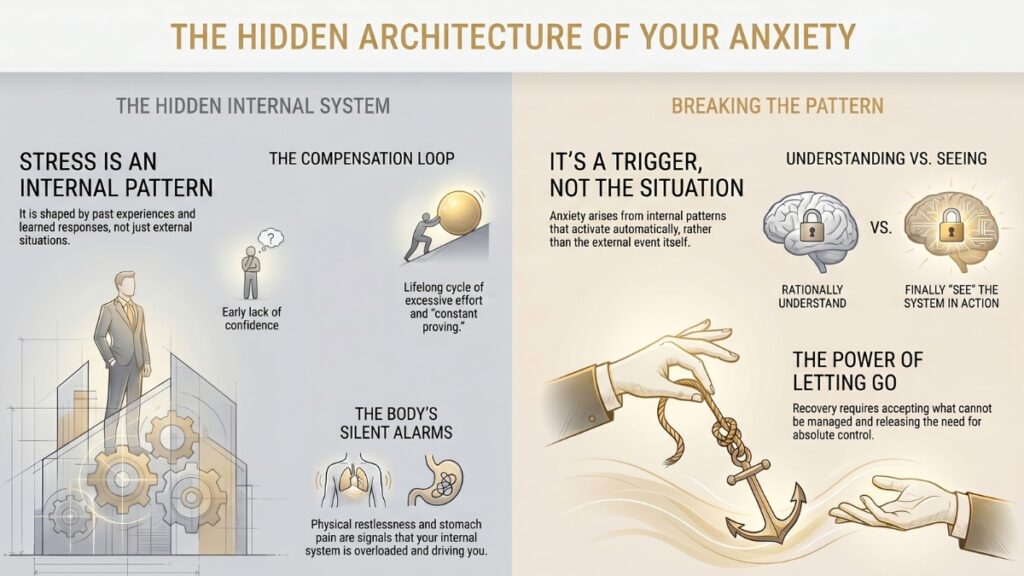
This is what stress actually looks like beneath the surface, not a situation, but a system.
If you want to understand how early experiences quietly build the system behind your stress, listen to this short reflection.
A short reflection on how early experiences shape the internal system that drives your stress, anxiety, and behavior later in life.
When Anxiety Becomes Personal (Fear, Identity, and Loss of Control)
At the peak of my professional strength, something unexpected happened. I suffered a brain hemorrhage, which brought an enormous fear for my survival.
In the next phase, that fear shifted into something even deeper: fear for my children.
Fear for Children
They were still young, and the thought of them growing up without a father was overwhelming.
This fear was much stronger. Much harder to control. Because it was no longer just about survival. It was about responsibility.
About losing something you cannot replace. About not being there. And in that moment, the system goes even higher.
Why anxiety feels uncontrollable in intense moments
There is no logic there.
You don’t calculate probabilities. You don’t think rationally. The mind jumps straight to the worst possible scenario. And the body reacts as if it is already happening. As if it is real.
That is the next layer of anxiety.
Not fear for yourself.
But fear for what matters most to you.
And this is where most people completely lose control.
Because now it is not just emotion.
It is identity.
And this is where the misunderstanding happens.
People think anxiety comes from the situation.
But it doesn’t.
It comes from what is triggered inside you.
From the system that activates automatically.
From patterns that are already there.
From fear that does not ask for permission.
And once it starts, you don’t control it.
You experience it.
That is the difference.
And that is also the beginning.
Because the moment you start seeing this clearly, something shifts.
Not outside.
Inside.
Conclusion
Throughout my life, this pattern of fear and anxiety kept moving in the background, always connected to the burdens I placed on myself.
At the core of it all was control, the need to manage everything, to maintain a sense of safety and stability.
Letting go became necessary.
Accepting what I could not control became necessary.
And, at times, letting go of people became necessary as well.
Only through that process was I able to reach the understanding I have today.
But here is the part that matters.
Nothing changes if this stays just words.
Stress is not just something happening to you.
It is something happening inside you.
A system.
Built over time.
Repeated without awareness.
And until you see it clearly,
you will keep reacting the same way.
Not because you are weak.
Because you are following a pattern you never questioned.
REMEMBER:
You don’t change when you understand more.
You change when you finally see.
And when you begin to see the system in real time,
even for a moment,
you create distance from it.
And in that distance,
you finally have a choice.
If you want to go deeper into this work,
to understand your patterns faster,
and stop repeating the same cycles,
this is exactly where structured coaching makes a difference.
Not by giving you answers,
but by helping you see what you could not see on your own.
Frequently Asked Questions
Stress and anxiety are not only caused by external situations. They are created by internal patterns, past experiences, and automatic emotional responses stored in the body and mind.
Anxiety often feels like it comes from nowhere, but it is usually triggered by internal patterns and subconscious reactions, not the current situation.
You cannot always control the initial feeling, but you can learn to recognize patterns and change your response over time through awareness and practice.
In intense moments, the brain reacts automatically, especially through fear-based systems. This makes anxiety feel immediate and overwhelming, even when there is no real danger.