
Why Burnout Happens More Often to High Performers
One of the most surprising aspects of burnout is that it often affects the people who appear most capable.
Entrepreneurs, leaders, founders, and highly responsible professionals frequently experience burnout despite strong discipline and work ethic.
At first glance, this seems contradictory.
If someone is disciplined and motivated, why would they burn out faster than others?
The answer lies in how high performers relate to responsibility.
When someone deeply cares about their work, the mind rarely disconnects completely. Even outside working hours, part of their attention remains engaged with unresolved problems, decisions, and expectations.
Projects continue to run in the background of the mind.
Deadlines, responsibilities, and strategic decisions remain mentally active long after the workday ends.
This ongoing cognitive engagement creates a hidden form of pressure.
From the outside, the person may appear to be resting. Internally, however, the mind is still processing unfinished loops.
Over time, this creates a situation where effort continues but recovery becomes incomplete.
The nervous system never fully resets.
This is why burnout often develops slowly rather than appearing suddenly.
At first, the individual may simply feel more tired than usual. Later, they may notice growing emotional fatigue or reduced clarity.
Eventually, even activities that once felt meaningful may begin to feel draining.
For many high performers, burnout is not the result of weakness or lack of discipline. It is the result of sustained effort combined with insufficient psychological recovery.
What Burnout Actually Feels Like
Many people ask a simple but important question:
What does burnout actually feel like?
Burnout rarely begins with dramatic symptoms. It typically appears gradually.
At first, the signals are subtle.
Work that once felt engaging begins to feel heavier. Tasks take longer to start. Concentration becomes more fragile.
Over time, these signals become more noticeable.
People experiencing burnout often report:
• constant mental fatigue
• reduced motivation
• difficulty concentrating
• emotional exhaustion
• increased irritability
• detachment from work or responsibilities
Another common signal is that even simple tasks begin to require far more effort than before.
The brain starts to resist effort.
In many cases, this increased resistance shows up as avoidance and delay, which is why understanding how to stop procrastinating (*LINK TO NEW ARTICLE – How to Stop Procrastinating – NOT PUBLISHED YET) becomes especially relevant when mental energy is already depleted.
This resistance often leads to increased procrastination. When mental energy is depleted, starting complex tasks feels mentally expensive.
The brain attempts to conserve resources by delaying demanding work or shifting attention toward easier activities.
These patterns are closely related to the psychological dynamics we discussed in our guide on how to stop procrastinating, where mental resistance increases when cognitive resources are already depleted.
In many cases, procrastination is not a motivation problem. It is a signal that the mind is overloaded.
Recognizing these signals early is important, because they often appear long before burnout becomes severe.
The Structural Reason Burnout Happens
To understand how to recover from burnout, we must examine the structure that allows burnout to develop.
Burnout rarely appears because of one difficult week or a temporary increase in workload.
Instead, it develops when several factors combine over time.
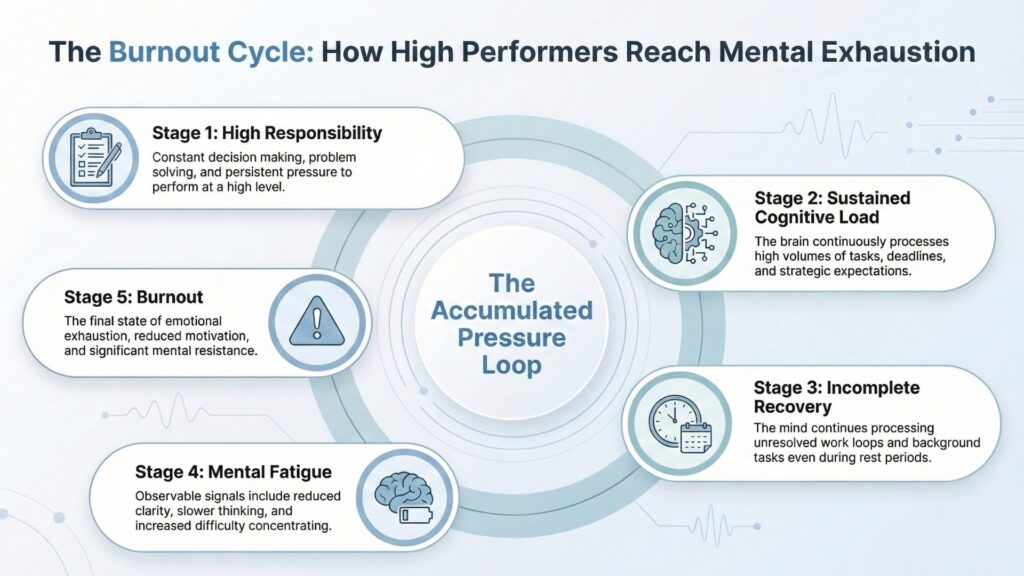
The first factor is sustained cognitive load.
Modern work environments require constant decision-making, problem-solving, and communication. The brain processes large amounts of information throughout the day.
When this cognitive load continues without sufficient recovery, mental resources gradually decline.
These dynamics make more sense once you understand how the mind works, especially how pressure, attention, and mental processing interact under sustained load.
The second factor is emotional pressure.
Many high-performing individuals carry a strong sense of responsibility toward their work, teams, and outcomes. This responsibility can create a persistent internal pressure to perform.
Even when the external workload decreases, this internal pressure often continues.
The third factor is incomplete recovery cycles.
Recovery is not only about stopping work.
True recovery requires periods where the nervous system can disengage from responsibility, decision-making, and mental tension.
Without these recovery cycles, stress accumulates.
Over time, the combination of cognitive load, emotional pressure, and incomplete recovery creates a system where burnout becomes increasingly likely.
These dynamics are closely connected to how the mind responds to sustained pressure. We explore these mechanisms more deeply in our guide on how the mind works under pressure, where the relationship between awareness, stress, and mental tension becomes clearer.
When the structure behind burnout becomes visible, the path toward recovery becomes clearer as well.
Early Signs You May Be Entering Burnout
Burnout rarely appears without warning.
Long before severe exhaustion develops, the mind begins to send signals that recovery is needed.
One early signal is loss of motivation.
Work that once felt engaging begins to feel heavier. Tasks take longer to initiate, and the sense of enthusiasm gradually fades.
At this stage, many people begin delaying important work more often, not because they are lazy, but because the mind is already under strain, which we explore further in our guide on why smart people still delay important work.
Another signal is mental fatigue.
You may notice that thinking feels slower or that maintaining focus requires more effort than before.
Decision-making may also become more difficult.
Even simple choices can begin to feel mentally draining.
Emotional signals often appear as well.
People approaching burnout frequently report increased irritability, frustration, or emotional detachment from work.
These signals are not signs of weakness.
They are early indicators that the system has been operating under sustained pressure for too long.
Recognizing these signals early makes recovery significantly easier.
When burnout is addressed early, restoring balance between effort and recovery becomes far more manageable.
How to Recover from Burnout: A Structural Reset for the Mind
Once burnout develops, many people instinctively try to solve it the same way they solved previous challenges: by pushing harder.
They attempt to regain productivity, increase discipline, or force themselves back into their previous routines.
Unfortunately, this approach often makes burnout worse.
Burnout does not happen because someone suddenly became less disciplined. It happens because the system that supports effort has been overloaded for too long.
Recovery therefore requires a structural reset, not increased pressure.
Instead of forcing motivation, the goal is to restore the conditions that allow energy, clarity, and focus to return naturally.
Step 1: Reduce Cognitive Load
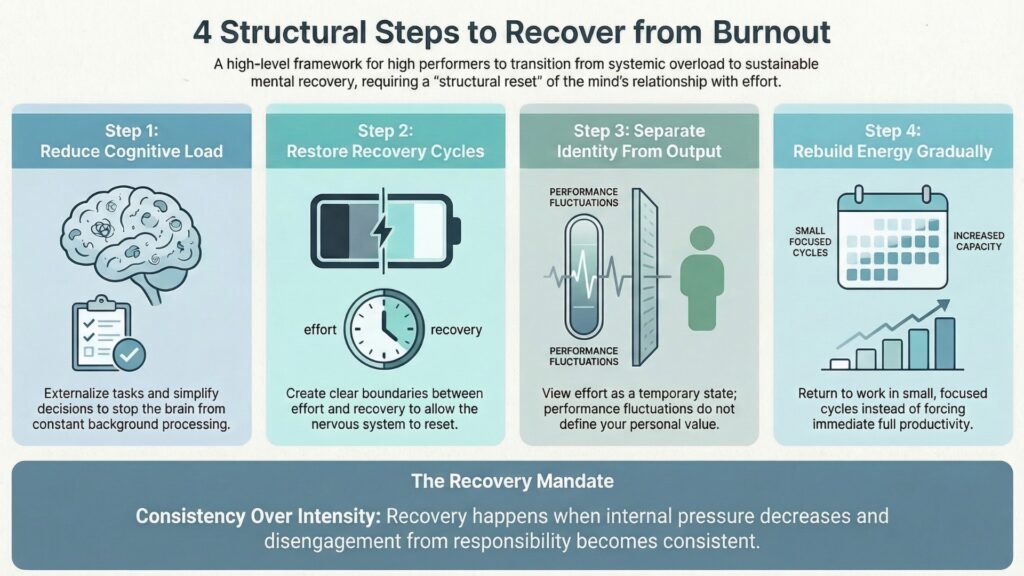
The first step in burnout recovery is reducing cognitive pressure.
Burnout often develops when the brain is continuously managing too many unresolved decisions, responsibilities, and expectations.
Even when a person stops working, these unresolved loops often remain active in the background.
The brain continues processing unfinished tasks, upcoming deadlines, and potential problems.
This constant background processing prevents genuine recovery.
One of the most effective ways to reduce this pressure is by clarifying and externalizing responsibilities.
Instead of holding tasks mentally, write them down. Define priorities. Simplify what must actually be done.
Reducing cognitive load allows the brain to stop running constant background simulations.
When the mind no longer needs to track everything internally, mental tension begins to decrease.
Step 2: Restore True Recovery Cycles
Many people assume recovery simply means sleeping more or taking a short break from work.
While rest is important, burnout recovery requires something deeper.
The nervous system needs periods where it can fully disengage from responsibility and decision-making.
This means creating time where the mind is not planning, solving problems, or anticipating future demands.
This is also why structured evening routines can play such an important role in burnout recovery, because they help create a clean transition between effort and restoration.
Without these recovery periods, mental pressure continues accumulating even during downtime.
One simple but powerful strategy is implementing consistent end-of-day closure routines.
Clear transitions between work and rest help signal to the brain that the day is complete.
These types of recovery structures are closely connected to evening discipline. We explored this in our guide on how to build an evening routine that actually creates discipline, where structured closure plays a key role in mental recovery.
When the brain learns that effort is followed by genuine recovery, mental resilience gradually returns.
Step 3: Separate Effort from Identity
High performers often carry an invisible pressure that others do not experience.
They tie their sense of identity to their productivity.
When performance declines during burnout, this connection can create additional psychological stress.
Instead of simply experiencing fatigue, the person begins to question themselves.
They may think:
Why am I not performing like before?
Why can’t I focus the way I used to?
Why does everything feel harder?
These questions increase internal pressure, which further delays recovery.
Burnout recovery becomes easier when effort is viewed as a temporary state rather than a measure of personal worth.
Performance naturally fluctuates.
Periods of intense effort must be balanced by periods of restoration.
When identity becomes separated from output, the mind no longer experiences recovery as failure.
Instead, recovery becomes a necessary phase in maintaining long-term performance.
Step 4: Rebuild Energy Gradually
Another common mistake during burnout recovery is attempting to return immediately to previous levels of productivity.
This often leads to frustration.
Burnout recovery rarely works like a switch that suddenly turns back on.
Instead, recovery happens gradually.
Mental energy returns step by step.
One effective strategy is rebuilding effort in small cycles.
Short, focused work sessions followed by genuine breaks allow the brain to regain capacity without becoming overwhelmed again.
This approach helps the nervous system relearn that effort does not always lead to exhaustion.
Over time, these cycles slowly rebuild stamina.
Clarity improves. Focus stabilizes. Motivation begins to return.
The key is patience.
Burnout recovery is not about quickly returning to peak performance. It is about restoring sustainable effort.
How Long Does Burnout Recovery Take?
A common question people ask is:
How long does it take to recover from burnout?
The honest answer is that recovery timelines vary depending on how long the burnout has been developing.
Mild burnout may improve within several weeks once recovery cycles are restored.
More severe burnout may take several months.
This happens because burnout affects several systems at once.
Mental energy becomes depleted. Emotional regulation weakens. Cognitive performance declines.
These systems require time to recalibrate.
Attempting to rush recovery often creates additional pressure, which delays the process.
Instead, recovery tends to follow a gradual sequence:
First, mental pressure decreases.
Then emotional stability improves.
Finally, cognitive clarity and motivation return.
When this process is respected, many people eventually regain not only their energy but also a healthier relationship with work.
Preventing Burnout in the Future
Recovering from burnout is important.
But preventing it from returning is even more valuable.
Burnout prevention does not mean avoiding hard work.
Many high performers enjoy working intensely on meaningful problems.
The key difference lies in how effort and recovery are structured.
Sustainable performance requires three elements:
First, clear boundaries between effort and recovery.
Work should have defined starting and ending points. Without these boundaries, mental tension never fully resets.
Second, reducing unnecessary cognitive load.
Not every decision needs constant attention. Systems, routines, and structured processes reduce mental friction.
Third, creating recovery cycles intentionally.
Rest should not only happen when exhaustion appears. It should be built into the rhythm of work.
When effort and recovery exist in balance, performance becomes far more sustainable.
Frequently Asked Questions About Burnout
What are the early signs of burnout?
Early signs often include mental fatigue, reduced motivation, difficulty concentrating, emotional exhaustion, and increased procrastination.
These signals usually appear gradually before more severe burnout develops.
What does burnout feel like?
Burnout often feels like persistent exhaustion combined with reduced mental clarity. Tasks feel heavier, focus becomes difficult, and motivation declines even for meaningful work.
Can burnout go away on its own?
In mild cases, burnout may improve with rest and reduced pressure. However, deeper burnout usually requires structural changes in workload, recovery cycles, and mental boundaries.
What is the fastest way to recover from burnout?
There is rarely a quick fix. The most effective approach is reducing cognitive pressure, restoring recovery cycles, and gradually rebuilding mental energy over time.
Final Thought
Burnout is not a failure of discipline.
It is a signal that the system supporting your effort has been under pressure for too long.
When effort continues without recovery, even the most capable individuals eventually reach their limits.
But burnout also carries an important message.
It reveals where the structure of work and recovery needs to change.
When that structure is redesigned, energy returns, clarity improves, and meaningful work becomes sustainable again.