

Have you ever asked yourself, “Who am I, really?”
Not your name.
Not your profession.
Not the roles you play for other people.
But the identity underneath your habits, achievements, expectations, and reactions.
Changing your habits can improve what you do. But it does not always change who you believe you are.
That is why someone can follow a new routine for weeks or months and still return to old patterns under pressure. The behavior changed temporarily, but the self-image beneath it remained the same.
Learning how to change your identity means examining the beliefs, roles, experiences, and repeated behaviors that shaped your sense of self.
It also means deciding which parts of that identity still belong to you, and which ones you are finally ready to leave behind.
The process can be slow, uncomfortable, and sometimes painful.
But it can also lead to a life that feels more conscious, authentic, and aligned with who you genuinely want to become.
Why Most Attempts to Change Yourself Do Not Last
There are many reasons why most attempts to change yourself do not stick.
But most of them share one common denominator.
Very much in line with the phrase “old habits die hard,” changing old patterns and habits is extremely difficult.
And this is the main thing you need to understand because it also becomes the foundation for how real change actually happens.
The difference between changing behavior and changing identity
Most people try changing behavior without changing identity.
They try to change their actions while remaining the same person internally.
This usually works temporarily, but under pressure, people often return to their old patterns.
Real long-term change happens when behavior becomes connected to a different self-image and a different way of seeing yourself.
Because identity usually determines behavior much more strongly than motivation does.
Why Willpower Eventually Runs Out
Willpower does not always run out, but it does very often.
Especially when people lack structure, discipline, vision, or a long-term system behind their actions.
At the beginning, motivation and emotional energy can create movement.
But over time, without deeper systems in place, people slowly become tired and stop trying.
This is why sustainable change usually requires much more than temporary motivation.
The Identity Thermostat: How Self-Image Pulls You Back
Every person has an internal identity thermostat.
Even when people temporarily improve, succeed, or change externally, their self-image often pulls them back toward what feels familiar internally.
If someone deep inside still sees themselves as lazy, unsuccessful, unworthy, or incapable, they will often unconsciously return to behaviors that match that identity.
This is one reason why people sometimes sabotage progress even when things are going well.
Because internally, the new version of themselves still feels unfamiliar or unsafe.
Why My Changes Kept Falling Apart
For years and years, I tried creating some kind of life structure around food, sports, work, meditation, and similar things. I was trying to get balance and harmony in all.
And constantly, something kept falling apart.

Either my nutrition improved, and sports got worse, or work harmony improved while something else collapsed.
There was always something missing.
Always.
And I kept struggling with this until I finally started building my life in a much more structured and disciplined way.
I started creating plans and ideas, taking time for myself, and, most importantly, accepting that the process would take months or even years.
And only after many months, actually after several years, can I honestly say that I slowly started reaching the harmony I wanted to create in my life.
What Identity Actually Is
If somebody asks you who you are, you will most likely answer with your name and surname.
You will talk about where you come from, what you do, what schools you attended, what sports you practiced, what hobbies you have, whether you are a father, mother, husband, or wife, and what you have achieved in life.
But none of these things is your true identity.
These are the external layers you built over the course of your life.
Identity is not your personality; it is your self-concept
As mentioned above, identity is not simply your personality, even though people often associate identity with whether someone is good or bad, moral or immoral, or successful or unsuccessful.
Identity is usually more deeply connected to your self-concept, your internal sense of who you are and what you believe yourself to be.
Most of the time, people are not even fully aware of it.
Only when somebody’s safety, reputation, status, or ego becomes threatened do the deeper parts of identity suddenly appear.
That is when people discover what they are truly protecting internally.
How Identity Is Formed Through Experience and Conditioning
Identity begins forming almost from the moment we are born.
It develops through family, parents, grandparents, siblings, school, society, work, relationships, successes, failures, and repeated experiences throughout life.
Identity is built.
It is not something fixed that simply exists on its own.
If somebody wants to become a successful businessman, they begin presenting themselves that way.
And once they become successful, they often hold onto that image even more strongly.
But identity does not appear overnight.
It is shaped by repetition.
By experiences.
By emotional events.
By the stories we tell ourselves.
And by the meaning we attach to those experiences.
Over time, these repeated experiences become our self-concept—the way we see ourselves and the way we believe the world sees us.
The Difference Between Your Essential Self and Constructed Identity
At some point, many people wake up and begin asking a difficult question:
“Who am I really?”
“Am I the person I built over thirty or forty years?”
Or “Am I something deeper underneath all of that?”
Richard Rohr often speaks about the distinction between the True Self and the identity we gradually build throughout life.
Our identity is often the external structure we create to function in the world.
It is shaped by achievement, status, expectations, fear, success, failure, and the roles we play for other people.
But beneath that identity there is something quieter.
Something much less concerned with proving itself.
Imagine a five-year-old child playing on a beach.
The child is simply building castles in the sand.
Not worrying about appearance.
Not worrying about success.
Not wondering what other people think.
The child is simply present.
Simply existing.
Over time, however, that same child slowly builds an identity.
School.
Achievement.
Career.
Status.
Responsibilities.
Social expectations.
None of these things are wrong.
In many ways they are necessary for adult life.
But gradually, the external identity becomes stronger while the deeper self becomes quieter.
Many people eventually realize they no longer want to live only from that externally constructed identity.
They do not want to abandon responsibility or become that child again.
They simply want to reconnect with something more authentic beneath everything they have built.
That is where real identity work often begins.
Not by rejecting life.
But by learning to live fully in the world without becoming trapped inside the identity created by fear, approval, survival, or external expectations.
Is Identity Change Actually Possible?
Identity can absolutely be changed.
Very often, the biggest obstacles are limiting beliefs and internal convictions about what is or is not possible.
When somebody says, “I cannot change,” it is usually not an objective fact.
Or
“That’s just how I am.“
It is an internal belief.
What Psychology Says About Changing Your Self-Concept
Modern psychology generally agrees that self-concept is not completely fixed.
People can change how they see themselves, especially through repeated experiences, emotional events, and long-term behavioral change.
The brain constantly adapts to new information and new patterns.
This does not mean identity change is easy.
But it does mean that people are far more adaptable than they often believe.
Why the Brain Resists Identity Change
Even with all our development, the human brain still reacts very strongly through emotional and survival-based systems.
The moment old patterns begin to change, the brain often interprets that as a threat.
Very quickly, fear appears.
People react emotionally instead of rationally.
This is one reason why identity change feels so uncomfortable.
Very often, the brain tries to protect what is familiar, even when that familiarity is unhealthy.
That is why self-awareness and honest self-analysis become extremely important during personal transformation.
What Can Trigger an Identity Shift?
Identity shifts happen more often than people realize.
Sometimes they happen gradually through repetition and discipline.
Sometimes they happen suddenly after emotional events, failures, losses, successes, or crises.
Many people describe moments in life where they no longer saw themselves in the same way afterward.
Very often, strong emotional experiences become triggers that force people to reevaluate who they are.
Why Crisis Transforms Some People but Leaves Others Stuck
A crisis often marks a significant turning point in life.
It can come through shock, stress, loss, failure, or trauma.
Usually, people first go through denial, then helplessness, sadness, or emotional collapse when they realize they cannot fully control what happened.
And this becomes the critical point.
Some people slowly grow through that pain and become stronger, wiser, and more grounded afterward. They learn from the experience and personally grow.
Others remain stuck in anger, resentment, blaming others, or emotional paralysis for years or even decades.
I have personally seen people who never emotionally recovered after losing a partner, even twenty years later.
At the same time, I have also seen people transform completely through suffering and become much stronger afterward.
The Emotional Stages of Crisis and Growth
A psychologist, Željko Ćurić, explains this process extremely well in one of his YouTube lectures about emotional growth through crisis: Kriza se konča v glavi (The crisis ends in the head)
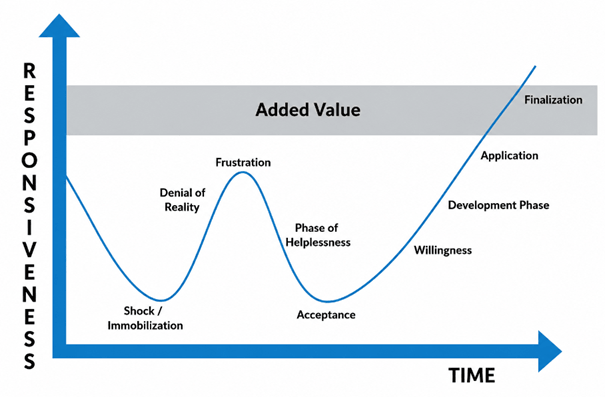
Author: Željko Ćurić
The entire process is based on the idea that at some point in life, a crisis appears and creates a shock. The curve begins somewhere around the middle level, but then suddenly drops into the first lower point, the shock phase.
After that initial shock, people often move into denial and frustration, where their emotional state may temporarily improve after the initial impact, but over time, many fall into a deeper sense of helplessness.
And this becomes the critical point.
As mentioned before, some people remain stuck in this helplessness for years or even decades. The movement from frustration toward acceptance can continue downward indefinitely if acceptance never truly happens. Without acceptance, people often stay trapped inside resentment, emotional paralysis, blame, or chronic suffering.
But when genuine acceptance finally appears, the next phase begins. Then real work becomes necessary. This is where willingness, development, application, and eventually finalization enter the process. And if you compare the starting point with the final point on the curve, you can see something important: through the crisis itself, the person actually grows.
The suffering, difficulty, and emotional collapse eventually become part of personal transformation and development.
How to Change Your Identity: A Six-Step Process
Usually, some kind of external event or internal realization needs to happen before you genuinely want to change your identity.
Something inside you has to shift first.
If that shift has already happened, and that is why you are reading this article, then despite all the uncertainty, I can honestly congratulate you. Even if it does not feel like it today, you have already taken one of the most important steps.
Identity change rarely happens overnight.
It develops gradually through awareness, repeated action, and a willingness to challenge old beliefs about yourself.
The following six steps provide a practical framework for that process.
Step 1: Get Honest About the Identity You Are Living Today
Every meaningful change begins with honesty.
Before you can become someone different, you first need to understand the identity you are currently operating from.
Ask yourself:
- Who do I believe I am?
- What labels do I constantly use to describe myself?
- Which of those labels actually help me?
- Which ones keep me trapped?
Many people unknowingly carry identities such as “I’m not disciplined,” “I’m always anxious,” “I’m not good enough,” or “This is simply who I am.”
Until those internal stories become visible, they continue directing your behavior without you realizing it.
Step 2: Identify the Beliefs Holding That Identity in Place
Every identity is supported by beliefs.
Some are empowering.
Others quietly limit your potential.
Very often, these beliefs were never consciously chosen. They developed through childhood experiences, repeated failures, criticism, expectations, or painful emotional events.
The question is no longer whether those beliefs were once useful.
The question is whether they still serve the person you want to become today.
Step 3: Define the Identity You Want to Build
Many people focus only on goals.
Lose weight.
Build a business.
Become more confident.
Those are outcomes.
Identity goes deeper.
Instead of asking,
“What do I want to achieve?”
Ask,
“Who do I want to become?”
Perhaps someone who remains calm under pressure.
Someone who keeps promises.
Someone who acts with integrity.
Someone who protects their health.
Someone who leads with compassion instead of fear.
The clearer this identity becomes, the easier your decisions become.
Step 4: Act From Your New Identity Before You Feel Ready
One of the biggest mistakes people make is waiting until they feel different.
Identity rarely changes that way.
Very often, you have to begin acting like the person you want to become long before it feels natural.
That does not mean pretending.
It means consciously choosing behaviors that align with your future identity instead of your old one.
At first, it may feel uncomfortable.
That is normal.
The old identity has been reinforced for years.
The new one is still being built.
Step 5: Build Evidence Through Small, Consistent Actions
Identity changes through evidence.
Every small action either strengthens your old identity or your new one.
Every workout.
Every honest conversation.
Every healthy boundary.
Every promise you keep to yourself.
Each one becomes proof that you are becoming the person you chose to be.
Small actions, repeated consistently, eventually become stronger than occasional moments of motivation.
Step 6: Change the Story You Tell Yourself
The final step is often the most overlooked.
The language you use about yourself reinforces your identity every single day.
Notice the difference between saying:
“I’m trying to become disciplined.”
and
“I am becoming someone who follows through on my commitments.”
Or between:
“I’m terrible with money.”
and
“I’m learning to make wiser financial decisions.”
These are not merely positive affirmations.
They are deliberate shifts in self-concept.
Over time, the stories you repeat become the identity you believe.
Why an Outside Perspective Can Help
These six steps look straightforward on paper.
Living them is much more difficult.
Because of that, outside support can become extremely valuable.
Whether it is a coach, therapist, psychoanalyst, mentor, or another trusted guide, the right person can often help you see patterns that remain invisible from inside your own thinking.
I do not say this simply to promote coaching.
I say it because genuine self-analysis has limits.
We are trying to understand the very mind that created the patterns in the first place.
That is difficult.
Very often, we end up thinking in circles.
A fresh perspective can interrupt those circles, ask questions we would never ask ourselves, and help us move forward with greater clarity.
Why the People Around You May Resist Your Identity Change
The situation is actually very simple.
Your Environment Is Wired to Keep You the Same
Every environment slowly creates its own balance and expectations. People become used to your habits, reactions, routines, and the role you play in relationships. The moment you begin changing, the environment often unconsciously tries pulling you back toward the old version of yourself because that version feels familiar and safe to them.
People have known you for years or even decades as a certain person, and it is very difficult for them to suddenly adjust to a new identity, new habits, or a different version of you.
People perceive you in a certain way, and changing that perception does not happen overnight. Even if you openly tell them, “I have changed,” that still does not mean they will immediately accept it.
In my experience, people will often not really want to accept your change. In many cases, they will simply be forced to adapt to it over time or leave the relationship if they can’t handle it, even if you explain it clearly.
When People Did Not Take My Need to Change Seriously
I remember studying for the bar exam. I sent an email to friends and family explaining that for six-plus months, I would not be very available, that I would spend most of my time studying and working, and that it would be difficult for me to go for coffee, socialize, or spend time the way I used to.
The response was received more with silence than support.
And today I understand why.
At that time, however, my question was simple:
“Why can’t you support me? Why can’t you help me?”
But the reality was that my change also affected their relationship with me. They may have needed me, but couldn’t articulate it honestly and vulnerably. Especially men.
A very similar thing happened decades later, as I started moving more into solitude, meditation, silence, and time alone.
Again, people took it personally.
I wrote openly that I needed peace, quiet, and time for myself.
But many people interpreted that as rejection.
As if they had done something wrong.
An extremely difficult and illogical experience.
Even some of the people who verbally supported me and said things like, “That is great, good for you,” later started judging me in different ways.
Why friends and family may unconsciously push back
They were saying;
“You changed.”
“You are not the same person anymore.”
“When you want us again, contact us.”
I couldn’t believe it. I told them just a few months earlier, and everyone forgot. Judging me with low punches, such as When will you take care of your family. When will you do this or that?
Those were hard times. I was dealing with medical issues at the time, but there was no room for my troubles.
All they saw was themselves and their issues with me. Make no mistake, I didn’t make it about them. My actions were not directly connected to them, but I indirectly affected them through people or others’ reactions.
So they blame me because they couldn’t handle their own pain. It is easier to say why you changed and why you are doing this than to face yourself.
Those were some hard times to get through.
Identity Change May Bring Relationship Losses
So if you truly decide to change your identity and your life, you should, unfortunately, also prepare yourself for possible losses.
Not only acquaintances.
Sometimes, even very good friends.
Some people simply will not be able to keep up with your change.
Even if they genuinely care about you.
That does not necessarily mean you need to cut those people out of your life.
But it does mean you should understand that identity change often comes with consequences in relationships.
Identity Change for Founders and Leaders
Founders and leaders often face identity change after major external events such as health problems, divorce, loss within the family, or some deeper internal realization and shift that forces them to reevaluate their life.
These moments often become ideal opportunities to honestly examine who we are and who we want to become.
There is a major difference between the identity you unconsciously built over thirty, forty, or fifty years and the identity you consciously choose moving forward.
What you built in the past was often shaped by environment, survival, expectations, and reactions to life.
What you choose next becomes a conscious decision.
How Early Success Can Lock a Founder Into an Outdated Identity
Early success can become dangerous because people start identifying with the exact version of themselves that originally created those results.
The problem is that what helped somebody survive and grow in the beginning may later become the very thing limiting further growth.
Many founders become trapped inside identities built around control, overwork, constant pressure, or proving themselves.
At first, those traits may create success.
But later they often create exhaustion, relationship problems, isolation, or stagnation.
And the more successful somebody becomes, the harder it can feel to let go of that identity.
The Trap of “I Have to Figure Everything Out Alone”
Many leaders unconsciously build an identity around being the person who solves everything alone.
At the beginning this often looks like strength, discipline, independence, and resilience.
But over time it can slowly become emotional isolation.
People stop asking for help.
They stop trusting others.
And eventually they create a life where everybody depends on them while they themselves have nobody they truly lean on.
When My Identity Became the Ceiling on My Growth
My identity and self-perception were always built around hard work. I believed that with enough work, discipline, hierarchy, structure, and respect, everything could be achieved. Everything I learned through police work and life, I later transferred directly into business.
At the beginning, I was an extreme control freak. I always wanted the final word. I did not trust people. I worked sixteen hours a day and tried solving everything myself. Everything was on me. From my perspective, I was the only irreplaceable person.
And for some time, that identity actually became the engine of my growth.
But eventually it also became the ceiling of my growth.
I slowly became trapped inside my own patterns, my own thinking, and my own identity. Success reached a certain point and then stalled. Problems began to accumulate slowly: family, health, stress, exhaustion, and more.
My own identity started sabotaging my future growth.
In reality, it had been limiting me for years already, but now I have finally become fully aware of it.
And it was only after serious health problems and brain hemorrhages that I was finally forced to begin moving beyond that identity and make the shift I mentioned earlier.
For me, this period coincided with extreme long-term stress and serious brain hemorrhages that had been developing over several years before reaching a crisis point in my mid-forties.
Thank God I eventually decided to use that experience for my own growth and turn the entire situation into something meaningful.
It was time to move on….

How to Know Your Identity Is Actually Changing
Very often you will recognize identity change only afterward, when things around you slowly start changing.
At the beginning, you usually will not even realize that this is the result of an identity shift.
Everything will feel strange, unfamiliar, both for you and for the people around you, and only over time will you begin connecting the dots and realizing that the internal changes happening inside you for quite some time have slowly started manifesting externally.
And this is difficult to notice because these changes usually happen microscopically slowly.
Only through journaling, reflection, or some kind of daily or weekly analysis can you begin seeing that the changes you consciously decided to make are actually happening.
And these changes often become one of the first signs that your identity is beginning to shift.
Signs the Change Is Deeper Than Surface Behavior
One of the first signs of real identity change is consistency.
You begin reacting differently even in situations where nobody is watching.
Your decisions slowly become more aligned with the person you want to become.
Old behaviors start feeling less natural.
And very often, people around you notice the changes before you fully notice them yourself.
Why identity change feels uncomfortable even when it is right
Identity change often feels uncomfortable because you are leaving behind something familiar.
Even unhealthy patterns can feel emotionally safe simply because they are known.
At the same time, the new version of yourself still feels uncertain and unstable.
This creates internal tension.
And many people mistakenly interpret that discomfort as proof that they are doing something wrong, while in reality it is often proof that real change is happening.
What to Do When You Slip Back Into Your Old Identity
Almost everybody slips back into old patterns at some point.
That is ok. Trust me.
That does not mean the process failed.
Identity change is rarely linear.
The important thing is not perfection but awareness.
The moment you notice yourself returning to the old version of yourself, you have already created more consciousness than before.
And that awareness itself becomes part of the transformation.
Frequently Asked Questions About Identity Change
Can you really change your identity?
Yes. Identity and self-concept are not completely fixed. They can change through repeated experiences, conscious reflection, new behavior, changing relationships, emotional events, and consistent evidence that supports a different view of yourself.
How long does it take to change your identity?
There is no fixed timeline. Some identity shifts begin after a major realization or crisis, while others develop gradually over months or years. Lasting change usually requires repetition, awareness, and enough time for the new behavior to feel familiar.
Why are habits alone not enough to create lasting change?
Habits change repeated actions, but they do not automatically change the beliefs and self-image beneath those actions. When the new behavior conflicts with your identity, you may return to familiar patterns during stress, fatigue, or uncertainty.
What is an identity-based habit?
An identity-based habit is a repeated action connected to the kind of person you believe you are becoming. Instead of focusing only on an outcome, you use behavior to reinforce a chosen identity.
Why does changing your identity feel uncomfortable?
Identity change creates tension between what is familiar and what is new. Even positive changes can initially feel unsafe or unnatural because the old identity has been reinforced for years.
What are the signs that your identity is changing?
Signs include making different decisions when nobody is watching, responding differently under pressure, feeling less connected to old habits, setting new boundaries, and noticing that your actions increasingly match the person you want to become.
Becoming More of Who You Truly Are
At some point, you may realize that you spent years building an identity without ever consciously asking whether it still reflects who you truly are.
That realization can be painful, but it can also mark the beginning of real change.
Changing your identity does not mean rejecting everything you have been. It means becoming more conscious of what you want to carry forward and what you are finally ready to release.
Habits remain important. They create structure, repetition, and visible progress. But habits become far more powerful when they reinforce a self-image you consciously chose rather than one you inherited from fear, pressure, survival, or other people’s expectations.
Identity change is not about becoming somebody artificial or completely different.
It is about becoming more honest, more aware, and more aligned with the life you genuinely want to live.