
Have you ever blamed yourself for something you could no longer change?
Or blamed someone else because it felt easier than facing what happened?
Many people confuse responsibility with guilt.
They believe that taking responsibility means carrying shame, self-criticism, or blame for everything that goes wrong.
It doesn’t.
Learning how to take responsibility for your life is not about punishing yourself.
It is about developing the ability to respond consciously to difficult situations, own your actions, and move forward without becoming trapped in guilt or victim mentality.
That distinction can completely change how you experience relationships, work, leadership, and life itself.
What Taking Responsibility Actually Means
Responsibility Is the Ability to Respond
Before responsibility becomes a moral principle, a legal obligation, or a leadership quality, it is something much simpler.
It is your ability to respond to what life places in front of you.
Every day presents situations that ask something of us. Sometimes they require action. Sometimes patience. Sometimes courage. Sometimes restraint. We may not always control what happens, but we always have a choice in how we respond.
Seen this way, responsibility is not about carrying the weight of the world on your shoulders. It is about refusing to live as though you have no influence over your own thoughts, actions, and decisions.
This understanding is beautifully illustrated by Sadhguru’s explanation of the word responsibility.
Sadhguru explains responsibility in a very interesting way. He says that the word responsibility comes from the ability to respond to a situation.
He gives a very good example.
Imagine you see a person lying motionless next to the road. You do not know whether the person is unconscious, injured, dead, or whether somebody hit them with a car.
At that moment, you have several possible responses.
You can walk past the person and pretend you did not see anything.
You can try to help:
- You can call emergency services.
- You can stay with the person until help arrives.
- You can call for help around, etc.
The essential difference is between ignoring the situation completely and responding to it in some way.
A doctor will naturally provide medical assistance.
A person with no medical knowledge, who may even be afraid to touch the injured person, can still call emergency services and ask for help.

In both cases, responsibility means being responsive to the situation rather than pretending it has nothing to do with you.
That is what Sadhguru tries to explain, and I personally agree with this perspective.
He says that all of us are responsible for everything around us to some degree. The level of responsibility may differ from person to person, but walking past suffering, pretending not to see it, or emotionally disconnecting ourselves completely is, in many ways, irresponsible.
So, responsibility is not only a moral concept.
It is about how we respond to life.
Responsibility Is Not About Fault, It Is About Power
Most people hear the word ‘responsibility’ and immediately think of guilt or blame.
But responsibility is not primarily about fault. It is about power.
The moment you take responsibility for your life, your reactions, and your decisions, you stop being only a passive victim of circumstances.
Responsibility gives you the ability to influence what happens next, even if you cannot change what already happened.
And that shift alone can completely change the way a person experiences life.
The Difference Between Responsibility and Accountability
Responsibility and accountability are connected, but they are not exactly the same thing.
Responsibility is more internal; it is the willingness to own your actions, decisions, and responses.
Accountability usually appears when those actions have consequences and you must stand behind them publicly, legally, morally, or professionally.
A person can feel responsible internally without anyone else knowing, but accountability often involves answering to others as well.
Healthy people develop both internal ownership and the ability to stand behind their actions externally.
You Cannot Control What Happens, But You Always Control How You Respond
We cannot fully control the external world.
Things happen whether we want them to or not, according to certain laws, patterns, randomness, coincidence, destiny, God, the universe, or whatever you personally believe governs life.
Personally, I believe there is a higher force beyond us, although each person will naturally understand that in their own way.
Pretending that nothing greater exists, at least for me personally, often reflects a certain level of ignorance.
Because no matter how intelligent, powerful, educated, or successful we become, life constantly reminds us that we are not fully in control.
Accidents happen.
Illness appears.
People leave.
Unexpected situations emerge.
And often, we cannot directly influence those external events.
But what we can influence is how we respond.
You can react externally by trying to control, manipulate, fight, or change everyone and everything around you.
Or you can go inward.
You can become more conscious, more grounded, and more responsible for your own reactions, emotions, and actions.
And very often, that internal response changes far more than external force ever could.
Understanding Victim Mentality
Victim mentality is extremely common in the modern world.
I see it almost everywhere. And if I am honest, I also notice how easy it is for me to fall into a victim mentality.
This is not something that only “weak people” experience. In many ways, it is a very natural psychological and emotional process.
The real problem is not that victim mentality exists. The problem is when people stay trapped inside it for years without becoming aware of it.
The Difference Between Being a Victim and Living in Victim Mentality
It is very important to separate being a victim from living in a victim mentality.
All of us can objectively become victims of certain situations in life.
You may become seriously ill.
You may lose a loved one.
Your partner may betray you.
You may experience abuse, manipulation, business betrayal, loss, injustice, or tragedy.
In those moments, you are genuinely a victim of external circumstances.
And a healthy adult should allow themselves to process that pain, grieve, survive the experience, and eventually continue forward stronger and wiser.
How a Man Conquered Victim Mentality
I personally know an older man who first lost his wife because of illness, and later lost both of his sons in separate, tragic situations. Today, he is already close to eighty years old.
And yet his strength to continue living despite losing almost everything is extraordinary.
The important question is not whether suffering happens.
The real question is:
Will you remain trapped in the identity of a victim, or will you eventually rise above what happened to you?
That is the difference between being hurt by life and building your identity around that pain forever.
It Hides Inside Language and Patterns, Not Obvious Complaints
Victim mentality is often much more subtle than people think.
It usually hides inside everyday language, repeated emotional patterns, constant excuses, blame, defensiveness, or passive thinking.
Many people openly complain that life is unfair, specifically toward them.
Others unconsciously wait for someone else to rescue, validate, understand, or finally “fix” what they feel inside.
And because these patterns become automatic over time, most people do not even realize they are operating from them.
Signs You Are Operating From a Victim Frame Without Realizing It
It is important to understand that people operating from a victim frame are usually dealing with deeply subconscious emotional patterns.
That is why it is often difficult for them to recognize what is happening internally.
Because of that, these people should not automatically be judged or attacked.
At the same time, however, they are still responsible for their actions, reactions, and emotional patterns. This connects directly to what we discussed earlier in the article.
The point is not that people are guilty for their emotions or that they intentionally created their suffering.
The point is that they remain responsible for how they choose to move forward.
Will they continue identifying only as victims of life?
Or will they eventually become people who overcame what happened to them?
That is the real difference.
And the first step is always awareness.
You must first recognize where you are psychologically and emotionally before you can move beyond it.
Why Successful People Are Not Immune to This
In many ways, successful people can fall into a victim mentality even more easily than others.
Success and fame often create a strong sense of self-righteousness, entitlement, superiority, or emotional insulation from reality.
People admire them.
Praise them.
Follow them.
Place them on pedestals.
And unfortunately, all of that can slowly disconnect a person from humility and grounded reality.
When money, fame, influence, or status begin solving most of your external problems, it becomes very easy to judge others harshly.
Suddenly, small inconveniences feel unbearable.
Why is the food not perfect?
Why must I wait?
Why did the hotel not give me a better room?
Why did somebody speak to me that way?
From my perspective, success and public admiration can sometimes become more of an obstacle than a benefit for personal growth and responsibility.
Because external success can quietly strengthen the ego while weakening self-awareness.
When I Fell Into Victim Mode After My Stroke
One of the periods where I clearly fell into a victim mentality was after my brain hemorrhage.
Those were extremely difficult times.
Objectively speaking, I really was a victim of serious health problems, fear, uncertainty, and confrontation with mortality.
And honestly, I felt that nobody truly understood me.
Even today, I still believe that very few people understood what I was trying to express at the time regarding fear of death and the psychological reality I was experiencing internally.
But over time, I realized something important.
Part of the problem was objective; people simply could not fully understand my situation because they had never experienced it themselves.
But the second part of the problem was me.
I rejected their compassion, support, and comfort because internally I had already entered the role of a victim.
And that mentality slowly pushed me deeper and deeper down emotionally.
That period probably lasted close to a year.
Getting out of it was extremely difficult.
It required enormous self-awareness, therapy, reflection, internal work, and gradual rebuilding of myself from the inside out.
Why Taking Responsibility Is So Hard
Taking responsibility is difficult precisely because most people were never taught the difference between responsibility and guilt.
My son often used to say:
“It’s always my fault?”
And only later did I begin to understand that, through certain words, reactions, and patterns from both me and the environment around him, he had slowly started to absorb guilt instead of responsibility.
That realization changed the way I communicated with him.
I became much more careful with language.
“You are not guilty,” I would say. “But you are responsible for your actions.”
If you were eating at the table and left crumbs, simply stand up and clean them up.
You are not guilty.
You are responsible for making up your own mess.
Simple as that.
But in life, when guilt enters the picture, the blame game usually begins.
And once blame starts, people often stop focusing on solutions and shift to shame, punishment, emotional reactions, and defensiveness.
The real goal should be much simpler:
Take responsibility.
Correct the mistake.
Learn from it.
Move forward without destroying yourself emotionally.
The Brain Defaults to Blame as Self-Protection
This is exactly where blame becomes a psychological defense mechanism.
The brain often defaults to blame because blame protects the ego from emotional discomfort, shame, fear, and vulnerability.
And in many ways, we learned this pattern throughout childhood and society itself.
Because very often, when you calmly take responsibility for something, people still expect something more from you.
They want emotional suffering.
They want visible guilt.
They want dramatic regret, punishment, humiliation, or endless apology.
But real responsibility can sometimes sound very simple:
“I made a mistake.
I will take responsibility for it.
I will correct what I did as I can.”
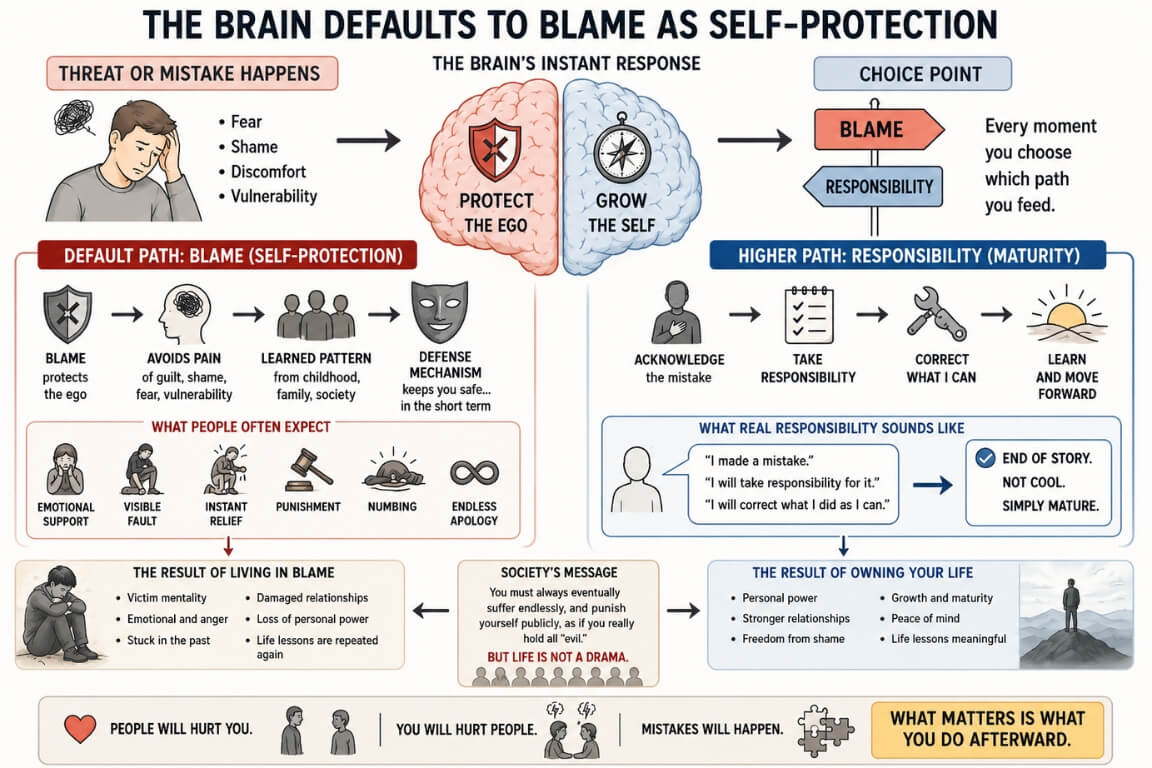
End of story.
That is not cold.
It is simply mature.
Unfortunately, society often teaches people that they must emotionally collapse, endlessly suffer, or publicly punish themselves in order for accountability to feel “real.”
But life does not need to become a constant emotional drama.
People will hurt you.
You will hurt people.
Mistakes will happen.
The important thing is what happens afterward.
Why Admitting Responsibility Feels Like Admitting Weakness
Again, much of this stems from the way we were conditioned throughout our lives.
As a society, we are still not emotionally mature enough to consistently separate responsibility from moral condemnation.
We still largely operate through black-and-white thinking:
right or wrong,
good or bad,
innocent or guilty.
If somebody makes a mistake, especially a serious one, society often immediately moves toward punishment and exclusion.
You can clearly see this inside many criminal justice systems, especially systems built primarily around guilt, punishment, and long-term condemnation.
There are people who committed crimes at eighteen years old, sometimes even younger, when neuroscience already shows that the human brain is not fully developed.
And yet some remain in prison for forty or fifty + years.
Even if they eventually leave prison, their entire lives have effectively been destroyed.
In many situations, one tragedy destroys multiple lives at once. The victim and then the perpetrator become a second victim of a system.
From my studies in criminology and penology (the science of criminal sanctions), I understand that criminals aim for transformation, not punishment itself.
“I want him/her to suffer” is an emotional reaction that is ok from the victim’s perspective or their near persons. To make the whole nation personally involved in such subjective emotional thinking is dangerous.
Then we become animals, governed by the talion rule of law (eye for an eye), and that is no good for anybody.
It provokes hatred instead of forgiveness. In the end, nothing you do will bring someone back or restore the situation to the way it was before the wrongdoing.
You can punish or even kill the perpetrator, but that will not make any difference in the person who got hurt. The damage is done. By punishing and hurting the perpetrator, you are only doing the same or something similar to what the perpetrator did on the grounds of the law.
The Hidden Cost of Avoiding Responsibility
The hidden cost of avoiding responsibility is that, over time, you slowly begin to lose your personal power.

You start believing that everybody else controls your emotions, your future, your happiness, and your direction in life.
That mentality creates resentment, helplessness, emotional exhaustion, and constant frustration.
Many people spend years waiting for somebody else to change before they allow themselves to move forward.
And in the process, life quietly passes them by.
How to Take Responsibility for Your Life
Understanding responsibility is one thing.
Living it is something entirely different.
The shift from blame to responsibility rarely happens overnight. It develops gradually through repeated choices, honest self-reflection, and a willingness to respond differently than you did in the past.
If you recognize yourself somewhere in this article, remember that awareness is already the first step.
The fact that you are questioning your own patterns means change has already begun.
The following principles can help you begin taking greater responsibility for your life without falling into guilt or self-condemnation.
1. Stop Asking “Why Is This Happening to Me?” and Start Asking “What Can I Do Now?”
One of the biggest differences between responsibility and victim mentality is the question you ask yourself.
Victim mentality keeps looking backward.
Responsibility looks forward.
Instead of searching endlessly for someone to blame, begin asking what your next constructive step could be.
That single shift often changes everything.
2. Own Your Past Without Living Inside It
Taking responsibility means acknowledging your past honestly.
It does not mean allowing your past to define your future.
Every mistake contains a lesson.
Once you have learned it, carrying unnecessary guilt no longer serves your growth.
3. Separate What Happened From How You Responded
Many situations in life are outside your control.
Other people’s behaviour.
Illness.
Loss.
Unexpected change.
Your responsibility begins with your response.
While you may not control the event itself, you always have influence over your attitude, your choices, and the direction you decide to take afterward.
4. Take Responsibility Even When Someone Else Was Also Wrong
Many conflicts involve mistakes on both sides.
Instead of asking who deserves more blame, ask yourself:
“What was my part in this?”
Owning your contribution does not excuse the other person’s behaviour.
It simply allows you to grow instead of remaining trapped in resentment.
5. Build Your Future One Responsible Decision at a Time
Responsibility is not one dramatic decision.
It is a habit.
Every conversation.
Every apology.
Every healthy boundary.
Every promise you keep to yourself.
Every difficult choice made consciously instead of emotionally.
Over time, those decisions reshape not only your behaviour but also the person you become.
Taking Responsibility in the Areas That Matter Most
Taking responsibility becomes most difficult in personal relationships and career situations.
With Yourself
Every form of responsibility begins with the relationship you have with yourself.
Before you can communicate honestly with others, lead a team, strengthen a relationship, or improve your career, you must first learn to observe your own thoughts, emotions, and behaviours without immediately becoming defensive.
This requires self-awareness, humility, and honesty.
It also requires compassion.
Taking responsibility does not mean attacking yourself for every mistake you make.
It means becoming willing to see yourself clearly enough to learn, grow, and choose differently next time.
When you develop that relationship with yourself, responsibility becomes less about guilt and much more about conscious living.
In Your Business and Career
Business and career environments are deeply connected to ego, status, performance, identity, and external validation.
That is why it is often extremely difficult to take responsibility without simultaneously absorbing blame and guilt.
You will need to learn to distinguish very carefully between ownership and emotional self-destruction.
Managers, CEOs, business owners, colleagues, and clients will often unconsciously pull you into blame games instead of healthy accountability.
Many times, you will be judged for far more than what objectively happened.
Unfortunately, that is simply part of how the modern world often operates emotionally.
In Your Relationships and How You Show Up
Relationships and families are probably the hardest places to practice mature responsibility.
These are deeply emotional environments connected to childhood wounds, attachment patterns, insecurities, fears, and emotional triggers.
In many ways, people often choose partners who unconsciously activate unresolved parts of themselves.
And then the relationship becomes a mirror.
Your partner points at you.
You point back.
Blame begins.
Defensiveness appears.
Very often, however, both people are simply operating from pain and protection mechanisms.
That is exactly why boundaries become essential.
Healthy boundaries help us distinguish between what is genuinely our responsibility and what belongs to someone else.
They remind us that we are responsible for our own words, actions, emotions, and decisions, but not for controlling another person’s reactions or healing their unresolved wounds.
Learning where your responsibility ends and someone else’s begins is one of the healthiest skills you can develop in any relationship.
In Your Mental and Emotional State
You must also take responsibility for your own mental and emotional state.
The mind plays an enormous role in shaping emotional reality.
Through thought patterns, awareness, discipline, emotional regulation, and perspective, people can create a much healthier internal foundation for understanding:
- what is truly their responsibility,
- what is not,
- where accountability is necessary,
- and where unnecessary guilt should be rejected.
That is exactly why boundaries become essential.
You must learn carefully which responsibility truly belongs to you, which guilt does not, which mistakes you genuinely need to own, and which emotional projections belong to other people rather than yourself.
How Owning One Area Changed Everything Else Around It
Over the last several years, I have spent a great deal of time taking responsibility for my own life and my own actions. Looking back, there are decisions I genuinely wish I had made differently.
What surprised me most, however, was not how difficult it was to admit my mistakes.
It was how differently people responded once I did.
For many people, acknowledging what happened, apologizing sincerely, and taking responsibility was enough. They appreciated the honesty and were willing to move forward.
Others could not.
Some people judged me far more harshly than the situation itself justified. Although my actions affected them emotionally, they had very little direct connection to what had actually happened. Yet the emotional impact made forgiveness almost impossible.
That became one of the most important lessons of my life.
I realized that another person’s reaction often says as much about their own emotional wounds, fears, and unresolved experiences as it does about the mistake itself.
It also changed the way I viewed certain relationships.
I understood that there are people with whom deep trust can no longer exist after certain events. Sometimes that is painful, but sometimes it is simply reality.
If you have sincerely acknowledged your mistakes, apologized where appropriate, learned from them, and genuinely changed your behavior, there comes a point where continuing to punish yourself no longer serves anyone.
Sometimes the healthiest decision is to accept that not everyone will forgive you.
And sometimes creating distance is healthier than spending years trying to earn acceptance that may never come.
That is not avoidance.
It is acceptance.
One of the greatest lessons I learned was that taking responsibility does not mean paying emotionally for the same mistake for the rest of your life.
It means acknowledging it honestly, correcting what you can, learning from it, and then allowing yourself to continue living.
This idea appears throughout many philosophical and spiritual traditions.
One of the best-known examples comes from the Gospel of Matthew.
When Peter asked Jesus how many times he should forgive someone who sincerely repented, he asked:
Then Peter came up and said to him, “Lord, how many times shall I forgive my brother if he sins against me? Up to seven times?” Jesus said to him, “I do not say to you, Up to seven times, but Up to seventy-seven times.” (Matthew 18:21–22)
Whether you approach these words from a religious perspective or simply as timeless wisdom, the message remains powerful.
The goal should not be lifelong emotional punishment.
The goal should be awareness.
Responsibility.
Repentance.
Growth.
And eventually, moving forward.
That is ultimately what serves everyone involved, especially the person carrying the pain.
Because if you remain trapped in resentment, shame, or guilt for the rest of your life, then the suffering simply continues.
And no matter what happened in the past, you deserve the opportunity to grow beyond it.
Responsibility Creates Freedom
Many people believe responsibility makes life heavier.
In reality, the opposite is often true.
Blame keeps you tied to the past.
Victim mentality keeps you waiting for someone else to change.
Guilt convinces you that one mistake defines your entire identity.
Responsibility does something entirely different.
It asks only one question:
“Given where I am today, how do I want to respond?”
That question shifts your attention away from what you cannot control and toward what you still can.
It allows you to acknowledge mistakes without becoming those mistakes.
It allows you to recognize your limitations without surrendering your future.
And it reminds you that while you cannot rewrite your past, you always have the ability to influence what happens next.
That is why responsibility is not the opposite of freedom.
It is one of the greatest sources of freedom you can develop.
Because the moment you stop waiting for circumstances, or other people, to determine the direction of your life, you begin reclaiming the only part that has ever truly belonged to you:
Your next decision.
Frequently Asked Questions About Taking Responsibility
What does taking responsibility for your life actually mean?
Taking responsibility means accepting ownership of your actions, decisions, and responses instead of blaming circumstances or other people for everything that happens. It is not about controlling life; it is about controlling how you respond to it.
What is the difference between responsibility and blame?
Responsibility focuses on ownership and finding solutions. Blame focuses on assigning fault and often leads to guilt, shame, resentment, or defensiveness. You can take responsibility for a mistake without believing you are a bad person.
Is taking responsibility the same as feeling guilty?
No. Guilt is an emotion, while responsibility is a choice. Healthy responsibility means acknowledging what happened, learning from it, and making better decisions without carrying unnecessary self-condemnation.
What is victim mentality?
Victim mentality develops when someone begins to identify primarily with what has happened to them rather than with their ability to move forward. Although people can genuinely become victims of painful circumstances, remaining permanently identified with that role often prevents growth and healing.
How do I stop blaming myself for everything?
Begin by separating what was genuinely within your control from what was not. Take responsibility for your own choices, but do not assume responsibility for other people’s decisions, emotions, or circumstances you could never have influenced.
Can you take responsibility even when someone else was also wrong?
Absolutely. Mature responsibility means asking yourself, “What was my part in this?” without excusing another person’s behaviour. Owning your contribution helps you grow while still allowing others to remain responsible for theirs.