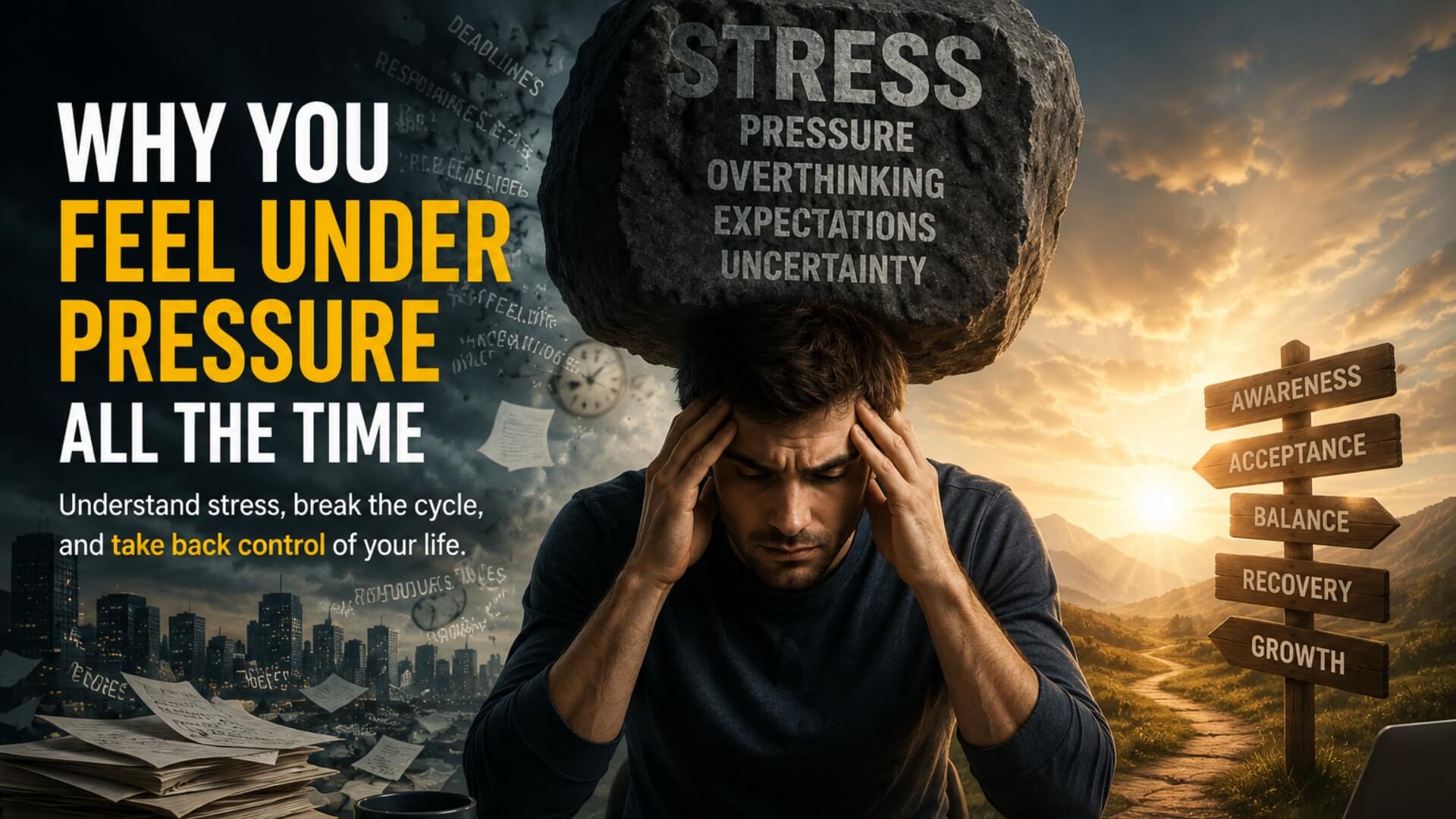
Many people ask, “Why do I feel under pressure all the time?”
The answer is rarely one major event. More often, stress develops through the accumulation of smaller pressures, constant mental activity, unresolved emotions, uncertainty, and insufficient recovery.
Stress affects both the body and the mind. It changes breathing, muscle tension, concentration, emotional reactions, and the way we interpret everyday situations.
Understanding how this system works is the first step toward managing stress more effectively instead of simply reacting to it.
But what is stress, really?
Most people think of stress as external pressure.
Too much work.
Too many responsibilities.
Too many problems.
In reality, stress is much more than that.

Stress is a system involving the body, the mind, emotions, and the way we interpret what is happening around us.
Until you understand how that system works, you will keep reacting in the same way, again and again.
What Stress Really Is
In the first phase, it is often a feeling of pressure that is difficult to describe precisely.
It manifests differently in each person, but certain patterns are common.
How the Body Responds to Stress
The body reacts.
The heart rate increases.
Muscles tense.
Breathing changes.
How the Mind Interprets Stress
At the same time, there is a psychological layer.
The mind interprets the situation based on past experiences.
Two people can stand in the same situation.
One will experience stress, the other will not.
Acute Stress vs Chronic Stress
An important distinction must be made between acute and chronic stress.
Acute stress is short-term.
It appears in specific situations, before a performance, a meeting, or a decision.
Once the situation passes, the body returns to balance.
Chronic stress is different.
It is a state in which the body remains activated for a prolonged period without proper recovery.
There is no clear switch back to calmness.
Most people see stress as something negative, but that is not entirely accurate.
Stress also has a function.
Without a certain level of activation, there would be no focus, no action, no movement forward.
A moderate level of stress can sharpen attention and prepare you for a challenge.
The problem begins when stress is no longer connected to a specific situation, but becomes a constant background state.
Then it no longer serves as a tool, but begins to create damage.
Not only physically, but also mentally.
Irritability, fatigue, and loss of concentration.
The second problem is management.
If a person does not know how to recognize that they are under stress or how to regulate it, everything begins to accumulate.
Coping Mechanisms: How You Respond to Stress
Most people do not collapse from a single great event, but from the long-term accumulation of smaller pressures.
It is not about whether you have stress, but what you do with it.
Adaptive Coping Mechanisms
Adaptive mechanisms are those that help in the long term.
Mindfulness means being aware of what is happening inside you without immediately reacting.
Breathing techniques help calm the body, which, in turn, affects the mind.

Physical activity releases tension.
Time management reduces the feeling of chaos.
Support from others reduces feelings of loneliness.
Maladaptive Coping Mechanisms
Maladaptive mechanisms, on the other hand, work only in the short term.
Avoidance means you avoid the problem, but it does not go away.
Substance use, alcohol, or other things give you temporary relief, but in the long term, they increase the problem.
Denial means that you do not even admit to yourself that you are under stress.
The key difference is that adaptive mechanisms reduce stress in the long term, while maladaptive ones postpone it or increase it.
When Stress Becomes a Lifestyle
What I want to emphasize above all is that, today, it seems to me we are all under stress. Of course, positive stress is not wrong, but even that must not be excessive.
A good example of positive stress that can still be overwhelming is something I myself did for decades. I often worked ten to twelve hours. Then I came home and went to a sports activity, which, for the body, was usually very stressful.
When Exercise Becomes Another Source of Pressure
So I went from one kind of stress, work stress, into sports stress. I went cycling, running, playing football, or hockey.
Although I was releasing some adrenaline, I was still under enormous stress from the sports effort and tension.
I wasn’t jogging. I was seriously working on my sports practice. I practically never went into sport in the sense of relaxation, to run an easy few kilometers or do a few stretches, and calm down.
Quite the opposite.
I always ran for a result.
I always wanted to achieve something more.
And of course, that increased the stress even more.
Why Recovery Requires Practice
Many people understand that recovery is important, but far fewer treat it as a skill that must be developed.
Slowing down, calming the mind, and allowing the nervous system to recover do not happen automatically after years of chronic stress. Just as the body adapts to constant pressure, it also needs time and consistent practice to learn how to relax again.
On our website you can find many meditation techniques with conceptual explanations.
Things are explained.
The practice is described.
The difficulties that appear there are also discussed.
Do not think for even a second that you will sit down to meditate and the world will lie in the palm of your hand. Hours and hours of training are needed for certain things to begin moving.
That is simply the price of personal growth and spiritual progress.
You must realize that for years, or even decades, you have been collecting certain thoughts, emotions, patterns, and situations. All of that has accumulated inside you.
If you have never let this surface, all that sludge will need to come out first.
Only after that has, at least to some extent, come up from the depths of our subconscious will cleansing and stress regulation slowly begin.
This is a long-term process.
It depends on the individual, the situation, and how tightly everything is caught in a loop. But I can certainly promise you that the results will become visible fairly soon if you work persistently on stress and its management.
Why Change Creates Stress
Results probably won’t be immediately visible to the people around you, because they experience you as you are.
Even when you change, they will not notice it quickly.
Even when they do notice the change, or when you ask them, “Have I changed?”, they will disinterestedly say, “Oh yes, you did.”
Why Other People Resist Your Change
People don’t like change.
They don’t like others changing, even when that would benefit them.
It is how our brain functions. We want what is known. Change is unknown and unpredictable. Therefore, the brain is avoiding it.
In my case, it sometimes took years for people to see that I had changed. Interestingly, even though I had changed for the better, they often did not even like it.
Everyone loved the old Mark with all his flaws.
Just don’t change. Now you have changed somehow. People think subconsciously, now he thinks he is more than us. Will we also have to change? That is how our brains work.
There is nothing wrong with that, but the people around you who do not want to change and who want to remain with you in the same old stories can now pull you downward.
That is why, in this phase, certain people will need to be let go, or you will need to spend less time with them.
The one who does not grow with you will often pull you down. And those can be wonderful people. Wonderful friends. With whom you have understood each other very well for decades and functioned very well.
Yet the time for separation has still come.
With love.
With respect.
With the recognition that every relationship ends one day, if not earlier in some other way, then through death.
I would not advise you to let your relationships end only through death. Do not be so cowardly.
Be brave.
Tell people you have changed. Tell them you are different. When necessary, tell them you no longer feel the relationship the way you used to. This can be done more directly or more gently, if that is hard for you.
If it is too stressful for you to handle these situations directly, or if you are not yet ready for them, handle them more gently.
With small withdrawals.
Less communication.
With the explanation that you need your peace. Then it is not about them, but it is about you. Of course, they will still experience it as being about them, but that then becomes their problem.
Inner restlessness is the next thing associated with stress, but it is not only stress or anxiety. It is a state in which body and mind are not in harmony.
Outwardly, you may look calm, but inside, everything keeps running as if it cannot stop.
It is a very exhausting state.
What Happens When Stress No Longer Controls You
Uncertainty and the anxiety connected to it often appear when we are trying to change old patterns.
This is where the real difficulty begins.
We do not yet know the new state, and we are not used to it. The old situation is familiar, even if it is unpleasant. The transition from the old to the new, therefore, creates uncertainty, anxiety, and ambivalence.
We cannot decide.
We are not sure whether we are doing the right thing. For example, we want to change jobs but do not know where to go. Or we want to lose weight and have already started, but the first problems appear very quickly.
And then the change comes
When awareness and understanding overcome stress, a transformation begins. It’s no longer a constant struggle, but a conscious choice.
With each mindful step, things start to shift. Investing in calm isn’t a battle anymore; it’s a way of living.
This is the moment where effort starts yielding results. Stress fades, control grows, and harmony becomes natural.

This is what it looks like when the system no longer runs you.
The process is not always fast. It doesn’t come in a bang but through determination and persistence.
Why Chronic Stress Keeps You Stuck
A whole cluster of thoughts and emotions arises, preventing us from moving from point A to point B.
I can tell you from personal experience, this is one of the hardest situations a person can face.
You want to change something. You know it is good for you. At the same time, it brings enormous pressure on the mind, body, and psyche.
Anxiety in the body.
Ambivalence in decision-making. People around you are giving advice, while the real answers are inside you. The longer this transition lasts, the harder it becomes to endure. That is why people give up.
In weight loss.
In addictions such as cigarettes, drugs, or alcohol.
I can speak about this from my own experience.
I had many unhealthy habits, even certain addictions. The transition from point A to point B is not a simple battle. It is brutal. The pain, uncertainty, and fatigue that come with such a transitional state, which can last five or even ten years, are endured by only a few.
To everyone who perseveres in those difficult moments, whether it is addiction, loss, or any major life change, I will always respect them for their courage, even if in the end they do not succeed.
But there is one essential point here. It is not important whether you win in the classical sense.
Only one thing matters.
That you do not give up.
The moment you decide, at a deep level, that you will not give up, you have already won. You do not overcome addiction by being perfect for ten or twenty years. You overcome it in the moment of decision, when you commit to never stopping trying to change.
In weight loss, sport, or business, people do not fail because they can’t do it.
They fail because they give up. I know this very well, because I gave up more times than I would like to admit, until I understood that the goal is not a perfect victory, but persistence.
Most successful people did not succeed because of extraordinary ability, but because they stayed in the process longer than others.
In the face of uncertainty, there is often a strong connection to control.
The mind wants to solve the situation.
Achieve closure.
Reduce risk.
How the Mind Creates Pressure
The mind will do everything in its power to protect you in the best possible way.
In doing so, it often generates many thoughts. These thoughts trigger emotions and bodily responses.
Those then feed back into the mind, creating new thoughts. A vicious circle forms. A loop of thoughts and emotions that keeps spinning without a clear end.
A person becomes stretched between the past and the future.
The past appears as events that have already happened. The future as projections of what might happen. In this space, countless scenarios arise.
Most of them negative.
Repetitive.
Endless.
How to Manage Stress More Effectively
Recognize Your Stress Signals
Notice recurring signs such as muscle tension, shallow breathing, irritability, racing thoughts, fatigue, or difficulty concentrating.
Build Recovery Into Your Day
Sleep, quiet time, walking, movement, and regular breaks help prevent stress from becoming a constant background state.
Focus on What You Can Control
Pressure often grows when attention remains fixed on uncertainty, other people’s reactions, or outcomes outside your influence.
Use Healthy Coping Mechanisms Consistently
Mindfulness, breathing exercises, physical activity, planning, and support from others work best when practiced before stress becomes overwhelming.
Accept Discomfort Without Reacting Immediately
Not every uncomfortable feeling requires immediate action. Learning to pause gives the body and mind time to settle.
The Way Out Is Understanding, Not Avoidance
The goal is not to eliminate every source of stress from your life. That is neither realistic nor necessary.
The goal is to understand what is happening inside you before pressure automatically controls your thoughts, emotions, and actions.
Stress will remain part of life.
But it does not have to become your permanent internal state.
The moment you stop running from discomfort and begin observing it with awareness, something slowly changes.
You become less reactive.
Your body begins to recover.
Your mind becomes clearer.
And pressure gradually loses the power it once had over you.