
Why This Question Feels So Difficult
When I first heard the question “Who are you?”, it did not mean much to me.
I think it was Sadhguru who first asked that question, or at least that is where I first encountered it. Later, I heard the same question from many other spiritual teachers and authors.
“Who are you?”
And honestly, I did not understand it.
I always felt that it was some kind of spiritual question, connected to meditation, enlightenment, higher consciousness, or something similar.
It seemed like one of those deep spiritual questions that had little to do with ordinary life.
But the interesting thing was that the question kept appearing.
Again and again.
“Who are you?”
And every time I heard it, I felt I was missing something.
Years later, I came across the Yoga Sutras of Patanjali. There, the topic was explored in greater depth through discussions about the self, identity, ego, consciousness, and the deeper dimensions of human existence.
Yet even then, I was not entirely sure what these teachers were trying to point toward.
The more I studied the topic, however, the more I realized that they were not really asking about my profession, achievements, education, social status, or any of the roles I play in life.
They were asking something much deeper.
Something that most of us rarely stop to think about.
Who are you beyond your titles, roles, achievements, and everything else you have built around yourself during your lifetime?
The Identity You Built vs. The Person You Truly Are
When we are born, we do not have a profession, a reputation, a social status, or a carefully constructed identity.
Those things develop gradually throughout our lives.
Every experience, relationship, achievement, and responsibility adds another layer to the way we see ourselves until, over time, we begin confusing those layers with who we actually are.
People identify themselves with the roles they play in life.
Whether that is a lawyer, an attorney, a plumber, a manager, a professor, an entrepreneur, a coach, or something else.
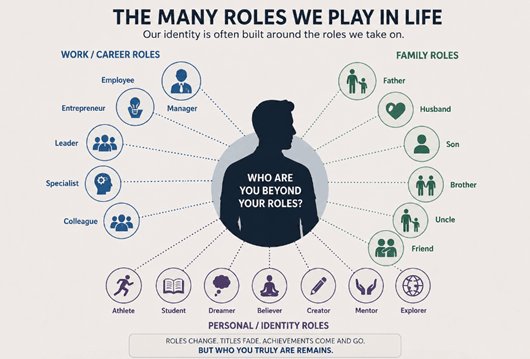
At the same time, we identify with many other things.
Father.
Mother.
Husband.
Wife.
Athlete.
Intelligent.
Funny.
Spiritual.
One person can play dozens of roles during a lifetime.
And slowly, these roles begin creating what we call identity.
Childhood
These roles appear much earlier than most people think.
As children and teenagers, we already begin collecting them.
You can become a good student.
A good athlete.
An excellent pupil.
A good friend.
A good son.
A good daughter.
A good brother or sister.
During adolescence, many of these identities are already formed.
And because they arrive so early, we usually never question them.
We simply accept them as part of who we are.
Early Adulthood
Then adulthood arrives.
And the roles keep accumulating.
You become a student.
You finish school.
Maybe you earn a degree, a master’s degree, or a doctorate.
You get your first job.
Your first serious relationship.
A boyfriend.
A girlfriend.
A husband.
A wife.
As the years pass, you become better and better in certain areas of life.
And the areas where we perform well are usually the areas where we identify most strongly.
Those roles slowly become part of us.
Or at least part of what we believe ourselves to be.
Midlife
In midlife, most people’s focus is centered around work, family, and a few hobbies.
Many of us know the feeling of repeating the same cycle for years:
Work.
Home.
Family.
Children.
Then back to work again.
This cycle often continues for twenty or thirty years.
During that time, success may arrive.
Career success.
Business success.
Financial success.
Social status.
And every one of those achievements adds another layer to the identity we have been building since childhood.
Later Life
Eventually, the final phase of life begins.
You slowly start withdrawing from work.
Retirement approaches.
Grandchildren arrive.
Friends start getting older.
Some begin passing away.
Life becomes calmer.
And many of the roles that once seemed extremely important slowly lose their significance.
When Roles Become Identity
If we look at all these stages together, we can see that by the age of sixty, a person has accumulated an enormous number of roles and identities.
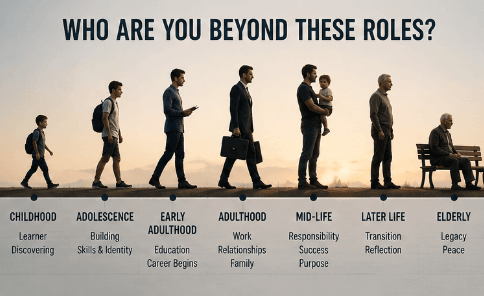
The process starts almost at zero.
Then, decade after decade, new roles are added.
And together, they create what we call identity.
But now comes the important question.
Who are You in those roles?
Are you the father, lawyer, athlete, entrepreneur, brother, husband, coach, or manager?
Or are those simply roles that you play?
Most people identify completely with these roles.
Very few stop and ask:
Who is the person underneath them?
What Happens When Life Takes Those Roles Away
Sooner or later, something happens that nobody likes, nobody expects, and everybody tries to avoid.
Life intervenes.
Something comes and throws you out of balance.
It can be an illness.
An injury.
A divorce.
The loss of a job.
Your children grow up and leave home.
A business collapses.
Friends leave.
Or somebody dies.
Sooner or later, some event arrives.
Sometimes it is one big event.
Sometimes it is a series of events that slowly breaks down the life you have built.
Personally, I have experienced both.
Powerful shocks that changed the direction of my life, and also periods where several difficult events accumulated over time.
This happens to all of us.
There are no exceptions.
Of course, from our perspective, it often looks as if our suffering is greater than everybody else’s.
But that is usually perception.
We know our own pain intimately.
We do not know the pain other people carry.
When Life Takes Away the Identity You Built
What happens when life takes away the identity you spent twenty, thirty, or forty years building?
Nothing unusual.
Emptiness appears.
Questions appear.
Many questions.
You suddenly find yourself in unfamiliar territory.
Anxiety can appear.
Depression can appear.
Confusion can appear.
The bottom line is simple.
You enter a new period of life.
A period that is uncertain, uncomfortable, and often painful.
A period that requires work.
A lot of work.
Of course, some people suppress everything and pretend nothing happened.
Others face reality more honestly.
But regardless of the path, this is usually a period of pain, suffering, transition, and change.
Why Some People Grow While Others Stay Stuck
What happens next is different for every person.
Some people come through the experience stronger.
They process what life brought them.
They learn what they came here to learn.
And they move forward.
Others remain somewhere in the middle.
Partly changed.
Partly stuck.
And some never make the transition.
For them, the crisis becomes a permanent state.
Sometimes that leads to severe depression.
Sometimes to addiction.
Sometimes to self-destruction.
And sometimes to tragedy.
That is why one of the most important questions is not whether difficult periods will come.
They will.
The real question is:
How Do You Move Forward After an Identity Crisis?
There is no simple answer to this question.
Every situation is different, and every person is different.
What is important to understand, however, is that there is always a way out of a difficult situation.
It may be hard, painful, exhausting, and full of obstacles, but there is a path forward. And in my experience, the only thing that truly moves us forward is action.
Sitting and waiting is usually not enough. Time alone does not heal. Time certainly helps things settle and gain perspective, but some form of action is still required.
If you do not want to remain depressed, you seek help.
You talk to a psychiatrist, a therapist, or a trusted friend. You start exercising, moving, reading books, listening to lectures, or learning from people who have already walked a similar path.
Today, information and support are available in enormous quantities.
Almost any action that moves you toward the person you want to become can help. The goal is usually simple: to get through the difficult period, to come out stronger on the other side, and not to give up halfway through the journey.
Why Most People Avoid This Question
It is hard to face our fears.
It is hard to face ourselves when we are struggling.
Some people manage; some don’t.
There is no judgment of anybody; there is only the question of whether you can help somebody in that situation, or you can ask for help if you are in such a situation.
And asking for help is hard.
We all know that.
But it is doable.
Just have faith.
Because We Fear the Answer
Most people never seriously ask themselves who they really are.
Not because the question is difficult, but because the answer can completely change the way they see themselves.
For most of my life, I never asked who I was beyond being a son, a student, a police officer, a lawyer, a husband, a father, or, later, a coach.
Life was moving forward; there was always another goal, another project, and another responsibility. As long as things are moving, you rarely stop and ask deeper questions. But sooner or later, life slows you down, and then the question appears: Who am I if all these roles disappear?
Most people do not avoid that question because it is wrong; they avoid it because it is uncomfortable.
The Ego Does Not Like Being Questioned
The ego likes certainty.
It likes knowing who it is, or at least who it believes itself to be. It becomes attached to titles, achievements, status, success, and recognition because these things help create a clear image of ourselves.
The problem begins when somebody asks, “What if you are not any of those things?”
That is where resistance appears.
Because if I am not my profession, my success, my reputation, or my achievements, then who exactly am I?
Silence Removes the Distractions
One reason many people struggle with silence is that it removes distractions.
When everything becomes quiet, there is nowhere left to run.
No meetings, no emails, no phone calls, and no roles to perform.
Only you.
And for many people, that can be uncomfortable because questions, doubts, old wounds, and unfinished stories surface. Sometimes, silence reveals something much deeper that has been patiently waiting beneath all the noise.
How Do You Discover Who You Really Are?
Spend Time Without Performing
For much of life, we are constantly performing a role.
Employee.
Leader.
Parent.
Partner.
Friend.
When you spend time alone, without trying to meet anyone else’s expectations, you begin noticing what remains when those roles become quiet.
Notice Which Labels You Defend Most
Pay attention to the labels that trigger strong emotional reactions.
When someone questions your intelligence, your career, your parenting, your success, or your beliefs, notice how quickly you become defensive.
Very often, the labels we defend most fiercely are the ones we have mistaken for our identity.
Ask Better Questions
Instead of asking:
“What do I do?”
Ask:
“What remains if this role disappeared tomorrow?”
“What qualities would still be part of me?”
“What would never change?”
Those questions begin shifting your attention from external identity toward something deeper.
Practice Self-Observation
One of the most powerful habits you can develop is simply observing yourself.
Notice your thoughts.
Notice your emotions.
Notice your reactions.
Notice the stories you repeatedly tell yourself.
That observation gradually creates distance between the observer and the identity the mind has constructed.
And that brings us to one of the oldest teachings on this subject.
Meeting the Person Beneath the Roles
It is all connected.
The second Yoga Sutra of Patanjali says that the essence of yoga is observing and mastering the mind’s movements.
A person who becomes skilled at this practice eventually gains clarity about many things in life.
Then comes the third Yoga Sutra:
“Then the seer abides in his true nature.”
The idea behind the Yoga Sutras is that by observing the mind deeply enough, we gradually move beyond the surface layers of our existence.
Beyond the mask.

Beyond the outer look.
Beyond the mind.
Beyond the roles and identities we have built.
The observer first watches the mind. But eventually, according to Patanjali, the observer begins to see something deeper.
Only then does the observer see his true self.
Of course, this is not something that happens overnight.
For most people, it is a process that takes years, perhaps even decades.
But the theoretical foundation is there.
And that is precisely the point.
To begin understanding that our identity is not necessarily who we truly are.
Or at least to begin questioning it.
Because if we spend our entire lives identifying with our roles, titles, achievements, and labels, we may never stop to ask the most important question:
Living Beyond Your Roles
When you finally reach the point where you begin to recognize yourself more than your roles, life starts to change profoundly.
Many things that once seemed important become trivial, unimportant, uninteresting, or simply unnecessary.
The roles you identified with for most of your life begin to appear in their proper perspective, and you no longer cling to them so tightly.
And that is the whole point.
Beneath the entire identity that has been built over many years and decades lies a very simple human being, or if you prefer, a soul.
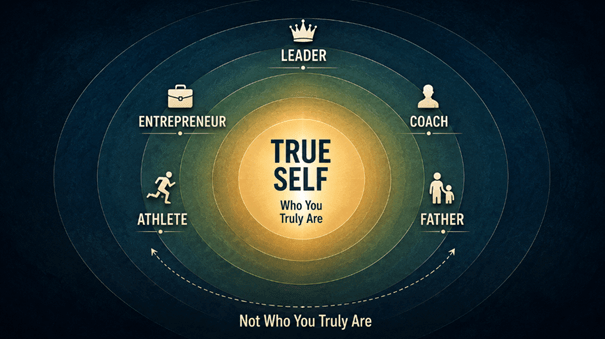
A soul that, in its essence, is no different from any other soul in this world.
Pure, unburdened, without expectations, without desires, and without attachments.
And perhaps that is the part of us that continues the journey.
The sooner you realize this, the better.
Very few people come to this understanding during their lifetime, but believe me, it is worth trying.
Your Roles Are Part of You, Not All of You
Your profession may change.
Your family responsibilities will change.
Your achievements will come and go.
Even your body will change over time.
But none of those things fully define who you are.
They are roles you play.
Experiences you have.
Responsibilities you carry.
Not your entire identity.
The more tightly we cling to our titles and achievements, the more frightening change becomes.
The more we learn to see them as temporary expressions of life, the more freedom we experience when life inevitably changes.
Perhaps that is why so many spiritual traditions continue asking the same simple question:
Who are you?
Not because the answer is easy.
But because it may be the most important question you ever ask yourself.