Most people think procrastination is a discipline problem.
They believe they lack focus, structure, or willpower.
So they try to fix it with systems, productivity hacks, and better planning.
And for a short time, it works.
Then something happens.
You sit down to start.
You know exactly what to do.
Nothing is unclear.
This is the same pattern described in Why You Know What to Change – But Still Stay the Same, where awareness exists, but action still does not follow.

“Procrastination is often driven by emotional resistance, avoidance behavior, and decision paralysis rather than laziness.”
And still… You don’t move.
Not because you are confused.
Not because you are incapable.
Because something inside you resists.
This is the part most people never look at.
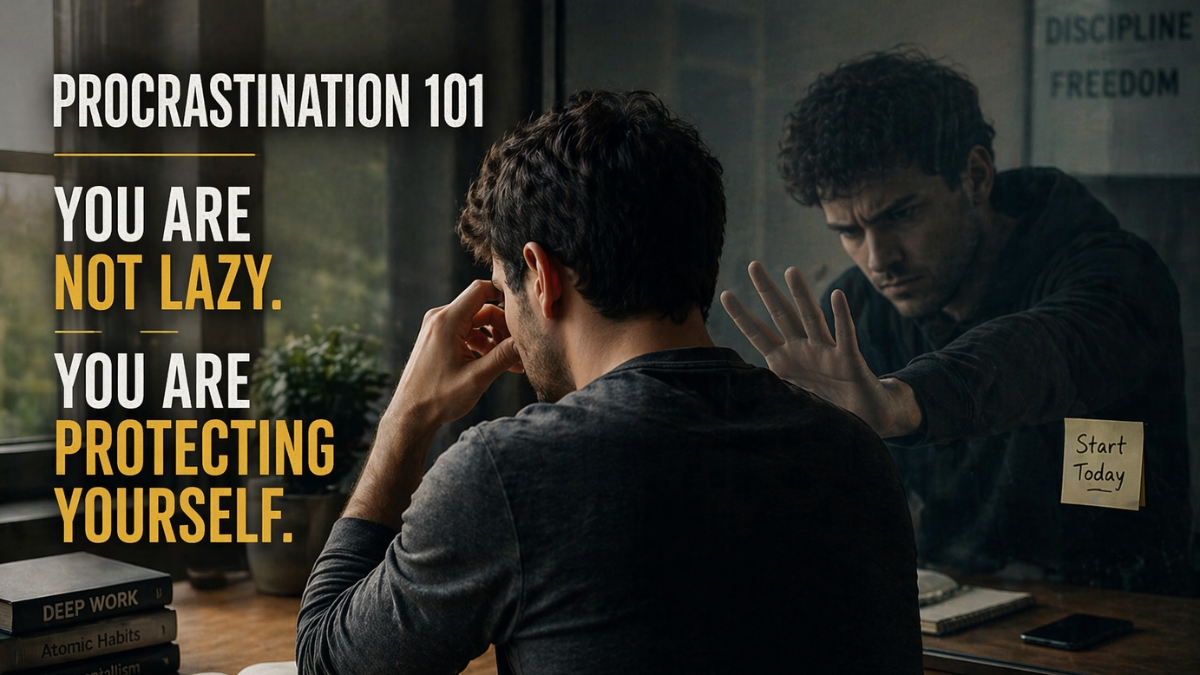
Procrastination is not laziness.
It is protection.
This is the real answer to the question many people ask: why do I procrastinate even when I know what to do?
Why Do We Procrastinate (Even When We Know Better)?
People experience procrastination differently, and we respond to it in different ways; some of us delay more than others. Usually, however, we all have certain tasks or activities we do not like to do. Therefore, procrastination is an option or default.
Personally, I tend to complete tasks that are moderately difficult or moderately unpleasant very quickly. Some very difficult tasks, I do immediately.
On the other hand, certain things, such as medical check-ups or shopping that is not very important, I can postpone for months.
This shows that procrastination is not necessarily connected only to the person, but also to the nature of the task itself.
At the same time, some of my clients, including people, procrastinate a lot. This can be seen already in simple things, like text messages, when they do not reply for days or even weeks. They agree to certain meetings or commitments, but then either do not show up or come up with an excuse and apologize.
These are not necessarily irresponsible people, quite the opposite, they can be very responsible, yet still struggle significantly with procrastination.
Those who are aware of this
will approach it more directly,
even though they may still delay.
Others procrastinate unconsciously,
which is the worst case.
They keep delaying indefinitely while justifying their actions.
Why Some People Don’t Even Realize They Are Procrastinating
This last type of person is often not even aware that they are procrastinating, or they acknowledge it in a dismissive way, saying, “Yes, I know I am like this, but that’s just how I am. In other words, buzz off or leave me alone.”
This “leave me alone” attitude usually creates the biggest problems, not only for them, but also for the people around them, friends, acquaintances, and business partners.
In legal and similar fields, procrastination is quite common. The volume of cases is high, and it becomes extremely easy to delay tasks. At the same time, it is very difficult to properly prioritize everything.
Imagine having fifteen cases on your desk that all need to be resolved within a week, while knowing that to do them properly would take three weeks. A similar problem can occur with multiple projects or tasks you have, regardless of the profession. It is the limited number and time that force us to procrastinate.
This creates a constant cycle, almost a vicious circle, and, for this reason, procrastination across different work areas is common.
And this is why many people struggle to stop procrastinating, they do not see it clearly enough to change it.
The Moment Before Procrastination (What Really Happens)
There is always a moment before procrastination.
It is quiet. Subtle. Almost invisible.
You open the document.
You look at the task.
And then, something shifts.

A slight tension in your body.
A thought you don’t fully catch.
A hesitation you cannot explain.
You don’t say: “I am afraid.”
You don’t say: “This matters too much.”
You just check your phone.
You make coffee.
You delay.
From the outside, it looks like a bad habit.
From the inside, it is something else entirely.
This is where procrastination psychology becomes visible.
“Procrastination is not a time management problem, it is an emotional regulation problem.”
What You Are Really Avoiding (It’s Not the Task)
You are not avoiding the task.
You are avoiding what the task represents.
Because every meaningful task carries risk:
- What if I fail?
- What if this is not good enough?
- What if others see this?
- What if I succeed and cannot sustain it?
This is where procrastination begins.
Not in time management.
In emotional exposure.
And most of it comes down to one thing.
The Hidden Layer of Procrastination: Shame and Self-Doubt
Underneath avoidance, there is often a deeper layer.
Not just fear.
Shame.
The quiet belief:
“I am not enough.”
You do not consciously think it.
But it is there.
And when you start something that matters, that belief gets activated.
Because now you are exposed.
Now your work reflects you.
Now it can be judged.
So your system protects you.
It does not say: “You are afraid.”
It says: “Let’s do it later.”
This is how protection works.
It does not feel like fear.
It feels like a delay.
Why Discipline Alone Doesn’t Fix Procrastination
This is why most productivity advice fails.
It treats procrastination as a behavior problem.
So, you get advice like:
- break tasks into smaller steps
- remove distractions
- use time blocks
All of that helps.
But only on the surface.
Because if the real issue is:
emotional risk,
fear of failure,
fear of exposure.
Then no system will solve it in the long term.
You will always find a way to delay.
Not because you are weak.
Because you are protecting something.
Learning to observe these reactions instead of immediately acting on them is part of the same process explained in When Your Mind Finally Slows Down.
The Internal Conflict That Keeps You Stuck
There is another layer most people miss.
Part of you wants to move forward.
Part of you does not.
And both parts have a reason.
One part says:
“This matters. Let’s go.”
The other says:
“This is dangerous. Stay safe.”
So what happens?
You freeze.
You oscillate.
You start and stop.
You plan, but you don’t execute.
This is not laziness.
This is conflict.
This internal conflict is closely connected to the patterns described in Why You Feel Stuck in Life, where invisible limits shape what we believe is possible.
Fear of Making the Wrong Decision
For many people, procrastination is not about action. It is about a decision.
Because deciding means:
- committing
- taking responsibility
- closing other options
And that creates pressure.
“What if this is the wrong path?”
“What if I regret this?”
“What if I lose something by choosing?”
So instead of deciding…
You delay.

You stay in ambivalence.
Because as long as you don’t choose, you don’t lose.
But you also don’t move.
Perfectionism Is a Hidden Form of Procrastination
Perfectionism looks like high standards. As I mentioned earlier, my coworker was a great worker and an exemplary legal expert. But…
Perfectionism is often a fear in disguise.
“If it has to be perfect, I cannot start or finish yet.”
“If it is not ready, I should wait.”
So you prepare.
You think.
You refine.
But you do not execute, you do not finish. Because perfection gives you a valid excuse to delay. It sounds responsible. But it is protective.
Emotional Exhaustion and Mental Overload
Sometimes, procrastination is not fear.
It is fatigue.
Not physical fatigue.
Emotional fatigue.
When you have been:
- under constant pressure,
- making decisions all day,
- dealing with people, conflict, and responsibility.
Your system is already overloaded.
And when you try to start something meaningful…
There is no capacity left.
So you delay.
Not because you don’t care.
Because you are empty.
Loss of Self-Trust and Confidence
There is one more layer.
And it is subtle.
Quite often, I have observed in others and in myself that procrastination is connected to self-worth and self-confidence.
At its core, it comes down to not feeling secure enough in yourself. You are afraid of making mistakes, afraid of doing something only “good enough,” and you believe that if you invest enough time into something, it will become more perfect.
This is closely related to perfectionism.
At the same time, it is also a separate issue, connected to self-trust and self-confidence.
This becomes especially visible in areas we are not yet familiar with, in situations where we are doing something new.
It often shows up in things we do irregularly, or in tasks we strongly resist.
These can be specific areas we do not like, or even an entire set of responsibilities within a job or similar environments.
This is why it becomes an important question to ask:
Where does this lack of self-trust come from, and how do we move forward from there?
How to Stop Procrastinating (Without Forcing Yourself)
If procrastination is a form of protection that prevents us from doing certain things when we are not in the right emotional or physical state, then it can actually be beneficial.
It suggests that the underlying state needs to be addressed first.
As discussed earlier, procrastination is often connected to deeper causes, such as fear, anxiety, a sense of not being enough, perfectionism, and similar patterns.
From this perspective, it is very useful to begin working on these root causes. Only then can we truly move forward and start resolving procrastination itself.
So the real question becomes:
Why do we procrastinate?
Then the solution is not force.
It is understanding.
Not in a soft way.
In a precise way.
WHERE TO START
1. Identify What You Are Avoiding
Not the task.
The emotion behind it.
Ask yourself:
“If I do this, what am I afraid might happen?”
Be honest.
That is where the real work starts.
2. Reduce the Emotional Risk
You don’t need to remove fear.
You need to lower the exposure.
- make the task smaller
- make it private
- allow imperfection
You are not building output.
You are building tolerance.
3. Resolve the Internal Conflict
Both parts of you are trying to help.
One wants growth.
One wants safety.
You don’t eliminate one.
You integrate them.
That means:
move forward, but not aggressively
challenge yourself, but not destructively
4. Rebuild Self-Trust
Start small.
Finish what you start.
Even if it is minimal.
Because consistency builds trust.
And trust reduces resistance.
This Changes Everything
When you see procrastination like this…
You stop asking:
“Why am I so lazy?”
And you start asking:
“What am I protecting?”
That question is different.
It is more honest.
And it leads somewhere.
How to Deal With People Who Procrastinate (Without Losing Control)
The only real way is to set boundaries.
Why Boundaries Are the Only Real Solution
Boundaries can be set in different ways. It is usually not easy. It requires time, willingness, knowledge, and a great deal of engagement.
Especially in a work environment, whether you are in a subordinate or superior position, you can have significant difficulties with such a person.
I have often been in the position of a superior dealing with someone who procrastinated, and in practice, there was nothing I could do except eventually let that person go because of their procrastination.
On a weekly basis, I warned her that she would need to complete tasks faster, that her perfectionism, which was limiting her, could not continue indefinitely, and that it was financially unsustainable.
Despite this, she remained extremely cautious and perfectionistic.
There were situations in which we had cases and business matters at risk, where clients could have lost significant amounts of money; in one case, a person was sentenced to 30 years in prison, and she almost missed filing a Supreme Court appeal.
In extreme cases, you simply have to separate from such a person, especially if there is no progress and working or living with them becomes unsustainable.
How to Set Boundaries Without Losing Control
There are, of course, softer and more effective methods that can influence procrastination.
Setting boundaries through deadlines is certainly one of them.
There is a well-known Latin phrase, dies interpellat pro homine, the term (deadline) warns/summons on behalf of the man, which emphasizes the importance of time.
In a business environment, this means setting a clear deadline for completing something.
If you are in a subordinate position and your superior is a procrastinative person, there is much less you can do. You can ask, you can set boundaries in a limited way, for example: “If you don’t review this matter, I will leave at six.”
Of course, this carries a risk, including the potential loss of your job. But in extreme cases, you would likely want to leave such an environment anyway.
Otherwise, your health will suffer a lot.
What is important to understand is that when you set a boundary with another person, you are also setting a boundary for yourself.
This may mean that you will no longer work or be with that person. It could be a friend, a partner, or even your own child.
I have seen cases where people had to cut off contact with their children for a period of time, until those children realized they could not continue living a certain way.
I am speaking about extreme situations, including substance abuse and destructive behavior.
But the principle remains the same.
Setting boundaries is the key issue.
How exactly to do it is another question, one that requires careful judgment in each specific situation.
Why You Procrastinate (And What Changes Everything)
You are not broken.
You are not undisciplined.
You are not weak.
You are protecting yourself from something that feels real.
Until you understand what that is…
You will keep delaying.
Not because you cannot move.
Because part of you believes you shouldn’t.
If you want to go deeper, this is where real work begins.
Not in productivity.
In awareness.
Understanding procrastination is the first real step toward changing it.
If this landed differently than you expected, that is exactly the point.
Procrastination at this level is not solved with better planning or stricter routines. It is solved by understanding what you are actually protecting yourself from, and that requires looking inward, not at your calendar.
If you are ready to do that work, coaching is where it happens.
You can learn more about working with Coach Mark here.
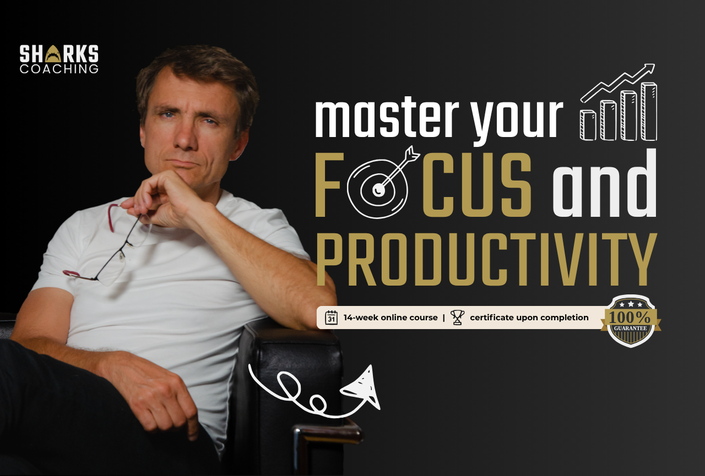
Or if you want to start with something more structured, the Master Your Focus programme was built to address the deeper patterns behind focus and performance.