

Most people think they want a quiet mind.
They imagine peace, clarity, relief.
What Happens When the Mind Slows Down (A Real Experience)
For a long time, I believed I was in control of my thinking. That I was choosing when to analyze, when to focus, when to stop. It felt like a skill I had built over the years. But what I didn’t see was this. I was not just using my mind. I was used to it. Constant thinking had become my normal state.
That became very clear when I stepped into a completely different environment.
A Vipassana meditation retreat.
Ten days in silence.
No phone, no books, no talking, no external input.

Just you and your mind. For someone used to constant thinking, this is not peaceful at the beginning. It is intense. The mind keeps running, producing thoughts, analysis, and commentary. It does exactly what it has been trained to do.
But after a few days, something starts to change. The volume drops. Not completely, but noticeably. The constant stream of thoughts slows down. And what surprised me the most was not the silence itself, but my reaction to it. It felt unfamiliar.
Almost uncomfortable.
As if something was missing. I was so used to thinking, analyzing, and processing that the absence of it did not feel like relief. It felt strange.
The First Shift: Realizing You Are Not in Control
That was the first real shift. I did not have as much control over my thinking as I believed. I was simply used to it. And there is a big difference between the two.
As the days continued, another layer became visible. Thoughts still appeared, but they were lighter, less connected. A random thought would come, stay for a moment, and then disappear.
Without effort. Without attachment.
I remember lying in bed and suddenly thinking about something completely trivial,
like a car hook.
It made no sense.
And I laughed.
Not because it was funny in itself, but because I saw how arbitrary the thought was. It came out of nowhere, stayed for a few seconds, and then it was gone.
That experience changes how you see thinking.
Thoughts are more random than you think
Because you start to realize that thoughts are not as solid as they seem. They don’t always carry meaning. They don’t always require attention.
Many of them are just passing mental events. But in everyday life, you don’t see it that way.
You catch them,
you follow them,
you build on them.
And before you know it, one small thought turns into a chain that shapes your mood, your decisions, even your behavior.
Meditation did not give me any mystical insight.
It gave me something more practical.
Distance.
The ability to see a thought without immediately becoming it. And once you experience that, even briefly, something shifts.
You stop asking only how to control your thoughts. You start noticing that not every thought needs to be controlled in the first place.
When Thoughts Lose Their Grip
After a few days, something even more subtle started to happen.
It was not just that the mind became quieter;
It was then that thoughts began to lose their weight.

Before that, almost every thought felt
relevant,
important,
connected to something that needed attention.
Now, many of them didn’t. They still appeared, but they didn’t stay. And more importantly, they didn’t automatically develop into something bigger.
This was a completely different experience from everyday thinking.
Normally, one thought triggers another, and then another. A simple idea becomes a chain, and that chain creates emotion, tension, sometimes even action.
But here, something was missing: continuation.
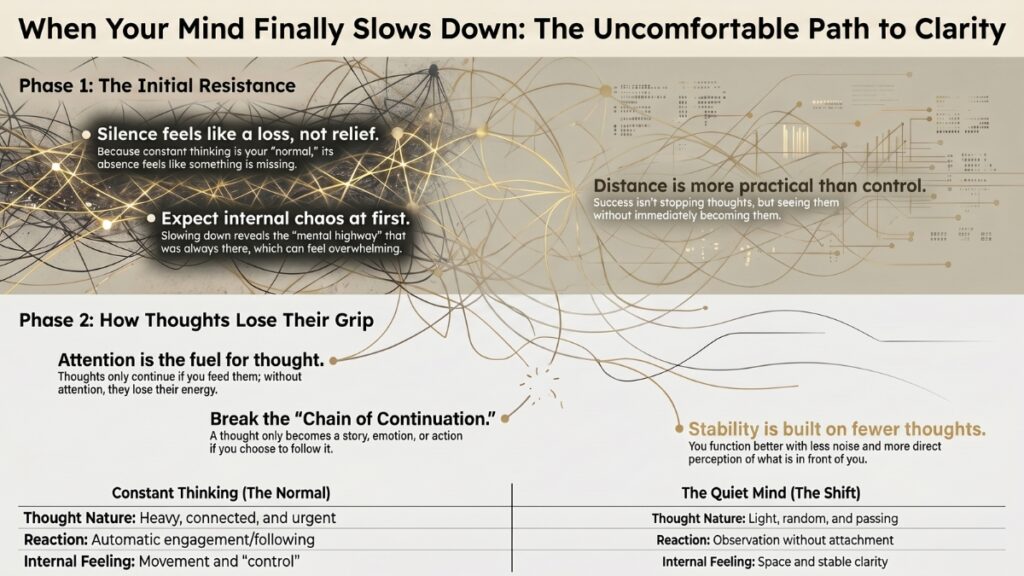
A thought would appear, and instead of turning into a story, it would simply disappear.
Not because I forced it away,
not because I controlled it,
it just didn’t have enough energy to continue.
That was new to me, because for most of my life, I believed that thoughts needed to be followed, developed, and analyzed.
But now it’s clear that most thoughts don’t require any of that. They only continue if you give them attention.
Attention Is What Keeps Thoughts Alive
And this is where something important becomes visible.
The mind not only produces thoughts,
but it also feeds on them.
The more attention you give to a thought, the more real it becomes. The less attention you give it, the faster it fades.
This is not a theory; it is something you can observe directly, even outside of meditation.
A random thought appears. If you engage with it,
it grows. If you don’t,
it disappears.
Simple, but not easy, because most of the time you don’t even notice when you engage. It happens automatically.
And that is why thinking feels continuous. But when that automatic engagement weakens, even slightly, the entire experience of the mind begins to change.
A Mind Without Constant Thinking Feels Empty at First
One of the most surprising parts of the experience was not the silence itself, but the feeling that came with it.
At some point, when the thinking slowed down enough, there was space. And that space did not feel good right away.
It felt empty,
unfamiliar,
almost uncomfortable.
This is something most people don’t expect. They imagine that a quiet mind will bring instant relief, but if you are used to constant thinking, silence feels more like a loss than a gain.
For years, thinking was an activity.
Movement,
control,
direction.
It filled the space.
Without it, there is a sense that something is missing. And this is where many people unconsciously return to thinking. Not because they need to, but because they are used to it. It is similar to sitting in a quiet room after years of constant noise. At first, the silence is not peaceful; it is strange.
But if you stay with it long enough, something begins to shift. The discomfort slowly fades, and what remains is something much more stable than constant thinking.
That stability is not built on more thoughts. It is built on fewer of them. Not because you forced the mind to be silent, but because you stopped feeding every thought that appeared. And in that process, something becomes clearer.
You don’t need constant thinking to function. In many situations, you actually function better without it. Less noise, more clarity, more direct perception of what is in front of you. And that is where a different relationship with the mind begins.
Not based on control, but on understanding.
What This Means in Practice (And Why It Takes Time)
At this point, it is important to say something clearly. Slowing down the mind is not simple, and for most people, it does not happen quickly.
Especially not if you are someone who has spent years thinking, analyzing, building, solving problems, and pushing forward. If you are active, driven, and used to using your mind as your primary tool, then the very thing that helped you succeed will also make this process more challenging.
For twenty or thirty years, or more, you have trained your mind to work at a high level. You have developed it, sharpened it, and relied on it.
In many areas of your life, this has brought results.
Your mind has become like a very effective piece of software, fast, responsive, capable. And now, for the first time, you sit down and try to slow it down.
What happens is not silence.
It is the opposite.
If you have ever tried meditation or any form of mindfulness, you probably already know this.
And if you haven’t, this is what you can expect.
The moment you sit down and
try to calm your thoughts,
it can feel like stepping into chaos,
like standing in the middle of a highway
where everything is moving at once, in all directions.
Thoughts rushing, jumping, overlapping, faster than you can follow them. In that moment, you are not failing. You are seeing the mind more clearly than before.
For many people, this is the first real awareness of what is actually happening inside their head, and it can be uncomfortable.
This is why many people stop. They try once or twice, feel overwhelmed, and conclude that they “can’t do it.” But the reality is different.
This is not a sign that something is wrong. It is a sign that you have finally slowed down enough to notice what was always there. If you have not practiced this before, there is no need to force anything. This is the beginning, not the end. The path toward a quieter mind is neither immediate nor linear.
It takes time,
patience,
and consistency,
sometimes years, sometimes longer, depending on how deeply your patterns are ingrained and how consistently you work with them.
In my own experience, this was not a short process. I started practicing meditation and tai chi more than 15 years ago, and even then, it took time before I noticed real changes. I remember some of the first attempts very clearly.
Sitting still for fifteen minutes felt intense, almost too much. It felt as if the mind was overloaded, like it had too much stored inside and no space to process it.
Looking back now, it makes sense.
At that point, my mind had already accumulated decades of information, reactions, patterns, and constant activity.
Expecting it to become quiet immediately was unrealistic.
Why Slowing Down the Mind Takes Time (Conclusion)
But if you stay with the process, something begins to shift.
Not overnight,
not dramatically,
but gradually.
The intensity decreases, the space increases, and the reaction becomes less automatic.
And that is the key.
Not forcing silence,
but allowing the mind to change over time.
This is not about stopping every thought, but about changing your relationship to them, so they no longer control every reaction and every direction.
So if you are at the beginning of this process, don’t expect quick results. Look for small changes.
Be patient.
Use tools that support you,
such as meditation, mindfulness,
or other practices
that helps you observe rather than react. And most importantly, don’t stop after the first resistance:
Because what feels like difficulty at the beginning is often just the first clear view of how your mind actually works.
And that is exactly where real change begins.