
“Modern life doesn’t just demand your attention, it fragments it.”
This powerful headline says it all.
We are living in the age of constant distraction.
Those times have come.
We are not aware of it, even though we believe we are.
If we truly were, we would be more cautious about what we are doing.
When I run, I have time to observe people.
And what I see is very telling.
I often feel like I am running a giant slalom.
Not because of obstacles, but because of people.
People are absorbed in their phones.
Lost in their thoughts.
Talking on the phone.
Or talking to someone next to them, without real awareness of the space around them.

Not to mention something else.
When people are in a group, they tend to take up the whole path people are walking, cycling, or running on.
They spread out without noticing others, without adjusting, without awareness of the shared space.
You can see it almost everywhere, and it says more than it seems at first glance.
It is very annoying; I won’t deny that.
But I try to relax and mind them as little as possible, because reacting to every situation would only pull me into the same state.
And that is exactly what I want to avoid. Still, that doesn’t change the fact that we are distressed.
That underlying tension is there, whether we admit it or not, whether we slow down enough to notice it.
Observe people on the streets for a day, or even for a week.
You will start to see patterns, not just isolated moments.
Tension, restlessness, distress, and something deeper that most people are not even aware of.
That is why it matters where your attention goes.
Keep your eyes on the life you live, on your own movement, your own direction, your own state.
Not on everything and everybody else, not on devices, people, work, food, dogs, sports.
Because the more you look outward without awareness, the more you lose what is happening inside you.
Why Losing Focus Has Become the Default
In today’s world of constant connectivity, achieving sustained focus and high productivity has become both a rare skill and a real competitive advantage.
We are always available, always connected, always pulled in multiple directions, whether we notice it or not.
For many professionals who have already reached a certain level, the situation becomes even more complex.
They have built businesses, careers, and lives filled with responsibility, decisions, and expectations.
And the problem is usually not a lack of knowledge or experience.
They know what to do.
They understand the game.
But what is missing is something far more subtle.
The ability to focus energy and attention in a world that constantly demands both.
A world where distraction is not an exception anymore. It is the default.The prefrontal cortex plays a key role in
| And when distraction becomes the default, the cost is not just lost time – it is worth understanding why stress and focus loss are the same system under different names, because treating them separately is why most fixes don’t hold. Why stress and focus loss are the same system under different names? |
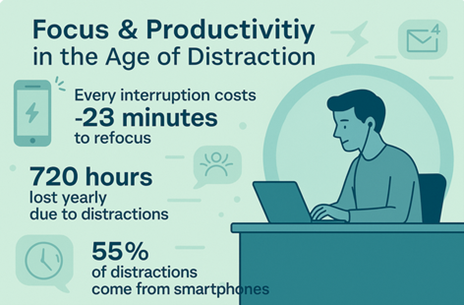
In many cases, focus and productivity are deeply intertwined.
How Focus and Productivity Work Together
The terminology and practical techniques used to improve one’s often
overlap with those used to improve the other.
The essence of focus is the ability to concentrate deeply on one thing at
a time.
Productivity, on the other hand, represents the result, the tangible
The outcome we strive to achieve by maintaining that focus.
It is not always easy to keep productivity and focus in line.
Before Focus and Productivity, we need Planning. Planning is the BASE for any work or activity:

How to Plan Your Day for Better Focus
The essence of planning is simple, but powerful.
As Robin Sharma puts it, “the things that get scheduled are the things that get done.”
The more you plan your actions, the higher the probability that they will actually happen.
When you write down your daily tasks, obligations, and routines, something shifts.
Your intentions become concrete.
Your day gains structure.
And with that structure, your goals stop being abstract ideas.
They become something you move toward, step by step.
That is why I strongly recommend morning planning and evening review.
A simple rhythm, but one that creates consistency over time. If that is not possible, then at least take a few minutes at the beginning of your day.
Review the previous day, and prepare for the one ahead.
Even this alone can make a significant difference. Planning, followed by execution during the day, already creates strong results.
Because you are doing something important. You are training your mind.
You are pushing it out of its comfort zone.
And into a more disciplined, structured way of operating.
What Is Focus?
Focus is the ability to concentrate on a task or goal with clarity and determination. Focus is the cognitive ability to direct attention to a specific task while filtering out irrelevant stimuli.
What Is Productivity?
Productivity, on the other hand, refers to the output of meaningful work within a given period.
Deep Work: Why Focus Creates Real Results
According to Cal Newport, deep focus, what he calls ‘deep work’, is becoming increasingly rare, yet increasingly valuable.
Productivity is not about doing more; it is about doing what matters, with clarity and without interruption.
It plays a crucial role in our daily lives and is essential for achieving success in all areas.
A focused mind allows us to block out distractions, stay present, and make informed decisions.
The Neuroscience Behind Losing Focus
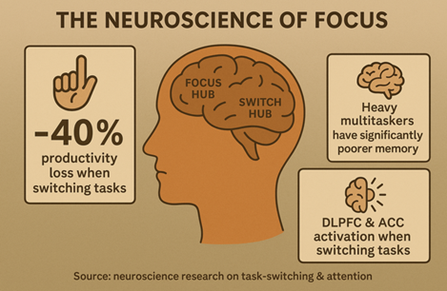
The prefrontal cortex plays a key role in maintaining attention.
It is the part of the brain responsible for focus, decision-making, and control over impulses.
| But it is also the part most exhausted by constant mental analysis, which is why understanding how a constantly analyzing mind accelerates distraction is the missing piece in most conversations about focus. |
Why Multitasking Reduces Focus
When we switch tasks frequently, what we call multitasking, something important happens.
We do not become more efficient.
We actually lose efficiency.
This is known as the “switch cost.”
A cognitive penalty that slows us down every time we move from one task to another.
And the effect is not small.
Studies have shown that it can take up to 23 minutes to regain full focus after an interruption.
Now place this into a modern environment.
A digital world filled with notifications, emails, messages, and constant background noise.
Your brain is never fully at rest.
It stays on alert.
Waiting. Reacting. Switching.
And over time, this creates something many people feel, but rarely understand.
Mental fatigue.
Mental Fatigue: The Hidden Cost of Constant Distraction
I always thought I was highly efficient at multitasking.
But neuroscience says something very different.
In reality, it is one of the worst things we can do.
We constantly shift between tasks, and even if it does not feel like it at first, frustration builds over time.
I did not notice it either.
Not until I started looking into it more.
What I discovered was simple, but very clear.
I was most productive in periods of my life when I worked in a completely different way.
Single tasking.
With zero tolerance for outside distractions.
One Thing, One Focus: The Power of Single Tasking
Years ago, when I was preparing for my bar exam, I made a decision.
A serious one.
I sent an email to friends and family.
I told them not to call me for six months.
If they really had to, it should be after 6 pm.
They did not like it.
But they respected it.
It was not even a polite request.
It was closer to a demand.
And then I did only one thing.
I studied.
The results were exceptional.
But more importantly, I felt good during the process.
Every day had a plan.
Every day I executed it.
Focus on one goal.
Discipline on one task.
Pass the exam.
As I said, research confirms this.
Switching tasks reduces efficiency and increases stress.
Your mind is constantly asking: “What is next?”
What is more important?
What is more urgent?
And there is always something.
But here is the key point.
What you feel as urgency is often not real urgency.
It is a perception.
And very often, it is driven by stress or fear.
I have seen this hundreds of times.
When I worked as a policeman and later as an attorney, people would call me in panic.
Messages, missed calls, requests to respond immediately.
“This is urgent.”
“Please call me now.”
And many times, I reacted.
Until I learned two important lessons.
Lesson No. 1: Most Things Are Not Truly Urgent
First. If something is not burning, if someone’s life is not in immediate danger, or if you are not being arrested, it is usually not urgent.
It only feels urgent to the person experiencing it.
Their internal system is in panic.
For you, it is just another day.
Second.
Most “urgent” situations resolve themselves very quickly.
In my experience, in perhaps 70 to 80 percent of cases, and yes, this is based on experience, not statistics, the problem was gone within hours.
Sometimes even within minutes.
I remember countless situations.
A message marked as urgent.
I call back after thirty minutes.
And the answer was simple.
“Thanks for calling. I already solved it.”
With someone else.
Or on their own.
And I would just say, good for you. Well done.
And they were even proud to solve it themselves when I said that.
Because that is what it was.
A moment of pressure, not a real emergency.
This is something important to understand.
In many cases, it is not reality calling for action.
It is the amygdala.
The part of the brain responsible for fear, reacting loudly.
From years of experience in police work, investigation, and law, I can say this clearly.
Truly urgent situations rarely come with a phone call.
In real urgency, people act first.
They do not analyze who to call next.
I am not speaking about close family or real emergencies.
That is different.
I am speaking about everyday situations, clients, acquaintances, and people on the edge of stress.
And this leads to something practical.
Why Boundaries Protect Your Focus
Boundaries.
Without them, the world will consume your attention. It will pull you into every perceived urgency. And if you allow that, you will be constantly reacting.
Pulled apart.
Distracted.
Boundaries are not selfish.
They are necessary.
Without them, you will be eaten, chewed, and eventually spit out by the very world you are trying to manage.
Listen Instead: The Hidden Cost of Mental Switching
If you prefer to listen or want to go deeper into how constant switching destroys focus and creates mental fatigue, this short audio breaks it down in a practical way.
The Biggest Distractions That Destroy Your Focus
“My pain in daily distraction is my phone.”
The Smartphone Trap
My brain constantly reminds me to check it.
A small impulse.
A quiet signal.
And I try to be clever.
I say to myself, no way.
I am not checking that news.
Not that idea that just popped into my mind.
I push it away.

But then something shifts.
The thought becomes more important.
More relevant.
More convincing.
How can I help my child do better?
How can I surprise my spouse?
How can I improve my training?
Maybe a new idea for cooking…
It all sounds reasonable.
Even useful.
And then the inevitable happens.
We lean into the temptation.
We justify it.
“It will only take a minute.”
It Is Never Just a Minute
Or, if we are a bit more honest, we admit it will take 10 to 15 minutes.
But in reality, it rarely stops there; it stretches, expands, and quietly takes over more time than we planned.
Half an hour.
An hour.
Sometimes even more.
And then the time is gone.
What follows is familiar: frustration, anger, disappointment, sometimes even a quiet sense of sadness, because we know we drifted again.
Does any of this ring a bell?
The truth is, our thinking adapts faster than we expect.
As soon as we say no to the first impulse, a stronger one appears. Then another, and another, each one more convincing, more reasonable, more difficult to ignore.
Usually, the second or third is enough to break us.
If there is no awareness of what is happening in that moment, there is no real way to interrupt the pattern.
We fall back into the same loop, multitasking, reacting, convincing ourselves that we are still in control.
So do not try to outsmart it.
Trust the science. Trust the process.
Step by step, things begin to change, not all at once, but faster than you think.
If this resonated, let’s talk.
If you are a Founder or CEO dealing with constant distraction, loss of focus, or the feeling that your attention is no longer fully yours, this is exactly what I work on with clients.
Book a free call with Coach Mark and find out what is possible.
No pitch. No pressure. Just a conversation.