
Procrastination is the voluntary delay of important work despite knowing the delay will create negative consequences.
Why You Procrastinate on Important Work
Procrastination can affect capable people who care deeply about their work.
The common stereotype suggests that procrastination comes from laziness or lack of ambition. In reality, many people who procrastinate are deeply thoughtful and intellectually engaged.
They think carefully about their work.
They analyze possibilities.
They anticipate potential problems.
This kind of thinking can be extremely valuable when applied at the right moment. But when it appears before action begins, it can create hesitation instead of progress.
The mind begins to simulate outcomes.
What if the result is not good enough?
What if the idea is flawed?
What if the effort turns out to be wasted?
Instead of creating clarity, the thinking process multiplies uncertainty.
At this point, starting the task begins to feel mentally expensive.
And when the mind senses that a task will require significant mental effort, it automatically looks for alternatives that feel easier.
Checking messages feels easier.
Watching a short video feels easier.
Organizing the workspace feels easier.
These activities are not chosen because they are important. They are chosen because they reduce mental resistance.
This is why procrastination is often misunderstood.
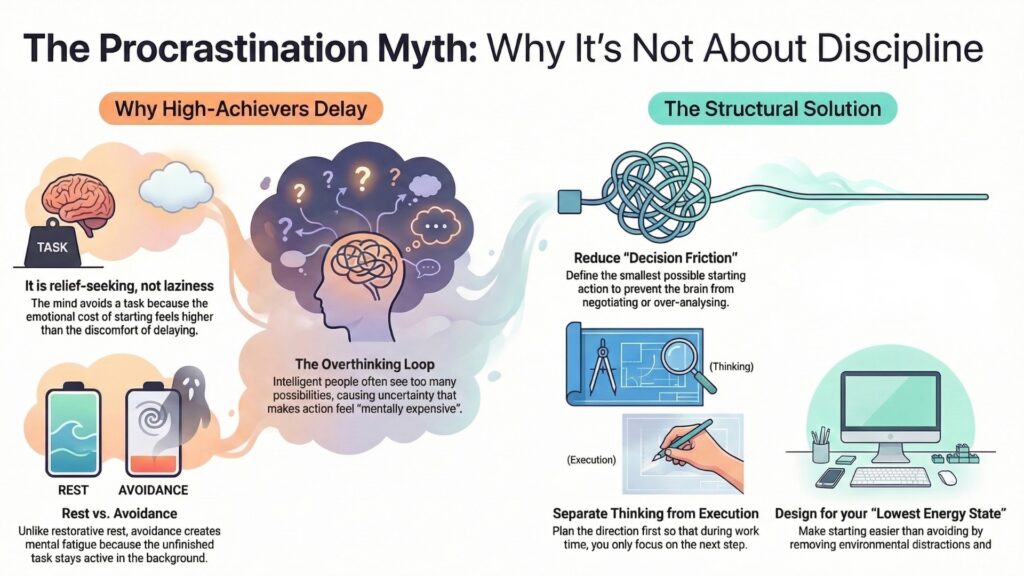
The behavior looks like avoidance. But the mechanism underneath is actually relief-seeking.
The mind is trying to escape the pressure created by the task.
Why procrastination is not laziness
Laziness implies a lack of willingness to work.
Procrastination usually looks very different.
Many people who procrastinate remain mentally occupied with the task the entire time.
They think about it repeatedly.
They worry about not starting.
They imagine how relieved they will feel once it is finished.
The work is not absent from their mind. In fact, it often occupies a large portion of their attention.
This is one of the clearest signs that procrastination is not laziness.
It is internal friction.
The person wants to move forward, but something inside the system is creating resistance.
Understanding how to stop procrastinating requires learning how this friction is created.
The hidden cost of overthinking
Intelligent people often experience another challenge that increases procrastination.
They see too many possibilities.
A task that could be started quickly becomes surrounded by dozens of decisions.
What is the best approach?
Is this the right strategy?
Should more research happen first?
What if a better idea appears later?
Each of these questions may seem reasonable on its own. But together they slow down momentum.
Instead of moving forward imperfectly, the mind begins searching for the perfect starting point.
Unfortunately, the perfect starting point rarely exists.
So the mind postpones action while waiting for clarity.
Ironically, clarity usually appears after action begins, not before.
This dynamic creates one of the most common procrastination loops:
The task feels uncertain → thinking increases → uncertainty grows → action feels harder → avoidance begins.
Breaking this loop requires understanding what procrastination actually is.
What Procrastination Actually Is (and What It Isn’t)
When people ask how to stop procrastinating, they often assume the answer involves forcing themselves to act.
But before solutions make sense, it helps to understand what procrastination really is.
In simple terms, it means postponing something that matters, even when you know doing it later will make things worse.
This definition reveals something important.
Procrastination is not simply a scheduling issue.
If it were, writing a better to-do list would solve the problem.
Instead, procrastination occurs when the emotional cost of starting the task feels higher than the discomfort of delaying it.
The mind compares two experiences:
Starting the task
or
Avoiding the task temporarily
If starting feels mentally overwhelming, the mind selects the easier option in the moment.
Avoidance.
This does not mean the task disappears. It simply means the discomfort is postponed.
But postponing the task introduces a new problem.
The pressure grows.
The closer the deadline becomes, the more stress builds around the unfinished work.
Eventually, the person is forced to act under intense pressure rather than calm clarity.
This is why procrastination often leads to rushed work, anxiety, and self-criticism.
But the most important insight is this:
The mind is not trying to sabotage success. It is trying to reduce discomfort.
When exhaustion becomes part of the picture, productivity techniques may not be the whole answer. Our guide on how to recover from burnout looks at recovery in more detail.
Understanding that mechanism is the first step toward learning how to stop procrastinating.
The difference between rest and avoidance
Another important distinction often gets overlooked.
Rest and procrastination are not the same thing.
Rest happens when a person intentionally pauses activity in order to recover energy.
Avoidance happens when the mind escapes from something that feels mentally uncomfortable.
The two experiences can look identical from the outside.
Both may involve stepping away from work.
But internally, the motivation is very different.
Rest feels restorative.
Avoidance feels tense.
During avoidance, the unfinished task often remains active in the background of attention. Even while doing something unrelated, the mind keeps returning to the work that was delayed.
This creates a subtle form of mental fatigue.
Instead of recovering energy, the person carries the weight of the unfinished task for hours or even days.
Why motivation rarely solves procrastination
Many productivity systems suggest that motivation is the key to solving procrastination.
The idea sounds reasonable.
If people felt more inspired, they would act more quickly.
But motivation is an unreliable driver of behavior.
Motivation fluctuates with mood, energy levels, sleep quality, stress, and environment.
When motivation drops, action becomes difficult.
This is why people often start projects enthusiastically and then struggle to continue once the initial excitement fades.
Learning how to stop procrastinating requires something more stable than motivation.
It requires understanding the structure behind resistance.
The Structural Reason You Keep Procrastinating
To understand procrastination at a deeper level, it helps to observe what happens inside the mind when a difficult task appears.
Imagine opening a project that feels important but complex.
Before any action begins, several mental reactions may occur:
Uncertainty about where to start.
Concern about whether the result will be good enough.
Awareness of how much effort the task might require.
These signals create psychological pressure.
The mind interprets that pressure as a potential threat to comfort.
At this point, the brain activates a simple strategy.
It searches for something easier.
Scrolling through messages feels easier.
Checking email feels easier.
Watching a quick video feels easier.
The task has not disappeared, but the mind temporarily escapes the pressure associated with it.
This pattern forms what psychologists sometimes describe as a relief loop.
Pressure appears → avoidance reduces pressure → avoidance becomes reinforced.
Over time, the brain begins associating difficult work with discomfort and avoidance with relief.
This makes procrastination increasingly automatic.
These reactions are not random. They follow predictable subconscious patterns that we explained in detail in our guide on how the mind works.
Understanding these internal patterns helps explain why procrastination can feel so difficult to break.
The mind is not fighting productivity.
It is protecting comfort.
Until that mechanism becomes visible, most attempts to stop procrastinating rely on forcing behavior rather than redesigning the system.
And forced behavior rarely lasts.
Why pressure increases avoidance
Another important factor is how the mind responds to increasing pressure.
As deadlines approach, many people expect urgency to increase productivity.
Sometimes this works.
But for many people, higher pressure produces the opposite effect.
The task begins to feel even more emotionally loaded.
Fear of failure increases.
Perfectionism intensifies.
Self-doubt becomes louder.
Instead of making the task easier to start, pressure amplifies the resistance around it.
The mind searches even more strongly for relief.
This explains why people often find themselves procrastinating most intensely on the tasks that matter most.
When procrastination becomes a habit
Over time, repeated avoidance creates a learned behavioral pattern.
The brain remembers that escaping from difficult work produces immediate relief.
So when a similar task appears in the future, the avoidance response activates faster.
Eventually, procrastination begins to feel automatic.
Not because the person lacks discipline, but because the brain has learned a predictable pattern of behavior.
The encouraging news is that patterns can be redesigned.
But redesigning them requires changing the structure that produces them.
And that brings us to the most important question.
If procrastination is driven by structural resistance inside the mind, how can that structure be changed?
How to Stop Procrastinating Using Structural Discipline
If procrastination is driven by structural resistance inside the mind, solving it requires adjusting the structure surrounding your work.
Most productivity advice focuses on forcing behavior.
Wake up earlier.
Push yourself harder.
Use more discipline.
But discipline alone struggles when the system itself produces friction.
The more effective approach is to redesign the environment in which action happens.
Instead of fighting resistance directly, you reduce the conditions that create it.
This is where learning how to stop procrastinating becomes practical.
The goal is not to eliminate discomfort entirely. Some level of resistance will always exist when doing meaningful work.
The goal is to make starting easier than avoiding.
When that balance changes, behavior naturally shifts.
Reduce decision friction
One of the biggest drivers of procrastination is excessive decision-making.
When a task contains too many choices, the brain experiences cognitive overload before action even begins.
Questions start appearing immediately:
Where should I start?
Which approach is best?
Should I prepare more before beginning?
Each of these questions consumes mental energy.
Eventually the mind looks for relief by postponing the task.
Reducing decision friction means defining the starting point before the moment of work arrives.
Instead of beginning with a vague instruction like:
“Work on the project.”
Define the first action clearly.
Open the document.
Write the first paragraph.
Outline three key points.
Small clarity dramatically lowers resistance.
When the mind sees a specific starting step, it no longer needs to negotiate.
Action becomes easier.
Make starting easier than avoiding
Procrastination survives because avoiding the task feels easier than starting it.
This balance can be reversed through environmental design.
For example:
If your phone is next to your keyboard, distraction becomes effortless.
If social media is one click away, the brain will naturally drift toward it when resistance appears.
But if distractions require effort, the equation changes.
Place your phone in another room.
Close unnecessary browser tabs.
Prepare the workspace before the task begins.
These adjustments may seem simple, but they change the decision landscape.
The brain often follows the path of least resistance.
If the easiest available action becomes starting the task, procrastination weakens automatically.
Design work for your lowest energy state
Another overlooked factor behind procrastination is energy.
Low-energy days call for a smaller starting point, not a larger promise to yourself.
Most people imagine productivity happening when they feel motivated, inspired, or highly focused.
But these states are temporary.
Real work often happens during moments of low energy.
When energy drops, the mind becomes more sensitive to friction.
Even small obstacles can trigger avoidance.
This is why it helps to design work for the lowest energy version of yourself, not the most motivated one.
Ask a simple question:
“What would make starting this task easier even when I feel tired?”
Sometimes the answer is breaking work into smaller pieces.
Instead of writing an entire report, begin by outlining the sections.
Instead of completing the full analysis, review the first dataset.
Lowering the entry point allows momentum to appear naturally.
Once action begins, energy often follows.
“Energy plays a major role in how easily we start difficult work.
When your mind is overloaded or exhausted, resistance increases and procrastination becomes more likely. This is also why structured evening routines can dramatically improve discipline the following day by reducing cognitive fatigue before it accumulates.”
A Simple Structure to Break the Procrastination Loop
To interrupt the procrastination pattern consistently, it helps to apply a repeatable structure.
This framework focuses on reducing resistance rather than forcing effort.
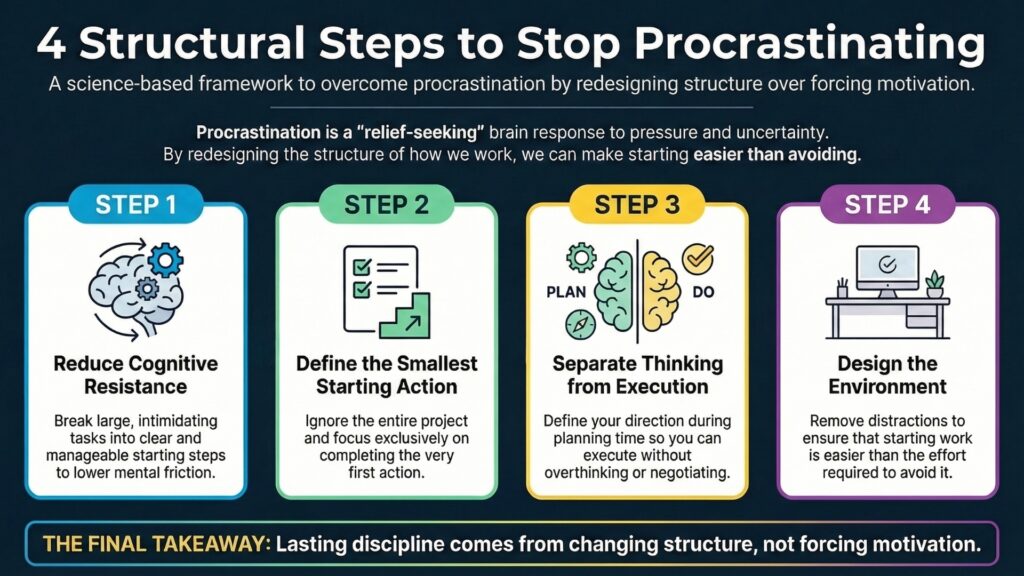
1. Reduce cognitive resistance
Start by simplifying the mental complexity of the task.
Large projects feel intimidating because the mind cannot see a clear starting point.
Break the project into the smallest visible action.
Not the entire outcome.
Just the first step.
The brain finds it much easier to begin when the target is clearly defined.
2. Define the smallest starting point
Many people wait until they have enough energy to complete a large portion of the work.
But action rarely begins this way.
Momentum grows from small beginnings.
Open the file.
Write one sentence.
Review the first page.
These actions appear insignificant, but they break the psychological barrier that keeps the task delayed. Once movement starts, continuation becomes easier.
3. Separate thinking from execution
Another common reason people procrastinate is that they attempt to solve every problem before beginning.
They try to think through the entire project in advance.
This creates mental overload.
A better approach is separating planning from execution.
During planning time, define the direction.
During execution time, focus only on the next step.
This separation prevents the mind from re-analyzing the entire project every time work begins.
4. Create environmental triggers
Habits strengthen when they are linked to consistent environmental cues.
Instead of relying on willpower, attach work sessions to predictable conditions.
For example:
Start deep work immediately after morning coffee.
Begin writing after reviewing your daily priorities.
Schedule focused work blocks at the same time each day.
Over time, these triggers signal the brain that action should begin.
The task stops feeling like a decision.
It becomes part of a rhythm.
Why Fixing Procrastination Is About Identity, Not Productivity
At its deepest level, procrastination is not only about behavior.
It is also about identity.
When a person repeatedly delays important work, they begin forming a story about themselves.
“I always procrastinate.”
“I’m not disciplined enough.”
“I struggle with focus.”
These beliefs gradually shape expectations.
When a difficult task appears, the mind anticipates avoidance before action even begins.
Changing procrastination therefore requires more than temporary productivity strategies.
It requires building evidence that a different identity is possible.
Each small action becomes proof.
Starting the task even when it feels uncomfortable sends a signal to the mind:
“I am someone who begins.”
Over time, these signals accumulate.
The identity slowly shifts from avoidance to reliability.
Discipline becomes easier not because the person suddenly gained more willpower, but because their self-image begins to align with action.
This is why consistent small progress matters more than dramatic bursts of productivity.
Identity changes through repetition.
How Evening Structure Reinforces Daily Discipline
Another overlooked factor in procrastination is how the day ends.
Many people treat evenings as unstructured time.
Work ends abruptly.
Energy collapses.
Distractions take over.
Without a deliberate closing structure, the mind carries unfinished tension into the next day.
This makes important tasks feel heavier before they even begin.
Creating a structured evening routine can reduce this effect significantly.
When the day ends with intentional closure, the mind releases unfinished pressure and prepares for the next cycle of work.
If you want a deeper breakdown of this concept, you can explore our guide on evening routines that create discipline, where we explain how structured evenings support focus and productivity.
Small structural changes across the entire day can gradually weaken the procrastination loop.
Frequently Asked Questions About Procrastination
Why do people procrastinate even when they want to succeed?
Procrastination usually happens because starting a task creates emotional discomfort such as uncertainty, pressure, or fear of failure. The mind temporarily avoids this discomfort by switching to easier activities.
Is procrastination laziness?
No. Laziness suggests a lack of desire to work. Most procrastination happens even when people care deeply about the task. The delay occurs because the brain seeks short-term relief from mental resistance.
Why do smart people procrastinate?
Intelligent people often analyze tasks more deeply. This can increase uncertainty and hesitation before action begins. Overthinking and perfectionism frequently contribute to procrastination.
How can you stop procrastinating immediately?
The fastest way to interrupt procrastination is to reduce the size of the task. Define the smallest possible action and begin with that step. Starting even a tiny action often breaks the resistance loop.
Conclusion
Procrastination is often misunderstood.
Most advice treats it as a discipline failure that can be solved through more motivation or stronger willpower.
But procrastination usually emerges from something deeper.
It is a structural response inside the mind.
When tasks feel uncertain, overwhelming, or mentally expensive, the brain automatically looks for relief.
Avoidance provides that relief in the short term.
Understanding how to stop procrastinating means learning how to redesign the conditions surrounding your work.
Reduce decision friction.
Lower the starting barrier.
Separate thinking from execution.
Create consistent environmental triggers.
These changes do not rely on constant motivation.
They reshape the structure that produces behavior.
And when the structure changes, action becomes easier to sustain.
Procrastination stops feeling like a personal flaw and begins to reveal itself as a solvable pattern.