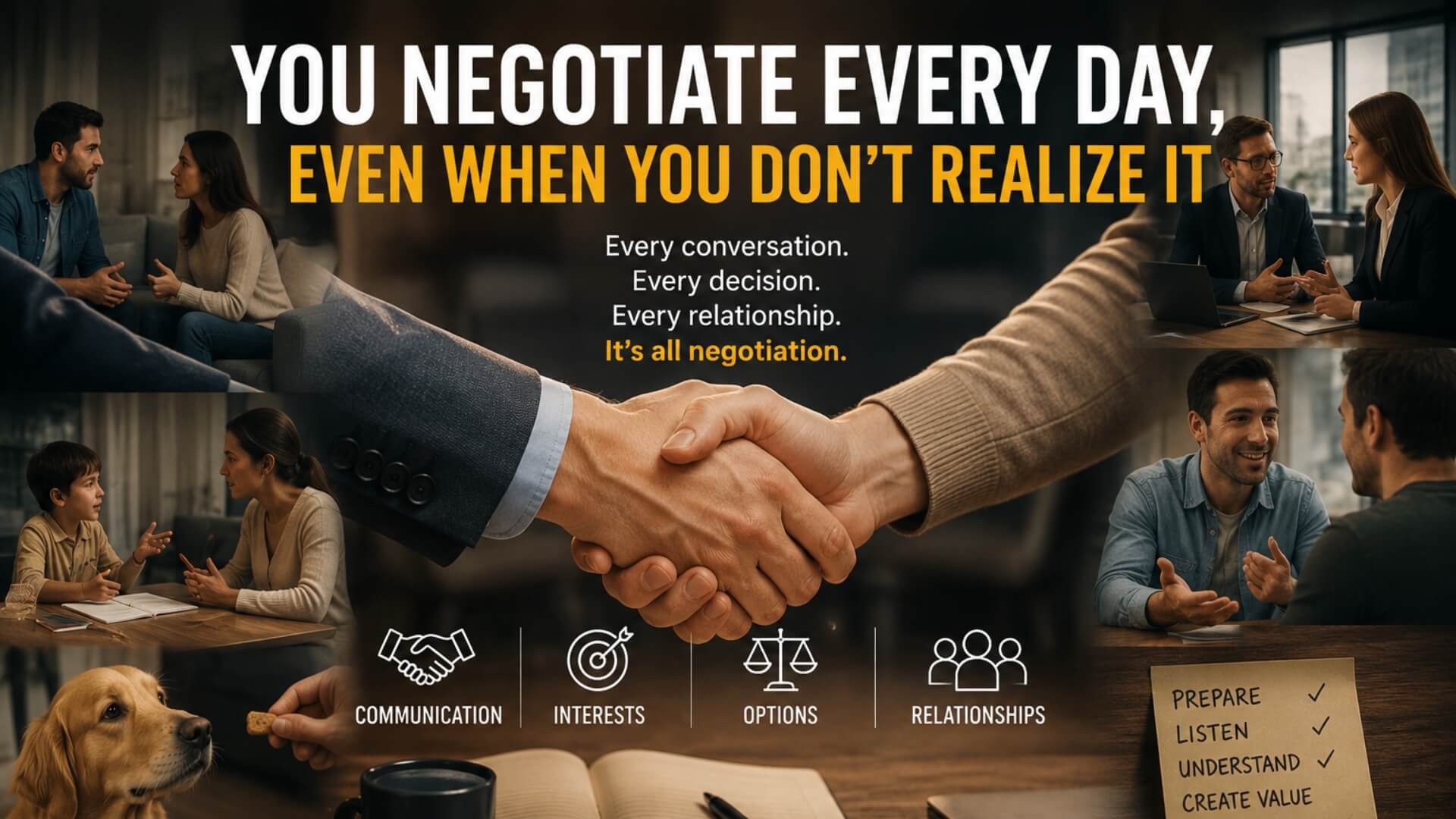
You negotiate far more often than you probably realize.
Not only during business meetings, salary discussions, or legal disputes, but also in everyday conversations with your partner, your children, your colleagues, your friends, and sometimes even with yourself.
Every discussion involving different interests, expectations, or needs is, in some way, a negotiation.
The better you understand how negotiation works, the better equipped you are to communicate, resolve disagreements, protect your interests, and build stronger relationships.
Negotiation Is Already Part Of Your Everyday Life
Most people associate negotiation with business meetings, lawyers, contracts, or high-pressure situations. But negotiation is much bigger than that.

Very often, negotiation is already happening in ordinary conversations and everyday situations without us even realizing it.
We Negotiate More Often Than We Think
Negotiation and mediation share many common features, which is why we are discussing them together.
We negotiate every day, many times a day.
The same applies to communication. Within communication itself, we often use different conscious or unconscious techniques to achieve something through conversation.
Many books have been written about negotiation and mediation.
Personally, I studied at PON, the Program on Negotiation at Harvard Law School, which I highly recommend.
Another very good direction for people who want to deepen their negotiation skills is Chris Voss, his company, The Black Swan Group, and his book Never Split the Difference.
Harvard and Chris Voss sometimes have different approaches.
Both are very good.
In the end, however, our goal here is much simpler.
We want to understand how negotiation appears in everyday life.
Not only in business.
But also in relationships, at work, in friendships, and in ordinary communication.
What Children And Dogs Can Teach Us About Negotiation
Whether we realize it or not, negotiation happens almost everywhere.
You negotiate with your partner, your children, your parents, your friends, and with people at work.
In the end, you even negotiate with your dog.
You look at him and immediately understand his goal.
He wants a treat.

He wants a bone.
And he will continue trying until he achieves his goal.
The same often applies to younger children.
Children and animals frequently negotiate through persistence and patience.
They repeat.
They test boundaries.
They try again.
And as strange as it sounds, there is actually a lot we can learn from them.
What Good Negotiation Really Looks Like
There are many approaches to negotiation. Different people and different schools focus on different techniques and methods.
But the purpose is usually very similar.
The goal is not simply getting what you want.
The goal is to find a way to communicate and move toward a better outcome.
Harvard And Chris Voss, Two Different Approaches
Harvard often focuses more on relationships, interests, and creating solutions that work for both sides.
Chris Voss comes from a very different environment.
For decades, he worked as the FBI’s lead international negotiator in hostage situations and high-pressure crises.
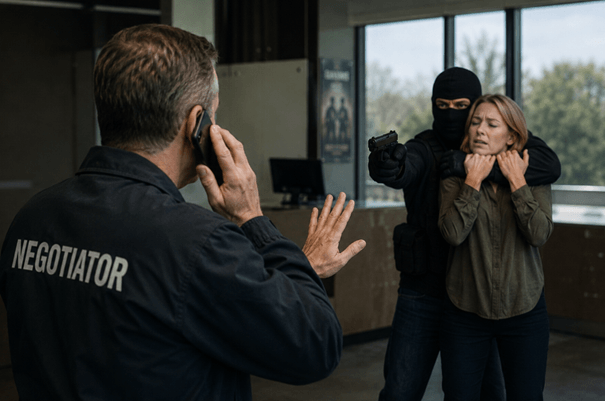
His approach relies much more on tactical empathy, tone of voice, mirroring, labeling, and understanding emotional reactions.
Eventually, he successfully applied these skills in the business and private sectors.
Although the approaches sometimes differ, there is no need to choose one and reject the other.
There is a great deal to learn from both.
Negotiation Skills Become Visible Under Pressure
Negotiation often looks easy while everything is calm.
The real difference appears under pressure.
Stress changes people.
Pressure changes people.
Strong emotions change people.
The true ability to communicate usually reveals itself in difficult conversations, family situations, workplaces, or environments where tension is high.
It is relatively easy to communicate well when everybody agrees.
It becomes much more difficult when emotions, frustration, fear, or strong interests enter the room.
The Psychology Behind Every Negotiation
Before any negotiation starts, there is one important question that many people completely miss.
First, you need to understand which role you are entering the negotiation in. Very often, people immediately start thinking about arguments, emotions, or techniques, while ignoring something much more basic.
Your position itself already changes the negotiation.
Why Your Position Changes Everything
The main difficulty in negotiation is first understanding which role you are in.
- Are you in a superior role, for example, a parent toward a child or an employer toward an employee?
- Are you in an equal role, such as partner-to-partner?
- Or are you in a subordinate role where you have a weaker negotiating position?
This initial rational overview of your role is extremely important.
If you are negotiating from a subordinate position, your starting point will usually be much more difficult.
Your leverage will often be significantly smaller than that of the person who holds more power.
This is where an important psychological moment arises, something I repeatedly used in both law and negotiations.
The question becomes:
“Where is my leverage?”
How can you influence the weak point of a person who appears stronger than you?
Walk-Away Price And Walk-Away Position
Leverage almost always exists.
The second question, however, becomes much more important.
What can we actually do with it, and how can we influence the other side?
There are also situations that are simply take-it-or-leave-it.
And this is where something extremely important comes into play.
You need to establish your own walk-away price or walk-away position.
In simple terms, you should know your limit in advance.
You never have to adapt 100% if the outcome does not truly work for you.
Nobody is forced into that position.
Nobody can force you into it.
Because if you do not have a walk-away price or walk-away position, then you can very quickly become trapped.
If your situation without the deal, agreement, or outcome becomes worse than accepting something that goes against you, then you will almost always feel forced to accept it.
That is why this becomes extremely important.
You need to know where your line is before emotions, pressure, or stress begin influencing your decision.
Very often, the strongest position in negotiation is simply being willing to walk away.
Don’t Negotiate From Fixed Positions
Many people from my practice came to me and said:
“This is what I want, and this is what I want you to achieve.”
The more I tried to explain that you cannot negotiate from a purely positional approach, the more difficult it became.
Because if you are simply setting your own conditions and expecting the other side to accept them, that is not a negotiation.
Those are one-sided demands that have very little to do with negotiation itself.
The same applies to mediation.
The purpose of negotiation is to search for common ground and common interests, not to fight a war over who wins.
Many people misunderstand this.
They come with a predetermined position:
“I want you to do this and this, exactly in this way.”
Situations like these are often doomed to failure, especially in legal disputes or business conflicts where neither side is particularly obligated to accept the other’s demands.
These are negotiations that are often already moving toward failure from the beginning.
If you recognize such a situation, you need to warn yourself, or a person thinking this way, that such an approach is not sustainable under practically any negotiation theory.
How I Negotiated From A Weak Position
A very practical example happened recently involving my son.
He was supposed to begin student practice with a large company. Everything had already been arranged and agreed upon. Then, on the very day he was supposed to start, they called and told him there had been some confusion and that he could not come.
I immediately knew I was dealing with a very large company and that I had almost no leverage.
Still, there were two things that had to be done.
First, the situation had to be solved, and another practice option had to be found for my son.
Second, I wanted written proof that they had rejected him, since they had only informed him by phone. I needed it for his high school.
At the same time, as a father, I wanted to show him an example that this was unacceptable behavior and that they had obligations under agreements they had already made.
From my position as one father against a large corporation, I realistically had very little leverage.
But I used what I had.
I mentioned that I was a lawyer and had worked as an attorney and a police officer, so I know the law.
At first, the person on the phone was quite firm. There was some superficial apology, but essentially the message was:
“This is how it is. The boss decided.”
I then told him that I saw both a legal and moral problem.
I told him that after many years as a lawyer and years in law enforcement, I would not simply let this pass and that I would begin taking legal and inspection steps if necessary.
Then I asked him for the name of the person who made the decision.
The moment I asked for the responsible person, I immediately felt a shift in the conversation.
He suddenly became uncomfortable.
He said:
“Please let us first discuss this internally, and we will get back to you.”
I knew at that moment that pressure had started building.
I told him not to wait.
I asked him to immediately send written confirmation that my son should not attend.
I also told him I wanted the name of the person responsible so I could resolve the matter calmly.
In reality, I mainly wanted a written email as proof for school.
I told him I want a letter within minutes, and I want to resolve the matter today.
When they didn’t reply, I started pressuring them first with email, then with text messages.
I knew I had to pressure them, and I did.
I knew that I was becoming somebody else’s problem.
I also knew that large organizations often want to avoid unnecessary complications.
Half an hour later, they called back.
Suddenly, my son was accepted again, and they had “resolved the situation.”
What I want to show with this story is something very simple.
I was a very small person with almost no leverage.
But through words, pressure, and an understanding of where the other side was vulnerable, I managed to strengthen my position.
My son couldn’t believe it. And honestly, neither could I. But all I did was give it a try. From the beginning, there was a B plan or a walkaway plan.
Very often, good negotiation is not about having power.
It is about recognizing where power actually exists.
Chris Voss And Never Split The Difference
Chris Voss explains a very similar idea in his book Never Split the Difference.
The central point of the book is simple.
Do not automatically meet in the middle.
If you want a specific price or outcome and the other side immediately offers a different number, do not automatically cut the difference in half.
He repeatedly says:
“Never do that.”
I made this mistake many times myself.
In legal practice, we often end up meeting somewhere in the middle.
Many lawyers even exaggerated their demands because they expected the final agreement would ultimately land somewhere in the middle.
Chris Voss argues differently.
He suggests giving a fair position from the beginning and then remaining patient.
Of course, many practical techniques also exist, such as using silence, specific wording, and emotional pressure.
But negotiation is not only a theory.
Eventually, negotiation becomes practice.
You improve by repeatedly putting yourself into real situations and training the skill.
How to Become a Better Negotiator
Prepare Before Every Important Conversation
Understand your goals, alternatives, and limits before entering the discussion.
Listen More Than You Speak
The best negotiators gather information before making arguments.
Focus on Interests Instead of Positions
People often argue about solutions when they should first understand underlying needs.
Separate Emotions From Decisions
Recognize emotions without allowing them to make important decisions for you.
Know When to Walk Away
The strongest negotiating position is often having a realistic alternative.
People Negotiate Emotionally And Explain Rationally
Human beings are emotional creatures, and no matter how much we try to look at things rationally, emotions will sooner or later enter the negotiation as well.
Even my story above was a mix of emotions and reason.

I knew what I wanted to achieve in the story above, but at certain moments, emotions also pulled me away from complete rationality.
I also told the man on the other side that I was angry because he had placed me in such a difficult situation.
So I was expressing my emotions.
At the same time, I was giving him information about how I had emotionally reacted, and I was also giving myself information I needed to calm down and begin thinking more rationally.
What is very important is becoming aware of your emotions and not believing that when you are highly emotional, you are still functioning completely rationally.
Those two things do not go together.
The best you can do is be angry on the outside but calm on the inside. That is really mastery. Not easy, but can be done.
If you are in an emotional state, inside fear, ego, frustration, anger, or what we could call an amygdala reaction, then you certainly cannot remain one hundred percent neutral.
Do not create that illusion for yourself.
Such a state simply does not exist.
Why Emotions Can Quietly Damage Negotiations
For the same reason we discussed above, this is usually where things such as fear, ego, frustration, anger, the desire to win, pressure, and the feeling of being attacked or respected begin to appear.
These are all things that can pull you away from rational thinking and move you toward emotional reactions.
And if you do not recognize them, they can work against you.
You may lose a good opportunity to get a position, a job, a business deal, or something important that you wanted to achieve.
On the other hand, because of fear, pressure, or uncertainty, you may accept a poor offer that does not really work for you.
In both situations, you lose.
The emotions we have discussed throughout this book are not different here.
The difference is that they now begin to show themselves within the negotiation itself.
The more you can stay calm and keep a certain level of distance from your emotions and from your ego, especially by separating the person, emotions, and the problem itself, the greater your potential chance of success becomes.
And there is another important thing.
The more you prepare yourself emotionally and mentally before the negotiation begins, the greater the probability of success.
Preparation Wins Negotiations Before They Begin
That is exactly why Harvard, Chris Voss, and many other negotiation approaches all emphasize one extremely important thing.
Preparation.
Preparation.
Preparation.
Harvard especially places enormous emphasis on preparation.
This means understanding the situation you are entering.
Understanding the other side.
Understanding your own weaknesses.
Understanding what you actually want.
It also means looking at BATNA, which Harvard defines as Best Alternative To a Negotiated Agreement.
BATNA simply means having another option available if negotiations fail.
It is the same or similar to a walk-away price or a walk-away solution, something that is better than accepting a bad agreement.
The better psychologically and practically prepared you are before entering negotiations, the greater your chance of success becomes.
Frequently Asked Questions About Negotiation
What are negotiation skills?
Negotiation skills are the ability to communicate effectively, understand different interests, manage emotions, and work toward solutions that benefit everyone involved. They are useful not only in business but also in everyday relationships, family discussions, and workplace conversations.
Why is negotiation important in everyday life?
Negotiation is part of everyday communication. Whether you are discussing responsibilities with your partner, asking for a salary increase, resolving a disagreement with a colleague, or setting boundaries with friends, negotiation helps you achieve better outcomes while preserving relationships.
What is BATNA in negotiation?
BATNA stands for Best Alternative to a Negotiated Agreement. It is the best option you have if negotiations fail. Knowing your BATNA gives you confidence, reduces emotional pressure, and helps you avoid accepting agreements that do not serve your interests.
What is a walk-away position?
A walk-away position is the point at which you decide not to accept an agreement because it no longer meets your minimum requirements. Establishing this limit before negotiations begin prevents emotional decisions and protects you from accepting poor outcomes under pressure.
How do emotions affect negotiation?
Emotions influence every negotiation. Fear, frustration, anger, ego, and anxiety can reduce clear thinking and lead to poor decisions. Becoming aware of your emotions allows you to respond more rationally and communicate more effectively, especially during difficult conversations.
What is the difference between negotiation and mediation?
Negotiation involves two or more parties working directly toward an agreement. Mediation includes a neutral third person who helps the parties communicate, understand each other’s interests, and move toward a mutually acceptable solution without making decisions for them.
The Best Negotiators Understand People First
Negotiation is rarely about who speaks louder, who pushes harder, or who wins an argument.
Very often, it is about understanding people, understanding yourself, and recognizing what is happening beneath the surface.
The better you understand your own emotions, preparation, and position, the more likely you are to create outcomes that work not only today but also in the long run.