
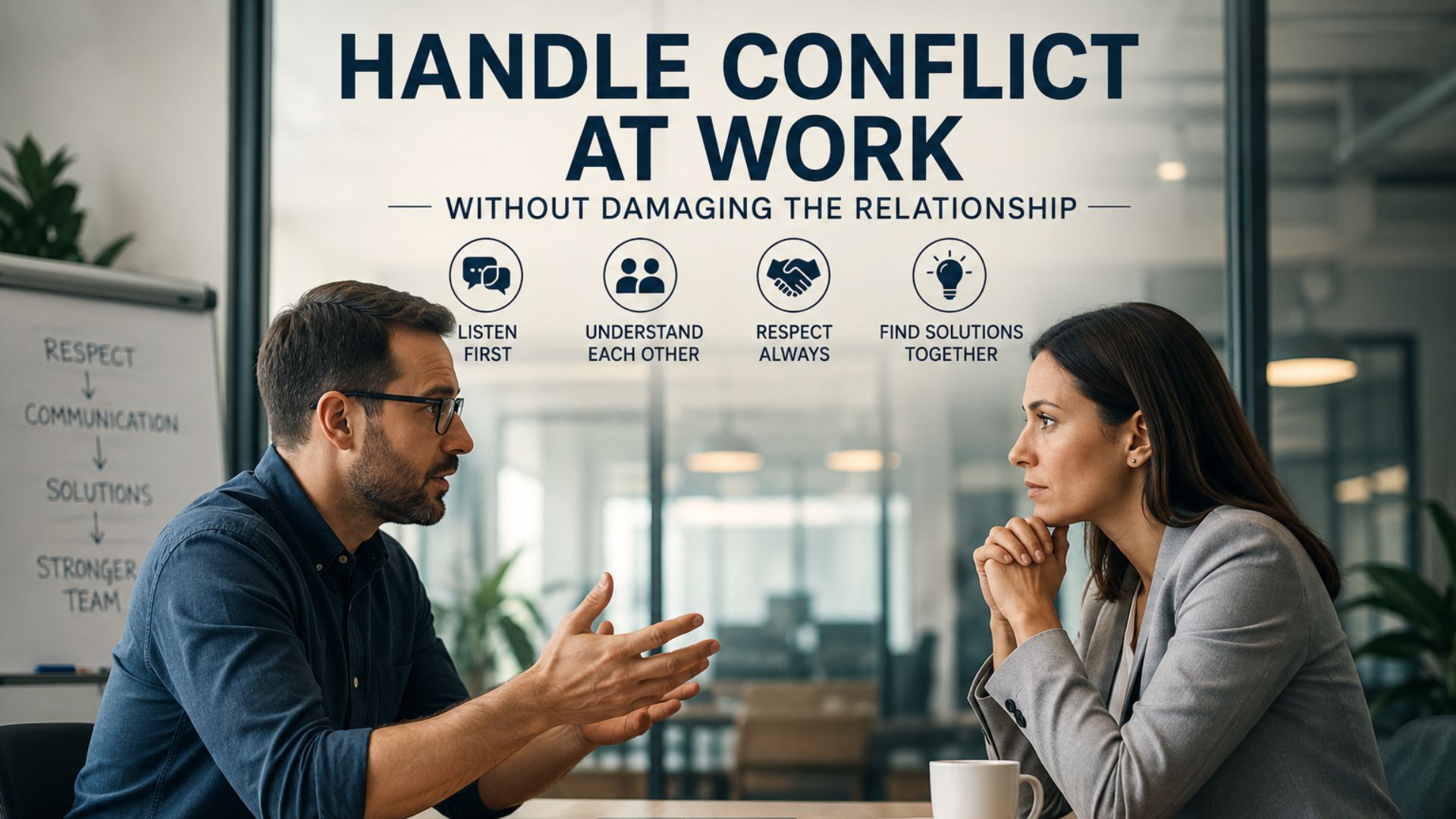
Why Conflict at Work Feels So Hard to Handle
Most of us do not choose the people we work with.
When we enter a new workplace, many challenges arise at once. A new environment, new managers, new leadership, new colleagues. For most people, changing jobs is extremely demanding.

Suddenly, you are trying to deal with multiple things at once.
Everything can feel overwhelming. Information comes from different directions, and it can feel as if things are hitting you from all sides.
At the same time, you still have to focus on the main reason you came there in the first place, the work itself.
And that is often new as well.
Even if the work is familiar, every company has its own rules, expectations, systems, and ways of doing things.
Then comes another layer that many people underestimate: relationships.
Whether it is a manager, an employee, a founder, a colleague, or a team member, we find ourselves very quickly in situations involving people we do not know, did not choose, and who are often very different from us.
Even in workplaces where people have worked together for years, the same reality often exists.
We still have not chosen the personalities around us.
Even leaders who hire their own teams often select people through interviews, qualifications, or experience. But a serious question remains:
How often do companies really evaluate whether someone’s personality fits the people they will actually work with?
All of this creates a complex environment where misunderstandings, tension, disagreements, and conflict become almost unavoidable.
Because workplaces are usually built around performance and results, not around conflict resolution.
And this is one reason organizations are increasingly paying attention to team dynamics and relationships. Because strong results rarely happen without healthy working relationships.
Learning how to handle conflict at work is one of the most valuable professional skills you can develop.
The mind reads disagreement as a threat
At work, people rarely react only to what was said. They react to what they believe it means.
A colleague questions your idea during a meeting. A manager asks whether something could have been done differently. A team member challenges your decision.
On the surface, these are normal parts of professional communication.
But the mind often translates them into something else.
“Maybe I missed something.”
“Maybe I look incompetent.”
“Maybe I am losing credibility.”
Very quickly, a disagreement over a task can start to feel like a judgment about the person.
This is one reason why workplace conflict resolution becomes difficult. People think they are discussing a problem, while internally they may already be defending their identity, competence, or status.
The conversation is no longer only about the work.
Now it feels personal.
Why the brain treats conflict like danger
The interesting part is that this does not happen only in the mind.
The body often reacts before we even realize what is happening.
You suddenly become tense. Your breathing changes. Your voice becomes sharper. Some people become defensive. Others shut down completely.
Some people push harder.
Others avoid the conversation altogether.
This is why conflict avoidance is so common in work environments. It is not always because people lack communication skills.
Sometimes the brain simply interprets tension as something dangerous and starts looking for protection.
Fight.
Flight.
Freeze.
Different people react differently, but the pattern is often the same.
The problem is that what protects us in the moment can create bigger problems later.
When Avoiding the Conversation Became the Bigger Problem
Avoiding conflict is often a short-term solution.
I remember becoming a manager early in my career. It was my first leadership position, and one day my secretary came to me to say that one of my colleagues occasionally touched her in ways that made her uncomfortable.
The difficult part was that this person was also my friend. We had worked together before, but now I was his superior.
I knew immediately that this would be an uncomfortable conversation.
For quite some time, I delayed it.
Not because I thought the situation would magically solve itself, but because I knew that bringing it up could affect our relationship.
The problem, of course, was that nothing changed.
And looking back now, that was completely predictable.
Eventually, I decided to talk to him directly. I explained the situation and told him that these interactions were making her uncomfortable and that I would ask him to stop.
He was visibly shocked.
Not only because I was the one bringing it up, but also because he genuinely seemed surprised that his behavior had been experienced that way.
From his perspective, this was simply part of his natural nonverbal communication and the way he interacted with people.
He accepted the conversation better than I expected.
He was hurt by it, and for a while, he became more distant. But after a few weeks, things settled down.
What stayed with me was something different.
The real problem was not the conversation itself.
The real problem was my avoidance.
Difficult conversations at work rarely become easier by waiting. More often, they quietly grow underneath the surface.
And the longer we protect a relationship by avoiding discomfort, the more likely we are to damage the very thing we are trying to preserve.
What Workplace Conflict Actually Is (and What It Is Not)
Conflict is not disagreement.
Just because two people do not agree on something does not automatically create conflict.
This is important because disagreement and different opinions are extremely valuable in a work environment.
If everyone agreed on everything and thought the same way, companies would function very poorly.
You do not need ten people thinking in exactly the same way.
You need people who can communicate at a mature-adult level. People who are not offended by someone disagreeing with them.
Disagreement itself is not the problem.
Conflict often starts when someone takes a professional discussion personally.
What began as a conversation about work suddenly becomes an ego problem.
Something touches a trigger point.
A person feels attacked, misunderstood, disrespected, or threatened.
Then the communication changes.
Words change.
Tone changes.
Body language changes.
And very quickly, both people can find themselves reacting emotionally rather than communicating rationally.
Conflict vs confrontation
There is often a very thin line between disagreement and confrontation.
At first, people may still be simply exchanging views. But sometimes only a word, a facial expression, or a certain tone is enough to shift the conversation into something else.

And once conflict begins, we are operating on a different level.
Then the question is no longer whether conflict exists.
The question becomes: what do we do with it?
Healthy conflict vs destructive conflict
Healthy conflict is often one in which both people learn something.
It is a situation in which people can say something that hurts, bothers, or feels inappropriate without attacking the other person.
This is not always easy.
Because healthy conflict requires honesty.
And honesty usually requires some degree of vulnerability.
People have to admit:
“This affected me.”
“This bothered me.”
“I did not experience that well.”
Even when disagreement turns into conflict, it can still lead to something positive.
People are human beings.
Differences, tension, misunderstandings, and conflict are inevitable.
The important question is what happens next.
If people try to understand what happened, identify trigger points, and openly explain their experience, the conflict can actually strengthen the relationship.
Not only can people learn more about each other.
They often learn more about themselves.
Destructive conflict works differently.
It escalates.
People lose control over themselves and become trapped in emotional reactions.
This can lead to shouting, blaming, misusing authority, or simply losing the ability to regulate emotions.
This kind of conflict creates resentment.
It damages relationships and affects the wider work environment.
Imagine two colleagues shouting at each other in front of the entire team.
Very quickly, people begin taking sides.
Half supports one person.
Half support the other.
Now the problem is no longer only between two people.
And when this continues for years without being addressed, destructive conflict slowly becomes part of the culture itself.
Then it starts destroying the work environment and eventually affects results.
Avoiding conflict is not the same as keeping the peace
Avoiding conflict is often simply the other side of destructive conflict.
People who dislike conflict often stay quiet.
They avoid difficult conversations.
Sometimes they physically distance themselves from situations that feel uncomfortable.
On the outside, this can look calm and controlled.
But internally, something very different is often happening.
The tension remains.
People feel it.
Very often, it appears later as passive aggression, distance, resentment, or emotional withdrawal.
Keeping peace at work does not mean becoming silent.
Internal peace is not the absence of difficult conversations.
Internal peace means being able to address a problem without losing yourself in the process.
You can say what needs to be said and still remain calm.
You can communicate directly without being controlled by what the other person thinks about you.
That is healthy peace.
Avoiding conflict is something very different.
The Most Common Types of Conflict at Work
There are different types of conflict at work.
It is useful to recognize the type of conflict you are dealing with, because otherwise, you may end up solving the wrong problem.
There is a difference between a conflict about the work itself and a relationship conflict, or a conflict involving authority and roles.
Task conflict – disagreements about the work itself
This type of conflict is connected to the work itself.
Usually, these are situations in which people disagree about solutions, strategies, priorities, timing, or how something should be done.
This is one of the most common disagreements that can grow into conflict.
From an organizational perspective, these disagreements can actually be extremely productive.
Very often, this is where good ideas appear.
If a leader can handle these situations calmly, decisively, and thoughtfully, task conflict can become one of the strongest drivers of progress.
The important thing is that communication remains appropriate.
Ideally, things stay at the level of disagreement rather than becoming personal conflict.
Tone of voice, body language, and respectful communication become extremely important.
I remember some of the strongest moments from courtrooms when I was in very intense disagreement with opposing lawyers.
The arguments were strong.
The pressure was high.
Sometimes the discussions were extremely intense.
But after leaving the courtroom, I remember one lawyer saying:
“You were very good in there.”
And I told him:
“You were good too.”
The disagreement was intense, but respect remained intact.
Eventually, we even became friends.
That is the essence of task conflict.
You fight for ideas and content, not against the person.
Relationship conflict – personal friction between people
If people are unable to manage task conflict appropriately, it can quickly escalate into relationship conflict.
This happens when friction develops between two people and things become personal.
You will often hear phrases such as:
“You are always like this.”
“You always do this.”
“I do not like people like you.”
At that moment, people stop discussing the issue itself.
Now they are discussing the person.
The problem is no longer the task.
The problem has become personal.
And once that happens, the conflict usually has to be resolved at the relationship level rather than at the work level.
Role conflict – unclear responsibilities and authority
This type of conflict is connected to authority, hierarchy, and roles inside an organization.
It often appears between managers and employees, but it can move in both directions.
I have been in this position many times myself.
People in positions of authority sometimes unconsciously believe that because they have more power, they are entitled to more.
The reality is that positions often give people that possibility.
But that does not necessarily create good work or good results.
The times when leadership relied mainly on fear and authority are slowly disappearing.
In my experience, the best employees are usually satisfied with relationships, especially with their bosses.
People who feel respected.
People who experience good relationships.
People who feel that they matter.
And some of the strongest leadership moments are often surprisingly small.
I still believe that when a manager makes coffee for an employee, brings breakfast, donuts, or shows simple human attention, there is enormous power in that.
Not because of the coffee.

Because of what it communicates (without words):
“You and I are the same, and I appreciate and respect you.”
Values conflict – different beliefs about how things should be done
Values are one of the most difficult things to discuss and disagree about.
Because values are usually deeply rooted inside us.
Many of them come from childhood and become part of our identity.
This means that when people argue about values or beliefs, they are often not discussing a simple opinion.
They are discussing something much deeper.
Something connected to who they believe themselves to be.
This is why value conflicts can become dangerous very quickly.
People can feel personally attacked, misunderstood, or disrespected.
Suddenly, the work itself becomes a secondary issue.
The conversation shifts away from business and toward identity.
Because of this, value conflicts require extreme caution.
Sometimes, the healthiest solution is not convincing the other person.
Sometimes it is accepting that people are different and allowing different values to exist.
Why Workplace Conflict Escalates
It is simple because we are humans.
People naturally tend to either solve conflicts, tolerate them, or avoid them completely.
Because of our personal stories, emotional reactions, and the things we carry from our past, conflicts often become bigger than they originally were.
How unspoken frustration compounds over time
Over time, every frustration that remains unspoken slowly becomes part of us.
And the more it becomes part of us, the more difficult it becomes to control.
Even though we often believe no one notices, people usually feel it.
Some people hide their frustration better than others.
But many of those people also suffer more because they keep pushing these emotions deeper inside themselves.
This is not healthy for the person carrying it.
And it is not healthy for the person who should have been part of the conversation in the first place.
Talking about a conflict does not automatically solve the conflict itself.
But it can begin solving something equally important.
Your internal frustration.
Why does the same conflict keep repeating
Conflicts repeat because patterns repeat.
Both you and the person you are in conflict with carry patterns from your own past, and very often those patterns begin colliding with each other.
As long as you stay focused only on the other person and keep asking yourself how wrong they are, how inappropriate they are, or how many mistakes they are making, the conflict will usually continue repeating itself.
But when you begin asking a different question, things start changing:
“What exactly is this person triggering in me?”
And equally important:
“What am I triggering in them?”
Then you slowly begin to understand why the conflict exists, why it keeps repeating, and, perhaps even more importantly, how to step out of that cycle.
And I can tell you from experience that this can even be done one-sidedly.
Of course, it is ideal if both people are willing to do that work.
But even if they are not, you can still analyze your own patterns and move beyond them.
The role of assumptions in turning friction into problems
The moment we begin guessing what is happening inside another person’s mind, we often enter a never-ending story of growing frustration.
And this is where small situations can slowly become very large problems.
Assuming what somebody meant, what they intended, or what they were really trying to say is one of the biggest communication mistakes people make.
If somebody says something that hurts you or behaves in a way that feels wrong, address the behavior itself.
Do not create assumptions about intentions.
Very often, people mean something completely different from what we think they meant.
And our assumptions often lean toward exaggeration.
We start turning small things into big things.
We create stories in our minds that are partially true, minimally true, or sometimes not true at all.
This is why assumptions should be approached with caution.
Many communication problems are not actually problems of content.
There are problems of interpretation.
When the conflict was never really about what it seemed
I remember one situation when I was in a leadership position, and we ended up in a surprisingly intense argument about buying a new computer for one of my employees.
From my side, I was trying to explain something very simple.
I wanted to buy a high-quality computer that would last a long time and make his work easier in the future.
But on his side, the message landed completely differently.
He started feeling that I was complicating things, delaying the process, being too strict, or simply trying to avoid buying the computer.
The discussion became more intense than it should have.
At some point, we were no longer discussing a computer.
We were discussing our interpretations of each other.
It became intense…

After a longer discussion, we finally realized something interesting.
We completely agreed.
Not only did we both agree that he needed a new computer, but I actually wanted him to get a better one.
The goal had never been different.
The misunderstanding was in the path, not in the destination.
I have seen this happen many times.
People believe they are fighting over the problem itself, while in reality, they are fighting over assumptions, interpretations, and communication style.
Sometimes the conflict is not about what it seems at all.
How to Handle Conflict at Work: A Practical Framework
This is one of the most important parts of handling workplace conflict.
Because conflict itself is often not the biggest problem.
Very often, the bigger issue is the way people choose to handle it.
The process matters.
The order matters.
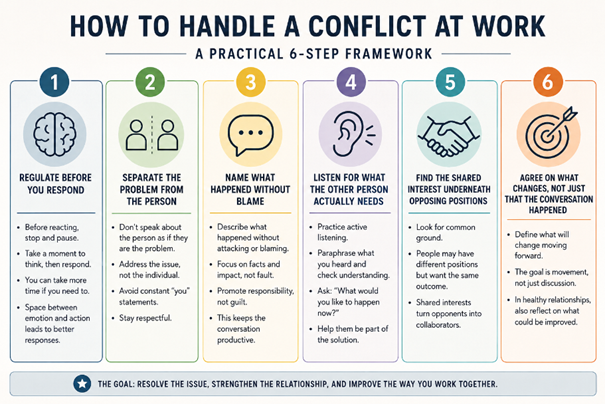
And the way you approach difficult situations can determine whether the relationship becomes stronger or weaker afterward.
Step 1 – Regulate before you respond
Before reacting, stop and pause.
When conflict appears, people often feel pressure to immediately defend themselves, explain themselves, or react emotionally.
Do not rush.
Stop.
Think.
Then respond.
And sometimes you do not need to respond immediately at all.
You can take as much time as needed.
Very often, the quality of your response improves when you create a little space between emotion and action.
Step 2 – Separate the problem from the person
Never speak about the person as if they are the problem.
Address the problem separately from the individual.
Try to avoid constant “You” statements and remain respectful.
The issue is the issue.
The person is the person.
The moment people begin to feel personally attacked, conversations often become much more difficult.
Step 3 – Name what happened without blame
Be extremely careful to avoid direct or indirect attacks.
Even when someone makes a mistake, the goal should not be to blame, shame, or make the person feel bad.

The goal is to take responsibility.
Not guilt.
Not humiliation.
Because blame usually creates defensiveness.
Responsibility creates movement.
And this is better not only for the relationship but also for the overall workflow.
Step 4 – Listen to what the other person actually needs
This is where active listening becomes extremely important.
Do not simply listen.
ACTIVELY LISTEN
Listen and then paraphrase what you understood.
Allow the other person to confirm whether you understood them correctly.
And then ask an important question:
“What would you like to happen now?”
This is a much higher level of communication.
Because now you are helping the other person participate in solving the problem rather than simply defending themselves.
Step 5 – Find the shared interest underneath opposing positions
This extends the previous steps.
If possible, look for shared interests.
Very often, people appear to stand on opposite sides while still wanting the same outcome.
When shared interests become visible, relationships often improve naturally.
Because people stop seeing each other as opponents and start seeing each other as people working toward a common goal.
Step 6 – Agree on what changes, not just that the conversation happened
Finally, try to agree on what actually changes moving forward.
The goal is not simply having the conversation.
The goal is to create movement.
And when the relationship is healthy, you can even discuss what could have been done better during the conversation itself.
Very often, this becomes another opportunity for growth.
Because healthy relationships usually improve through many small conversations rather than one perfect conversation.
How to Have a Difficult Conversation at Work Without It Going Wrong
Difficult conversations are always difficult.
It makes sense to prepare for them, write down a few notes, sleep on it if necessary, and then approach the conversation thoughtfully and clearly.
Choosing the right moment
Choosing the right moment is extremely important.
The wrong moment can send the conversation sideways and make the situation even worse.
And that is not something you want.
If somebody is under extreme stress, emotionally overwhelmed, surrounded by people, or in a situation where they feel pressured, the conversation can quickly move away from the original problem.
Timing does not solve everything.
But bad timing can damage a conversation before it even begins.
How to open without triggering defensiveness
Here, it becomes very important to use “I” statements.
Talk about your own experience rather than presenting assumptions as facts.
For example:
“I felt…”
“I saw it this way…”
“My impression was…”
Or even softer openings:
“It seems like something may have gone wrong.”
“It seems like I may have upset you.”
Sometimes the person may even respond:
“No, that is not what happened.”
And that is perfectly fine.
You can simply say:
“I am only sharing how it looked from my perspective.”
Very often, people become defensive because they feel accused.
When you talk about your own experience rather than attacking theirs, people are usually more open.
What to do when the other person shuts down
If the other person shuts down, and you genuinely want the conversation to continue, tell them openly that you want to discuss the issue and that they can come back when they feel ready.
You need to give people space.
Because if you keep pushing, many people simply close even more.
There are techniques for helping sensitive people come out of their shells and feel safer.
But at the end of the day, the person also needs to want to participate.
If somebody does not want to leave their protective shell, nobody can do that work for them.
That responsibility belongs to them.
Your responsibility is to decide what you will do if the person continues to shut down. You will probably have to put some boundaries on. Otherwise, this kind of behavior will continue, and that’s not good for anybody.
And sometimes it can even mean that working together simply becomes very difficult.
How to close so both sides feel heard
One of the most important things in communication is feeling heard.
One of the strongest techniques for this is very simple.
One person speaks.
The other person paraphrases what they heard.
Only after both people agree that the message was understood does the second person begin speaking.
Then the process repeats.
The goal is to make it crystal clear what each person actually meant.
Because very often people argue not because they disagree, but because they misunderstood each other.
And this kind of communication usually creates a very different feeling after the conversation.
People feel heard.
People feel understood.
And that alone can completely change the quality of a relationship.
How to Resolve Conflict at Work Successfully
Conflict resolution is rarely about finding the perfect solution.
More often, it is about creating enough understanding, trust, and communication for people to move forward together.
Many workplace conflicts continue not because the problem itself is impossible to solve, but because emotions, assumptions, and misunderstandings prevent people from addressing the real issue.
The goal is not to “win” the conflict.
The goal is to resolve it in a way that protects both the work and the relationship.
How to Stay Calm During Conflict
One of the most valuable skills in conflict resolution is emotional regulation.
When emotions take control, communication usually becomes less effective.
People interrupt.
People become defensive.
People focus on proving a point rather than solving a problem.
This is why it is often useful to pause before responding.
Take a breath.
Slow down.
Think before speaking.
A calm response usually creates a better outcome than a fast reaction.
The more emotionally charged the situation becomes, the more valuable self-control becomes.
Focus on Understanding Before Defending
Many people enter difficult conversations preparing their defense.
They are already thinking about what they want to say next.
What they will disagree with.
How they will prove they are right.
But conflict resolution often improves when people focus on understanding first.
Ask questions.
Listen carefully.
Clarify what the other person actually means.
Very often, the conflict people are trying to solve is not the conflict that truly exists.
Understanding creates clarity.
And clarity often reduces tension.
Address Problems Early
Small problems are usually easier to resolve than large ones.
Unfortunately, many people wait.
They hope the issue will disappear on its own.
Sometimes it does.
Most of the time, it does not.
Instead, frustration quietly grows beneath the surface.
By the time the conversation finally happens, the issue is no longer about one event.
It is about months of accumulated resentment.
This is why healthy communication requires timely communication.
The earlier a problem is addressed, the easier it is to manage.
Protect the Relationship While Solving the Problem
One of the biggest mistakes people make is treating the other person as the problem.
The problem is the problem.
The person is the person.
The moment people feel personally attacked, conflict usually becomes harder to resolve.
Focus on behavior.
Focus on actions.
Focus on situations.
Avoid attacking character, personality, or intentions.
You can disagree strongly with someone and still treat them with respect.
In fact, the strongest professional relationships are often built exactly that way.
When Conflict at Work Becomes a Sign of Something Deeper
When the same conflicts repeat across different jobs
f the same conflicts keep recurring across different jobs, the issue may not be limited to the workplace itself.
I have met people who have changed many jobs and kept experiencing almost identical problems.
The managers were always the problem.
The work environment was always the problem.
The colleagues were always the problem.
But when the same situations repeat, and people continue receiving similar feedback over time, it becomes worth asking a different question:
“What if there is a pattern here?”
Because changing environments does not automatically change patterns.
Changing yourself often does.
If you are a leader and notice similar patterns in employees or candidates, it can also be useful to understand their previous experiences.
Not to judge them.
But to understand whether there are recurring themes.
As a lawyer, I personally noticed something similar with clients.
If somebody changed one lawyer, or even two lawyers, over a long period of time, that was understandable.
But when someone changed several lawyers over a short period, I often saw it as a signal that something deeper might be happening beneath the surface.
Not because the person was necessarily wrong.
But because patterns deserve attention.
When to bring in a coach or external mediator
There comes a point at which conflicts can become too complex or emotionally charged for the people involved to resolve on their own.
Especially when situations begin escalating and become difficult to manage.
This is where a coach, mediator, or external person can help.
Because somebody outside the situation can often see things more clearly.
Sometimes the issue may mainly involve one person.
More often, however, it is a combination of factors interacting.
Many small things can slowly create an environment that becomes difficult to tolerate.
And at that point, a third person who is not emotionally involved can often bring clarity.
I have seen situations where problems that seemed impossible were significantly improved in only a few steps.
What Good Conflict Resolution Looks Like in Practice
Signs a conflict has been resolved, not just suppressed
One of the first signs that conflict is actually being resolved is that people are willing to talk about it.
They do not avoid it.
They do not walk away from it.
They can openly address difficult topics without immediately becoming defensive.
Because silence is not always peace.
Sometimes silence only means that conflict has moved underground.
How to rebuild trust after a disagreement
One of the most important things is making sure that conflict does not permanently damage relationships between people.
I remember one of my managers, a person I still deeply respect today.
I was young at the time, around twenty-seven, working as his assistant manager.
We had an argument, and I became angry.
I held onto resentment.
I looked at him differently.
I avoided speaking to him.
After a day or two, he called me into his office.
For the first time in my life, somebody said something very directly:
“Stop this stubbornness and pull yourself together.”
I was shocked.
But quickly, I became incredibly grateful.
Because nobody had ever given me that kind of lesson before.
Almost like a father would.
Stop behaving like an offended child.
He always had a rule:
“We can disagree. We can argue. But then we have a whiskey and move on.”
And I still carry that lesson with me today.
No conflict should become bigger than the relationship.
Why the best working relationships have been tested by conflict
The strongest teams are usually not the teams that have never experienced conflict.
They are the teams that moved through difficult situations together.
Because if people can survive disagreements, pressure, difficult conversations, and stressful periods while maintaining respect, trust often becomes stronger.
Open communication.
Freedom to think differently.
Respect.
Creativity.
Humility.
These are the qualities that create good employees, good leaders, and strong work environments.
Strong work environments often produce exceptional results.
Conflict itself is usually not what destroys relationships.
More often, it is avoidance, assumptions, silence, and things left unsaid.
You do not need to become somebody who loves conflict.
You only need to become somebody who is willing to step into difficult conversations without losing yourself in the process.