
A man raises his voice, clenches his fists, hits the steering wheel, honks, threatens, or becomes aggressive. From the outside, he may appear confident and powerful.
But very often, anger is not the first emotion.
Underneath it may lie fear, powerlessness, humiliation, or a sudden loss of control. This is one reason men often express fear through anger, especially in tense situations where safety, pride, or authority seem at risk.
Anger Is Often a Secondary Emotion
When something dangerous happens, the body reacts before the mind has time to explain the situation. The amygdala awakens instantly.
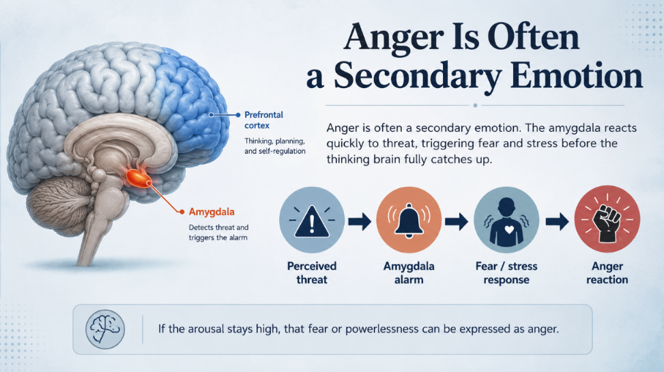
A car suddenly cuts in front of us—a pedestrian steps onto the road. Someone almost causes an accident. Our heart starts beating faster, adrenaline surges, and our full attention shifts to avoiding danger.
The first reaction is often fear.
But many men do not stay with that fear long enough to recognize it. Within seconds, it turns into anger.
Instead of saying, “That frightened me,” a man may shout:
“What are you doing?”
“Are you blind?”
“Do you know how to drive?”
The visible emotion is anger, but the original experience was often fear and helplessness.
For one brief moment, the man was not in control. He could not guarantee his own safety or the safety of the people with him. Anger then gives him a temporary feeling of power.
Watch: How Fear Becomes Anger
In the video below, I explain how fear, adrenaline, and powerlessness can turn into anger within seconds. I also share two real situations that ended very differently depending on whether the fear was recognized or denied.
Why Traffic Brings Out So Much Aggression
Traffic is a particularly strong environment for this reaction.
People are moving at speed, surrounded by metal, noise, rules, and constant risk. A small mistake can have serious consequences. At the same time, drivers often feel anonymous and protected inside their vehicles.
This creates a strange combination.
A person feels vulnerable because an accident could happen at any moment, but also powerful because he is sitting inside a large machine. When another driver interrupts his movement, takes his right of way, or forces him to brake, it can feel like more than a simple traffic mistake.
It can feel like a personal challenge.
This is why people honk, wave their hands, shout through closed windows, follow another car, or stop to argue. In extreme cases, they become physically violent.
The reaction often has very little to do with the actual event.
The dangerous moment may last two seconds. The anger can remain for hours.
Fear, Pride, and the Need to Protect
I am primarily speaking about men here.
That does not mean women never become angry or aggressive. Of course, they do. Every person is different, and culture also plays an important role.
Still, during my years in the police, I observed that loud, physical, and confrontational aggression appeared more frequently among men.
Part of this may come from the traditional male role of protector.
Many men feel responsible for safety, order, and protection. When their own safety or their family’s safety is threatened, they feel an immediate need to act.
That instinct can be useful. It can make a man brave, responsible, and willing to protect others.
The problem begins when protection turns into the need to prove strength.
Pride then enters the situation.
A man may feel that another driver has disrespected him, humiliated him, or made him look weak. The conflict is no longer only about who had the right of way.
It becomes a question of status.
At that point, the man is not simply reacting to danger. He is defending his self-image.
What Police Work Taught Me About Aggression
During my years as a police officer, I often saw how quickly aggressive behavior could change.
A man would sit in his car shouting, waving his arms, and acting as if he controlled the situation. If we were using an unmarked vehicle, he would not have immediately known he was dealing with police officers.
He behaved naturally, without restraint.
Then I would step out of the vehicle in uniform.
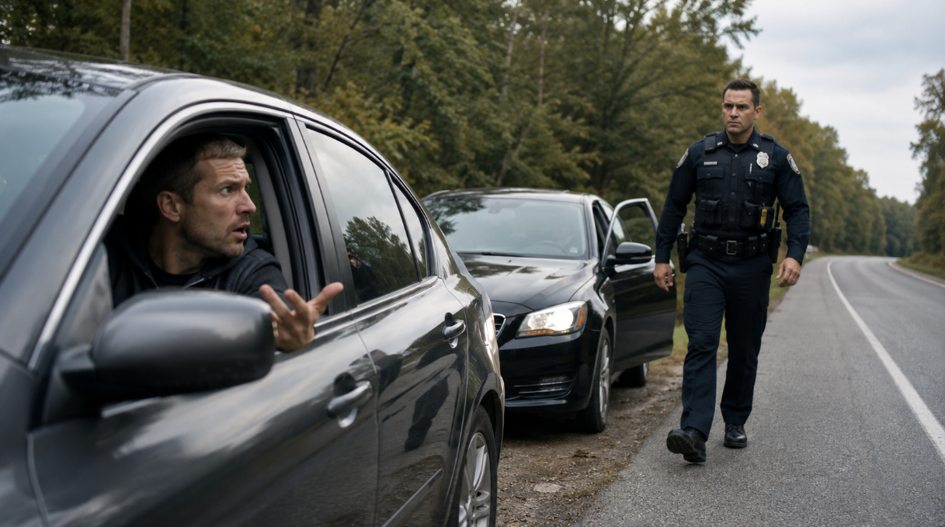
In most cases, the change was immediate. The man lowered his voice, calmed down, and became more respectful.
This taught me something important.
His aggression was not always a sign of real inner strength. It was often a reaction based on the belief that he had more power than the other person.
When a stronger authority appeared, the aggression disappeared.
Real inner strength does not depend on whether the other person is weaker or stronger. A truly strong person does not need to dominate someone to feel in control.
When Fear Turned Into Anger Toward My Son
One of the clearest examples in my own life happened more than fifteen years ago.
My family and I were at the seaside. My son was about four years old. He climbed onto the railing of a terrace.
When I saw him, I wanted to tell him to get down because he could fall.
But before I could react, he fell backward.
I was standing several steps away. Everything happened so quickly that I could not reach him. For one brief moment, I watched my child falling toward the ground and could do nothing.
I remember the fear very clearly.
I was afraid that he would land on the back of his head or injure his neck. At the same time, I felt completely powerless because I could not protect him.
Fortunately, he was not injured.
But when I saw that he was all right, my first visible reaction was anger.
I was angry with him.
Later, I asked myself why.
He had not done anything wrong. He was a child exploring the world. He did not understand the danger of sitting on the railing. He was not trying to disobey me or create a problem.
The anger was not really about what he had done.
It came from my fear and helplessness.
For a fraction of a second, I had been unable to protect my own child. When the danger passed, that feeling of powerlessness came out as anger toward the person I had been afraid of losing.
That realization stayed with me.
The Difference Between Strength and Reaction
Anger itself is not always wrong.
Sometimes it tells us that a boundary has been crossed. It can give us energy to act, protect someone, or stop dangerous behavior.
The problem is not the existence of anger.
The problem is a reaction to anger.
Shouting is not necessarily a strength. Intimidating someone is not necessarily a strength. Winning an argument does not mean that we handled the situation well.
Sometimes the stronger response is to notice what is happening inside us before we act.
That may mean recognizing:
“I felt powerless.”
“I lost control for a moment.”
“I was frightened.”
When we can name the real feeling, we have more choices.
We can still set a boundary. We can still tell someone that his behavior was dangerous. But we do not have to attack, insult, or prove ourselves.
What to Do Before Anger Takes Control
The next time you feel anger rise quickly, especially in traffic or another tense situation, do not look only at what the other person did.
Look at what happened inside you one second earlier.
Did you feel fear?
Did you feel that you had lost control?
Did you feel disrespected or humiliated?
Did you feel unable to protect yourself or someone you love?
You do not have to deny the anger. You only need to understand where it came from.
That small moment of awareness can change the entire direction of the situation.
Instead of reacting from fear, you can respond with control.
That is not a weakness.
It may be the first real sign of strength.