
For most of my life, I believed my problem was anger.
Whenever I lost my temper, I focused on the outburst itself. I thought that if I could just stay calmer, count to ten, or control my emotions better, the problem would eventually disappear.
Sometimes it worked for a while, but sooner or later I found myself reacting the same way again. It was frustrating because I genuinely wanted to change, yet I never seemed to get to the root of the problem.
Looking back today, I realize I was fighting the wrong battle.
Anger was never the real problem. It was only the most visible part of a much deeper psychological process that had already been unfolding long before
I raised my voice or reacted impulsively.
The explosion was simply the moment everyone else could see. What no one saw was everything that had happened inside me beforehand.
When it all began
One of my earliest memories goes back to when I was about eight or nine years old. I was playing table tennis, a sport I loved, when I became so frustrated that I wanted to throw my racket against the wall. I remember looking at it and knowing exactly what would happen if I did. It was an expensive racket, and it would probably shatter into pieces.
Whether I actually threw it or stopped myself at the last second is no longer important.
What stayed with me was the intensity of the emotion.
Even as a child, I could feel that something inside me was much stronger than the situation itself.
Around that time, my father had already started telling me that I needed to learn how to control my temper. I didn’t like hearing it. In fact, I resisted it for years because I didn’t want to see myself as someone with an anger problem.
Today I look at those memories differently.
Part of my temperament was probably learned from my environment, but I also believe some emotional patterns can be passed down epigenetically across generations. Whether that explains everything or not, I cannot say with certainty. What I do know is that my struggle with anger began long before I understood what was really happening inside my mind.
Many years later, while studying the Bhagavad Gita together with Paramahansa Yogananda’s commentary, I came across an explanation that completely changed my understanding of anger.
For the first time, I realized that anger is almost never the beginning of the problem.
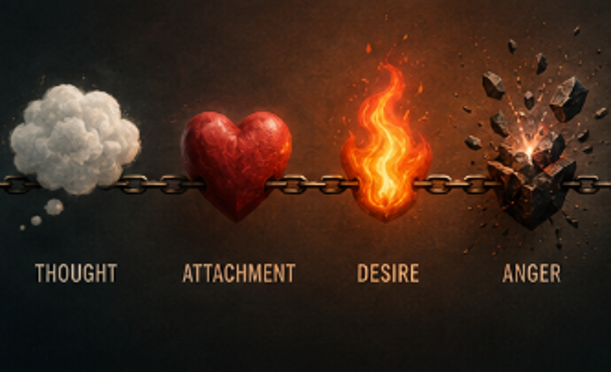
It is usually one of the final steps in a chain that starts much earlier—with a thought, grows into attachment, develops into desire, and, if left unnoticed, eventually ends in anger and the loss of clear judgment.

The storm begins in the mind
Understanding what is behind is the begining
I spent years trying to understand why this kept happening.
Eventually, the answer came from a source I never expected—one of the oldest spiritual texts ever written.
What I discovered there changed not only the way I understood anger, but the way I understood the human mind itself.
Why Men Really Explode
The Chain That Begins with a Single Thought
The Bhagavad Gita presents one of the most profound psychological explanations of anger I have ever encountered.
What surprised me most was not its description of anger itself, but where it says anger actually begins. According to Krishna, anger is never the first step. By the time it appears, the mind has already traveled through several stages that most of us never notice.
The process begins with a simple thought.
We dwell on something repeatedly, giving it more attention than it deserves. Over time, that repeated attention creates attachment. Without realizing it, we begin to identify with the object of our attention, whether it is success, recognition, a relationship, being right, or simply winning a football match.
That attachment gradually develops into desire.
Desire, in itself, is not necessarily harmful, but it easily becomes an expectation. We no longer hope things will happen a certain way—we begin to believe they should. When reality fails to meet those expectations, frustration appears. If we continue feeding that frustration, it eventually turns into anger.
Looking back at my own childhood, I can see this process much more clearly than I could at the time.
When my sister and one of my friends used to tell me that I couldn’t stand losing, I rejected their words immediately.
Today I realize they had noticed something I couldn’t yet see. The football match wasn’t the real issue. My attachment to winning was. Losing challenged my pride, my identity, and the image I had of myself. The game simply revealed what had already been happening inside me.
When Anger Clouds Our Judgment
Paramahansa Yogananda explains that intense anger temporarily disconnects us from our higher intelligence. We no longer see people or situations as they truly are. Instead, we see them through the narrow lens of wounded pride, fear, frustration, or unfulfilled desire. The more emotionally overwhelmed we become, the less access we have to calm reasoning.
We may still believe we are thinking clearly, but in reality, our judgment has already been compromised.
I experienced this loss of judgment very clearly as a young adult.
During one argument, I felt as if everything briefly went dark. I asked my girlfriend to leave the room, and after she left, I smashed several objects. Although I never directed physical violence toward another person, the experience showed me how quickly anger can disconnect us from clear judgment.
Years later, Yogananda’s commentary helped me understand what had happened. He explains that when anger dominates the mind, our capacity for discrimination begins to disappear.
We lose the ability to distinguish between what is wise and what merely feels satisfying in the moment.
That is why people often say things they deeply regret or make decisions that completely contradict their values.
It is not because they suddenly became bad people. It is because, for a brief moment, they lost contact with the part of themselves that could still choose wisely.
That insight shifted my attention away from the outburst itself. The more important question was no longer what I had done in anger, but at what earlier point I had surrendered my ability to choose wisely.
The Real Battle Begins Before Anger
Freedom Starts with Awareness, Not Suppression
The practical challenge is not simply to stop an outburst once anger is already present. It is to notice the inner movement that comes before it. By that point, the mind may already be defending an expectation, a wounded identity, or a need for control.
This is where the Bhagavad Gita offers a completely different perspective.
In the very next verse (2:64), Krishna shifts the focus away from anger and toward inner freedom.
He describes a person who moves through life without becoming controlled by attraction or aversion. Such a person still experiences disappointment, success, criticism, and praise, but no longer allows those experiences to determine his or her inner state.
This doesn’t mean withdrawing from life or becoming emotionally cold.
It means developing enough inner awareness to notice the mind’s movement before it takes control. We begin to recognize attachment while it is still small, before it grows into desire, frustration, and eventually anger.
The earlier we notice the process, the easier it becomes to interrupt it.
The real change began when I stopped treating anger as an isolated reaction and started observing the conditions that produced it.
That shift required more honesty, because it was easier to focus on another person’s behavior than to examine my own expectations, pride, and need for control.
How meditation helps
Meditation became an essential part of that process.
Not because it made me passive, but because it trained me to observe my thoughts before identifying with them.
The more clearly I could observe them, the less power they had over me.
I gradually discovered that freedom isn’t created by controlling anger. It is created by understanding the mind before anger ever appears.

Recognizing the pattern is the first step. Changing it consistently requires deeper work, especially when anger is connected to long-standing habits, identity, relationships, or the need for control.
This is the kind of inner work I guide clients through in The Inner Edge.
A Lesson That Changed My Life
Looking back, the most valuable lesson was not that I had to become less emotional, but that every strong reaction contained information.
Anger revealed where I felt threatened, misunderstood, powerless, or unable to accept reality as it was.
Once I began reading it in that way, it became less of an enemy and more of a signal that something within me required attention.
Over the years, first as a lawyer and later as a coach, I have listened to hundreds of people describe conflict, disappointment, betrayal, divorce, and emotional pain.
Although every story was different, the inner pattern was remarkably similar. Most people believed they were reacting to what had just happened. In reality, the emotional process had often begun long before the argument itself.
The conflict simply exposed what had already been growing beneath the surface.
What these experiences taught me is that conflict often reveals more than it creates. It exposes the places where we are still dependent on approval, control, certainty, or a particular response from another person.
The moment we can see that clearly, conflict becomes more than a problem to solve. It becomes an opportunity to understand ourselves more honestly.
My journey is far from over. I still experience frustration, disappointment, and anger. But today I recover more quickly, take responsibility sooner, and spend less time defending reactions that I know were not wise. For me, that is what real progress looks like: not perfection, but a growing ability to return to clarity before anger determines what I say or do.
Ready to Change the Pattern, Not Just Control the Reaction?
Anger is rarely an isolated problem.
It is often connected to deeper patterns involving attachment, fear, pride, expectations, and the need for control. Until those patterns are understood, the same reactions tend to return in different situations.
The Inner Edge is a private coaching program designed to help you understand these internal patterns, change how you respond under pressure, and create results visible in your relationships, decisions, and everyday life.
If you are ready to work on the cause rather than repeatedly managing the symptoms, learn more about The Inner Edge.