
You sit down to work.
You have a plan.
You know what matters.
And then, without even noticing, your attention is gone.
Not because you are lazy.
Not because you don’t care.
But because the world you live in is designed to take it from you.
Why Workplace Distractions Are Destroying Focus and Productivity
What has shaped us to need to be more productive?
What do data and statistics say?
Those are the questions that lead us to modern times and thinking of more of everything, being better, sometimes even the best.
We are no longer operating in a world where focus comes naturally.
How Workplace Distractions Affect Attention Span and Productivity
We are operating in a system that constantly competes for our attention, where speed is rewarded more than depth, and where being busy is often mistaken for being effective.
The pressure is subtle but constant, and over time it reshapes how we think, work, and even define success.
At the same time, expectations have grown on every level.
Professionally, personally, socially.
We are expected to perform, respond, adapt, and deliver, often all at once. And somewhere in that process, focus is no longer a given; it becomes a skill.
A skill that must be trained, protected, and understood if we want to maintain not just productivity, but also clarity, stability, and a sense of control over our own lives.
The Hidden Cost of Workplace Distractions on Productivity
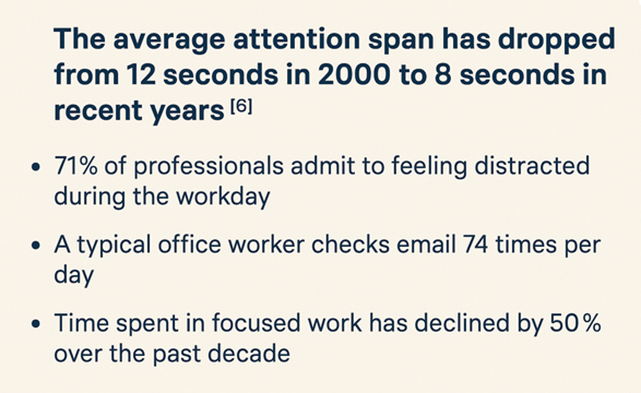
Research Insight: The Hidden Cost of Workplace Distractions (Clockify, 2025)
Modern workplaces are filled with interruptions that quietly drain focus and productivity.
According to recent studies, employees lose on average 720 work hours per year due to workplace distractions, a loss that costs U.S. businesses roughly $650 billion annually.
The top productivity killers remain familiar.
Cell phones (49%), the Internet (38%), social media (37%), and constant interruptions from emails, gossip, or noisy coworkers.
More than 58% of employees spend 30-60 minutes each day on activities unrelated to work.
Another third spend up to 2 hours daily on such activities.
Cognitive research shows that people struggle to sustain deep attention for extended periods.
What used to be normal, staying with one task, is becoming increasingly
difficult.
Digital tools, while designed to increase efficiency, have created something else.
What researchers call “continuous partial attention.”
Why You Can’t Focus: The Impact of Continuous Partial Attention
The habit of constantly switching between tasks without full engagement.
The result is fragmented thinking, shallow understanding, and reduced overall performance.
Even after the interruptions stop, the cost continues.
Workers spend approximately 127 hours a year simply regaining focus after being distracted.
Add to that 75 hours spent on unproductive emails and 78 hours in inefficient meetings.
The hidden costs become staggering.
In fact, 6 in 10 employees say digital tools such as video calls, emails, and instant messaging apps increase their stress rather than their productivity.
The psychological toll is just as high.
A study by Crucial Learning revealed that 73% of employees feel overwhelmed by the constant flow of tasks.
72% report feeling worried and stressed.
54% say they lack motivation or fulfillment.
Nearly half feel inadequate or disappointed with their performance.
The modern workplace often lacks protected time for deep focus.
And this leads to something deeper.
A cycle of exhaustion and frustration.
Yet, there is hope.
Awareness is rising.
Around 76% of employers have started taking steps to reduce distractions.
Blocking time-wasting websites, limiting phone use, and cutting unnecessary meetings.
The use of time-tracking tools like Clockify provides insight into where the hours truly go.
And helps teams rebuild a culture of presence, clarity, and responsibility.
Because the first step to mastering focus
is understanding how, and where, your attention escapes.
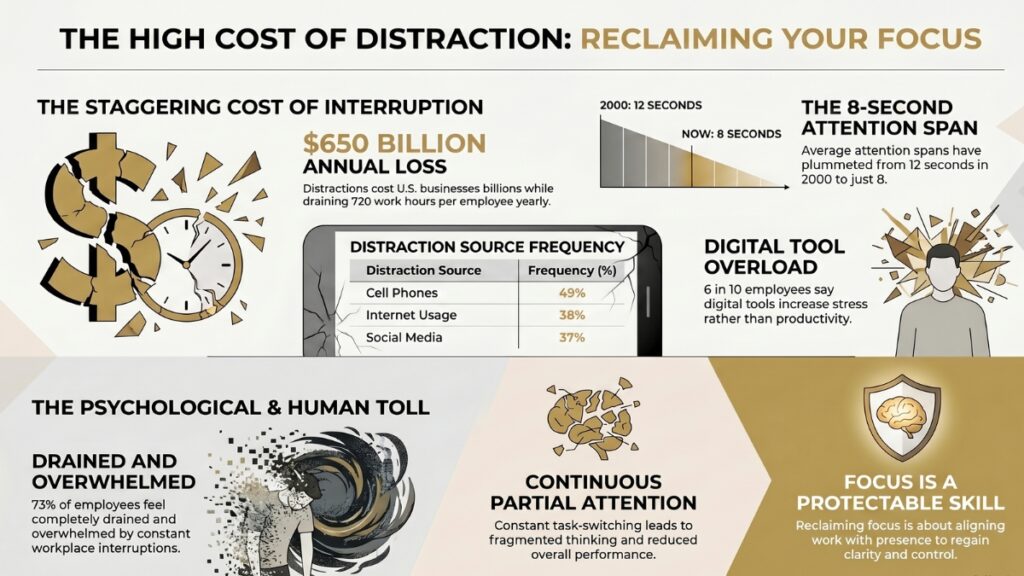
The biggest workplace distractions are the smartphone and the Internet. Namely, a CareerBuilder survey found that US employers believe the following are the biggest distractors among their workforce:
- Cell phones: 49%
- Social media: 37%
- Gossip: 35%
- Smoke/snack breaks: 25%
These figures suggest that productivity is not limited by time or effort, but by attention.
This is why workplace distractions are one of the biggest causes of productivity loss today.
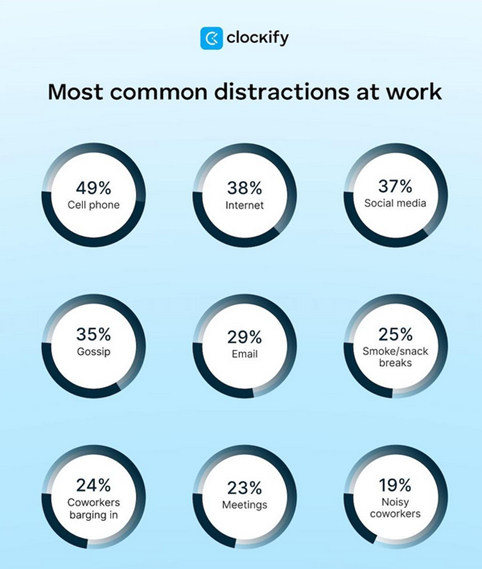
Source: Clockify
We live in hard, frustrating times where everything has to be done here and now. Nobody wants to wait, not for information, not for a dentist, not for a car dealer, or anything else for that matter. We want it now.
But when we are on the other side of the street, performing duties or services for others, we feel trapped, unheard, cornered, or even exploited.
Sometimes it’s even worse. We feel the pressure, we feel their pain, we feel much more than we want to, or more than we are paid for.
People expect us to solve all their problems regarding a matter. Not just to give advice or provide a service people want to eat us alive if that would help them. They transfer their entire burden onto us. And we don’t want that.
People (73,2 %) find constant interruptions overwhelming
A Crucial Learning survey analyzed how people feel due to continuous workplace distractions. The results were eye-opening:
- 73.2% feel overwhelmed with how much they have to do,
- 73% feel completely drained,
- 72.6% feel worried and stressed,
- 71.7% feel that they’re inefficient,
- 54.2% feel unmotivated and unfulfilled, and
- 49.4% feel inadequate and disappointed.
“These findings show that office distractions and interruptions negatively impact the team’s motivation, stress levels, and overall energy” – Clockify
Too many interruptions
Based on Microsoft’s Work Trend Index report, 68% of people feel their workday doesn’t include enough uninterrupted time. Moreover, 62% of surveyed workers find searching for work-related information too time-consuming.
For the majority, inefficient meetings were among the biggest triggers of distractions and productivity drops. Other problems included:
- Lack of clear goals,
- Too many meetings,
- Lack of inspiration, and
- Trouble finding the needed info.
We can influence some things, but not all; however, working toward the goal of optimizing your time is essential.
Why Focus and Attention Matter More Than Productivity
I remember being a young lawyer and attorney 15-20 years ago.
Things were different then. I wanted to help everybody, and many times I couldn’t.
But being young and ambitious, I tried.
I remember a girl who came to me many years ago and told me she was a victim of sexual assault.
Through her tears, she told me what had happened and that she hadn’t told anyone about it, not her parents, not even her best friends who were nearby when the assault took place.
She shut herself down and didn’t speak to anyone.
It took her more than an hour just to start explaining why she came to my office that day. I saw she was in pain.
I saw something terrible had happened but I couldn’t get her to talk at first.
Eventually, she managed to trust me enough to tell me the story without expectations, without demands just to get it off her chest and cry for help.
I was devastated because that was my first time facing such a case.
But what shocked me the most was her expectations of me and my office.
She just wanted to be helped in a way that would allow her to survive the court session she would have to face with the defendant.
She didn’t want any big compensation or lawsuit, just peace of mind. It wasn’t easy at all; it was hard, but we managed to get through it.
The result wasn’t perfect, all she wanted was an apology and a small reimbursement of costs.
We managed to get some, but all in all, it wasn’t a big win, nothing spectacular, just a small compensation for what had happened to her.
I still remember her sorrowful eyes with no expectations, just sadness and grief. And she wasn’t the only client like that.
People were different back then. Both good and bad things happened, but times were different as well. There wasn’t this egoistic, “only me” approach, there was more humility, more care for others, and more willingness to help each other than today.
Nowadays, most people are so preoccupied with their daily activities that they can hardly manage. That shows in our health, stress levels, behavior, habits, and so on.
Why Modern Work Environments Make It Hard to Focus
We usually play both roles waiting in line to get something and providing services to others. But wherever we are, it doesn’t feel good.
Why is that?
What happened to us?
That is the question everyone should ask: Why do I feel the way I do when I’m waiting for something and who or what is pressuring me when I have to do something?
We should start with those kinds of questions.
What truly kills productivity is not the lack of time but the loss of presence.
What Really Kills Productivity: Loss of Focus and Attention
In the past, even under pressure, people still made time to see each other, to listen, to feel, to help. Today, we live in constant reaction.
We respond to emails, messages, deadlines, and notifications, yet rarely to what truly matters.

The story of that young woman reminds us of something we often forget.
Human attention is not just a resource.
It is something deeper.
It has the power to heal.
To connect.
To give meaning to another person’s experience.
When we lose the ability to be fully present, the loss is not only professional.
We do not just lose focus at work.
We lose part of our humanity.
In a world driven by metrics, targets, and performance charts, we have learned how to count hours.
But we have forgotten how to measure depth, how to stay with a moment, how to truly see another person.
Productivity is not just about output.
It is about aligning what we do with how we show up while doing it.
The quality of our work reflects the quality of our presence.
If we can reclaim even a fraction of that lost focus, the kind that listens, understands, and can stand still, something begins to shift.
Not only in our results, but in how we experience our lives.
Because in the end, true productivity is not about doing more.
It is about being more.