
Communication psychology affects almost every part of life, even when we do not notice it.
We often believe that communication is simply about words and facts, but most misunderstandings begin far below the surface, in emotions, perceptions, expectations, and the need to be understood.
Why Communication Is More Than Words
Most people think communication starts when someone begins speaking.
I believed that for many years as well.
I thought communication was mostly about logic, arguments, facts, and clear explanations.
Over time, I discovered that communication often has much less to do with words than we think.
The Wise Old Man and Two People Arguing
Two people were arguing about political issues.
They had been debating for quite some time when they noticed an old man sitting not far away from them.
He looked calm and wise.
There was something about him that gave the impression of inner peace and satisfaction, as if he was completely at ease with himself and with the world around him.
Eventually, both men approached him and asked for his opinion.
They told him they would each explain their side of the story and that, in the end, he should decide who was right.
The first man began speaking.
He carefully explained his arguments and why he believed his position was correct. When he finished, the old man calmly looked at him and said:
“You are right.”
The first man smiled with satisfaction.
Then the second man started speaking.
He explained his own arguments and perspective. After he finished, the old man again calmly replied:
“You are right.”
Both men looked at him in confusion.
Then the first man said:
“You told me that I am right, and you also told him that he is right. That is impossible. We cannot both be right. One of us must be wrong.”

The old man looked at him again and calmly answered:
“You are right.”
This is one of the best stories I have ever heard. In a very simple way, it summarizes more than thirty years of my own thinking about communication, arguments, and truth.
For many years, I tried to explain my position to people and show them why I believed what I did. But there was another part inside me as well.
A small ego child.
It wanted something beyond truth. It wanted validation. It wanted people to agree with me. It wanted to prove that I was right.
And perhaps that is where communication starts becoming much more complicated than words alone.
Why We Want To Be Right So Much
Most of us believe we argue because we want truth, facts, or clarity.
Sometimes that is true.
But often, something else is happening in the background. Something much more personal.
We not only want to express our opinion. We want to feel understood.
We want to feel respected.
We want confirmation that our thinking, values, and perspective matter.
The Hidden Need For Validation
For many years, I always tried to be honest with myself in what I said and what I defended.
I always wanted to explain my position to people and show them why I believed something. But a lot of times, my arguments didn’t fall on solid ground, and I was confused and hurt.
Then I started analyzing why I feel that way.
And there was a part inside me. A small ego child.
It wanted something.
Validation.
It wanted to convince people that I was right.
It wanted to win the argument.
The moral of the story is that we are usually right from our own perspective.
We see the world through our own experiences, beliefs, values, and ways of thinking. What feels logical and obvious to me may look completely different to someone else.
For a long time, I believed that if my arguments were stronger, clearer, and supported by enough logic, people would eventually understand my position.
But communication does not work that way.
Because people very often do not protect facts.
They are protecting their own perspective of reality.
When Winning Arguments Became the Goal
Very early in my youth, I was often criticized for my long arguments and almost endless conversations in which I defended my point of view.
I learned argumentation, persuasion, and even verbal conflict mostly from my mother. From a very young age, we had long and intense debates.
I remember conversations when I was around 15 years old about whether women were as good drivers as men, as good karate fighters, as good pilots, and many other things.
Even back then, I thought I understood her perspective, but I was emotionally passionate about defending my own position.
I was convinced that I was right, and I wanted to prove it through arguments, logic, and explanation.
Bear in mind that I was fifteen at the time, and this happened around thirty-five years ago.
The world was different.
Society was different.
Views were different.
And today, I have to admit that many of my mother’s words about equality, emancipation, and even feminism turned out to be surprisingly correct.
Back then, I would rather have died than admit something like that.

Very difficult battles took place between my mother and me.
And I am not going to pretend that later, when I became much more skilled in speaking and argumentation, I did not sometimes hurt her with my words.
That was never my intention.
At the time, I simply did not understand the power behind words.
Or the power behind things that were never spoken at all.
Emotions.
Attitudes.
Connection.
Why People Hear Different Things In The Same Conversation
One of the strangest things about communication is that two people can sit in the same conversation, hear the same words, and walk away with completely different conclusions.
For many years, this made no sense to me because I believed that if something was logical and explained clearly enough, people would simply understand it.
Over time, I realized that communication does not pass only through logic. It passes through experiences, emotions, beliefs, fears, and personal history.
The Mistake Of Assuming People Think Like You
That was probably my first big mistake.
I assumed people were like me.
I assumed they thought like me and understood situations in the same way I did.
And I was wrong, so wrong that I could not have been more wrong.
I always came from my own perspective:
“If you are wrong, just say it and let’s move on.”
I never had a problem admitting when I was wrong.
If someone gave me stronger arguments or better evidence, I could usually accept it and continue forward.
Because of that, I expected exactly the same from others.
But people are different.
Some people experience disagreement as a challenge to ideas.
Others experience it as criticism.
Some people hear the discussion.
Others hear rejection.
Some people hear facts.
Others hear emotional danger.
I did not understand this at the time.
I believed everyone was operating under the same rules.
They were not.
When Winning Started Hurting People
I want to be clear about something.
For the most part, my arguments were actually good and on point. I usually cornered the other person with some sort of Colombo tactic and, when the moment was right, I attacked with arguments that proved their thinking was incorrect.
Because of the pressure and humiliation, they probably felt, people rarely admitted they were wrong. And that irritated me even more.
Then I pushed harder.
When they defended themselves with superficial or illogical arguments, I attacked even more aggressively.
And I usually did not stop until something happened.
Either someone cried, and I suddenly realized I had gone too far, or they completely shut me off.
Or they completely shut me off and ignored me.
It was a lose-lose situation either way.
And honestly, I did not understand why this kept happening.
For me, it was just a normal discussion.
For the other person, it often was not.
For me, it was content.
For them, it was emotion, connection, and the feeling of being respected.
That was a lesson that took me many years to understand.
The Difference Between Content And Human Connection
For decades, I focused mostly on content.
I believed that if arguments were logical enough and facts strong enough, the outcome would naturally follow.
It was the same in the courtroom or the police investigation rooms.
Facts, facts, facts.
And even here, where it should be all about facts, it wasn’t. Even here, emotions, perceptions, and everyone’s history were major factors in the argument.
Looking back today, I can see that something important was missing.
People are never just listening to what you say.
Regardless of the situation, social, political, or business-wise.
They are paying attention to how they feel while you are saying it. They are looking behind the scenes.
We as humans have great sensors for that. Body language, moving, gesticulating…
Why Logic Alone Is Not Enough
Do not misunderstand me, facts are, of course, important.
Logic is important. Argumentation is important.
But the way you present them, the words you choose, your tone of voice, your attitude, whether your approach is aggressive, soft, firm, or decisive, is extremely important in determining how the other person will receive the content of your message.
If the other person does not feel threatened, they will usually pay more attention to the content itself.
Otherwise, they will automatically process all the factors I mentioned and create their own interpretation or story of what they heard.
For example, you can communicate something very difficult in a kind and compassionate way, and the other person may even thank you for it, even though it was criticism or a difficult message to hear.
On the other hand, you can communicate something very small or relatively unimportant in a harsh way, with an overly strong tone or an aggressive attitude, and the person may completely shut down, become offended, and feel deeply hurt by what you said.
That is why all elements of communication matter.
Communication is not only verbal.
It is everything that happens around the words as well.
When I Finally Started Understanding People
I will not lie and say that one-sided argumentation did not bring me rewards.
As an attorney, I developed my own style of thinking and arguing, and I became good at it. From my perspective, there was almost no case that I could not argue in favor of my client.
I always found something solid.
My colleagues often came to me for advice, and honestly, that made my ego grow.
Because I was the “go-to guy for solutions.”
But there were also moments when courts did not agree with me.
And that made me angry.
Especially when higher courts rejected arguments that, from my perspective, seemed completely justified.
When I did not succeed, I often took it personally.
I should not have.
But I did.
And slowly, I started realizing something uncomfortable.
Winning arguments and understanding people are not necessarily the same thing.
I will not lie, the losses I experienced in court, and there were not many, affected me deeply.
Once again, I was coming from my own perspective. I could not understand why they did not see things the way I saw them.
From my point of view, the court’s argument often seemed insufficient, which bothered me a lot.
It felt unfair to me, and I had a very difficult time accepting and processing situations like that.

Communication Is Not Only About Information
In my arguments with my mom, it was just a normal argumentative conversation.
For her, things were often emotional.
I wanted to explain.
I wanted to defend my position.
I wanted to prove something.
As a mother, however, she wanted something else as well.
She wanted to stay connected.
She wanted to teach me something.
And it was exactly there that we often struggled.
For years, I focused mostly on content. I focused on facts, arguments, and logic.
Today I see something differently.
Very often, people are not only exchanging information.
They are trying to preserve a relationship.
And if we focus only on winning, proving, or defending ourselves, we sometimes destroy the very thing the other person is trying to protect.
Communication Is Mostly What Happens Beyond Words
For years, I believed facts and arguments were enough. Over time, I started noticing something else. People often react to things that are not even spoken.
Tone Of Voice Matters More Than We Think
After years of communication, courtroom experience, and life experiences, I realized something extremely difficult for me to accept.
The way someone says something can sometimes have more influence than what they actually say.
You have probably experienced this yourself.
The exact same sentence can feel completely different depending on who says it and how they say it.
“Are you okay?”
Those three words can sound caring.
They can sound angry.
They can sound sarcastic.
They can sound controlling.
The content remains identical.
The experience completely changes.
Body Language And Emotional Signals
Modern communication theory suggests that people process only a small part of communication through actual words and content.
The rest is connected to tone, facial expressions, body posture, emotional impression, eye contact, and the overall delivery of the message.
Whether the percentages are completely accurate is not even the most important point.
The bigger point is this:
People observe far more than they consciously realize.
A person can say:
“I am fine.”
But their body says something different.
Their face says something different.
Their eyes say something different.
Their energy says something different.
And very often we react to that hidden message without even realizing it.
How to Improve Communication Skills
Many communication problems are not caused by bad intentions.
They are caused by misunderstanding.
The good news is that communication is a skill.
And like any skill, it can be improved through awareness and practice.
Listen Before Preparing Your Response
Most people listen while preparing their next argument.
They are physically present but mentally waiting for their turn to speak.
Real listening requires something different.
It requires curiosity.
Try to understand before trying to convince.
Focus on Understanding, Not Winning
Many conversations become battles because both people are trying to win.
The problem is that winning an argument often comes at the expense of the relationship.
The most effective communicators focus on understanding first.
Only then do they focus on being understood.
Pay Attention to Tone and Body Language
People often remember how a conversation felt more than what was actually said.
Your tone of voice.
Your posture.
Your facial expressions.
All of these influence how your message is received.
Ask Better Questions
Questions often create better communication than statements.
Instead of immediately explaining your position, ask:
“What do you mean by that?”
“Can you help me understand your perspective?”
Questions create openness.
Defensiveness usually creates resistance.
How to communicate better
The next time you find yourself in an argument, pause for a moment before preparing your next response.
Ask yourself a different question.
Not:
“How do I prove that I am right?”
Ask:
“What is really happening here?”
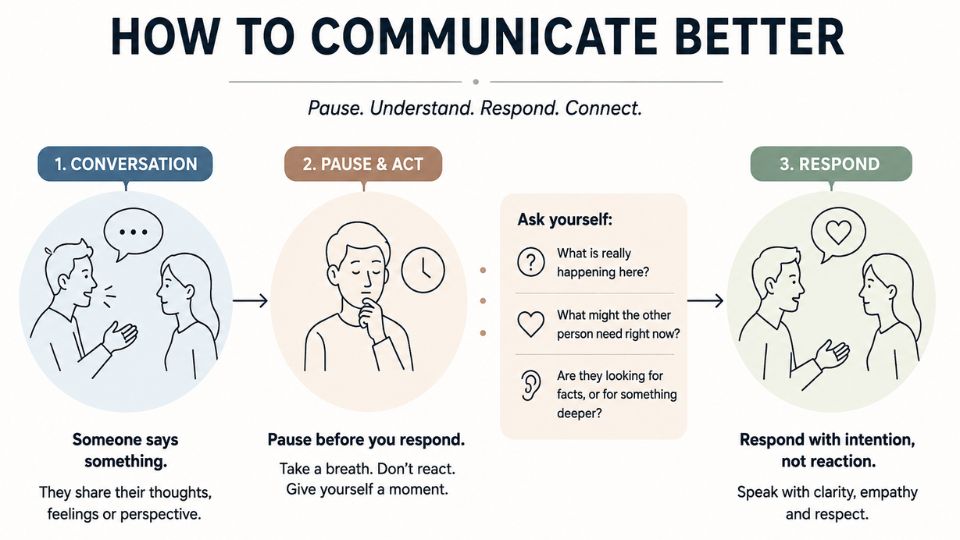
Because many conversations are not only about facts.
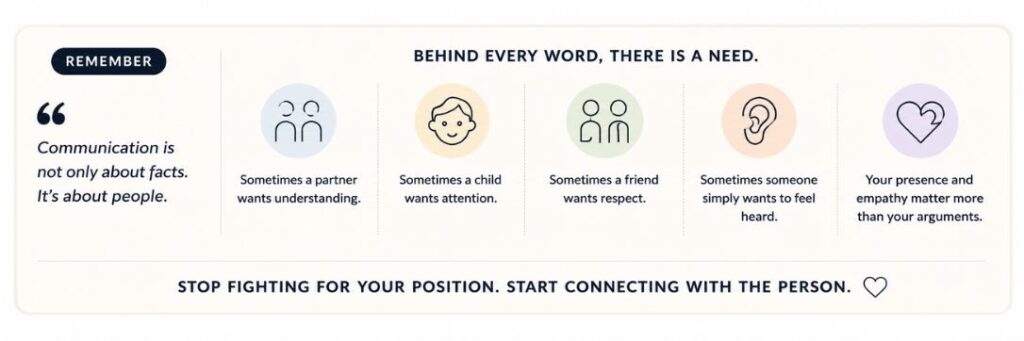
Sometimes a partner wants understanding.
Sometimes a child wants attention.
Sometimes a friend wants respect.
Sometimes another person simply wants to feel heard.
Communication changes the moment you stop fighting only for your position and begin paying attention to the person standing in front of you.
Communication Is About Understanding People
Communication is not mathematics.
It is not about winning arguments.
It is not about proving who is right.
It is human nature.