

How the Mind Works at a Fundamental Level
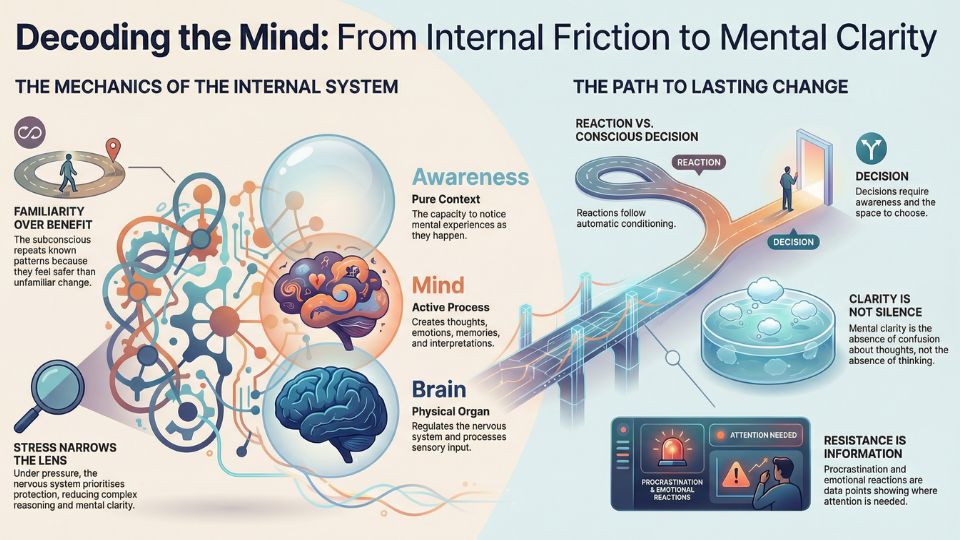
To understand how the mind works, we first need to clear up a few common confusions.
The Difference Between Brain, Mind, and Awareness
The brain is a physical organ. It processes sensory input, regulates the nervous system, and enables cognition.
The mind is not a thing. It is a process. It includes thoughts, emotions, memories, interpretations, impulses, and meaning-making.
Awareness is the capacity to notice experience as it happens.
Most people unconsciously collapse these three into one. As a result, every thought feels true, every emotion feels justified, and every mental impulse feels like a command.
But thoughts arise in awareness. Emotions move through awareness. Sensations appear and disappear within awareness. Awareness itself is not a thought or emotion. It is the context in which mental processes occur.
This distinction is not philosophical. It is practical.
When awareness is weak, people identify with whatever appears in the mind. When awareness strengthens, the relationship changes. Thoughts are seen as events, not identities. Emotions are experienced, not obeyed.
Understanding how the mind works begins here.
Why Identification Creates Inner Friction
When a person identifies completely with their mental activity, inner conflict becomes unavoidable.
One thought says I should act.
Another says I’m not ready.
An emotion pulls one way, a belief pulls another.
Because these inner movements are not seen clearly, they feel like “me.” The result is confusion, hesitation, and self-judgment.
Clarity does not come from eliminating thoughts. It comes from seeing how the system operates.
Why Confusing These Layers Creates Suffering
When the brain, mind, and awareness are not clearly distinguished, inner friction becomes inevitable.
A thought appears, and it feels true.
An emotion arises, and it feels justified.
An impulse shows up, and it feels like it must be acted on.
Because awareness is collapsed into mental activity, everything that appears inside the mind is experienced as “me.” There is no distance, no context, and no space to choose. The system becomes reactive by default.
This is why people feel trapped inside their own thinking. They are not observing mental processes, they are identified with them. Every internal movement becomes personal. Every fluctuation in mood becomes a verdict about who they are. Every hesitation becomes a flaw.
From this position, self-control feels exhausting. Clarity feels temporary. Discipline feels forced.
When awareness is not differentiated from the mind, the person is constantly negotiating with their own thoughts and emotions, trying to suppress some, amplify others, and justify the rest. This creates continuous internal tension.
Suffering does not arise because thoughts exist.
It arises because thoughts are mistaken for identity.
Once awareness is recognized as the context rather than the content, the entire system reorganizes. Thoughts are still present, but they are no longer commands. Emotions still move, but they no longer dictate behavior. Sensations still arise, but they are no longer interpreted as threats.
Understanding how the mind works at this level does not remove difficulty from life. It removes unnecessary conflict with experience itself.
That is where clarity begins.
Perception and Interpretation: Where Reality Gets Filtered
One of the most important aspects of how the mind works is also one of the least noticed: interpretation.
Perception vs Interpretation
Perception is raw input. Sounds, images, words, memories, bodily sensations.
Interpretation assigns meaning to that input.
This happens almost instantly and mostly outside conscious awareness.
Two people can experience the same event and walk away with completely different emotional responses. The difference is not the event. It is the interpretation.
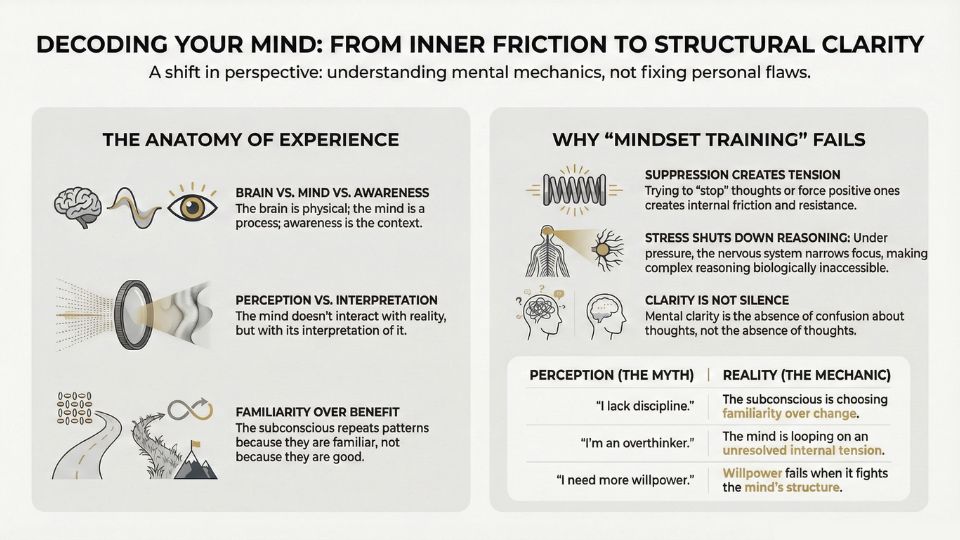
The mind does not interact with reality directly. It interacts with its interpretation of reality.
How Past Experience Shapes Interpretation
Interpretation is shaped by past experiences, emotional memory, beliefs, and conditioning. The subconscious mind plays a dominant role here. It scans constantly for threat, relevance, and familiarity.
If a situation resembles a past negative experience, the mind reacts before conscious reasoning has time to intervene. This is why emotional reactions often feel automatic.
Understanding how the mind works means understanding that most reactions are not chosen. They are conditioned.
This realization alone reduces self-blame.
The Subconscious Mind and Automatic Mental Processes
Much of how the mind works happens beneath conscious awareness.
Why the Subconscious Prefers Familiarity
The subconscious mind stores patterns. Habits, emotional responses, assumptions, identity structures. Its primary function is efficiency.
Once a pattern is established, it is repeated automatically. This conserves energy and reduces uncertainty.
The problem is that the subconscious prefers what is familiar over what is beneficial. This is why people return to old habits even when they no longer serve them.
Familiar discomfort feels safer than unfamiliar change.
Habit Loops and Emotional Conditioning
Habits are not just behavioral. They are emotional and cognitive.
A trigger appears.
A response follows.
A short-term relief or reward reinforces the loop.
Over time, these loops become embedded. Conscious intention alone is rarely strong enough to override them.
Understanding how the mind works reveals why willpower fails and why awareness-based change succeeds.
Inner Dialogue and Why We Overthink
Inner dialogue is one of the most visible expressions of mental activity.
Thoughts comment constantly. They evaluate, compare, predict, rehearse, criticize, and justify.
Overthinking Is Not Excess Intelligence
Overthinking is often misunderstood. It is not a sign of high intelligence. It is a sign of unresolved tension.
The mind replays thoughts when something remains incomplete: a decision not made, a boundary not set, an emotion not processed, a responsibility avoided.
The system keeps looping because it has not found resolution.
Why Suppression Makes It Worse
Trying to “stop thinking” rarely works. Suppression adds tension. The mind responds with more activity.
Understanding how the mind works reframes overthinking. Thoughts are attempts to resolve something. When the underlying issue is addressed, mental noise decreases naturally.
Attention and Awareness: Why Focus Breaks Down
Focus is often treated as a character trait. In reality, it is a function of awareness and energy.
Attention Is a Limited Resource
The mind can only hold a certain amount of information at once. When cognitive load increases, clarity decreases.
Constant multitasking fragments attention. Continuous stimulation exhausts mental resources. This is not a moral failure. It is biology.
Awareness Stabilizes Attention
Attention follows awareness. When awareness is weak, attention gets pulled by impulses, emotions, and external triggers. When awareness strengthens, attention becomes intentional.
This is why sustainable focus training does not rely on force. It relies on noticing distraction.
Understanding how the mind works shifts focus from control to relationship.
Stress, the Nervous System, and Loss of Mental Clarity
The mind does not operate the same way under stress.
How Stress Changes Mental Functioning
When the nervous system perceives threat, it shifts into a protective mode. Attention narrows. Emotional responses intensify. Complex reasoning decreases.
This is why people make impulsive decisions, freeze, or react aggressively under pressure.
It is not a lack of intelligence. It is a physiological response.
Why Mental Clarity Depends on the Body
Mental clarity is inseparable from nervous system regulation.
Skills learned in calm states become inaccessible under stress unless they are deeply integrated. This is why techniques collapse when pressure rises.
Understanding how the mind works includes understanding how the body influences perception, emotion, and decision-making.
Why Common Mindset Training Fails
If the section above resonated, this short explanation will help you see the structure behind it.
The popularity of mindset training suggests that people sense something important is missing. Focus, confidence, discipline, clarity, and emotional stability are all influenced by how the mind works.
Yet most mindset training fails to produce lasting change.
The Problem With Positive Thinking
A large portion of mindset training focuses on replacing “negative” thoughts with positive ones. This approach assumes that thoughts are the problem and that better thoughts will fix behavior.
But thoughts are symptoms, not causes.
When internal resistance, fear, emotional charge, or unresolved conflict remains untouched, replacing thoughts only creates tension. One part of the mind repeats affirmations. Another part does not believe them. The result is internal friction.
This is why people feel motivated for a short time and then revert.
Motivation Is Not a Stable Foundation
Motivation fluctuates by nature. It depends on energy, emotion, and circumstances. Training the mind to rely on motivation guarantees inconsistency.
When mindset training ignores how the mind works under stress, fatigue, or uncertainty, it collapses when it is needed most.
Lasting change is not created by emotional highs. It is created by structural clarity.
Cognitive Patterns and Mental Conditioning
To understand why change sticks or fails, we need to look at cognitive patterns.
What Cognitive Patterns Really Are
Cognitive patterns are repeated ways of perceiving, interpreting, and responding to experience. They form through repetition and emotional reinforcement.
Examples include:
- Interpreting uncertainty as danger
- Equating rest with laziness
- Avoiding decisions to escape responsibility
- Overanalyzing to feel in control
These patterns are not conscious choices. They are conditioned responses.
Understanding how the mind works means recognizing that cognition is shaped long before conscious intention appears.
Mental Conditioning Shapes Identity
Over time, cognitive patterns solidify into identity statements:
- “I’m not disciplined”
- “I always overthink”
- “I work better under pressure”
These are not objective truths. They are conclusions drawn from repeated patterns.
Once identity forms around a pattern, the mind defends it. Even change can feel threatening if it challenges who a person believes they are.
This is why willpower alone rarely works. It fights the structure instead of understanding it.
Conscious Decision Making and Responsibility
Many people believe they are making conscious decisions when they are actually reacting.
Reaction vs Decision
A reaction is immediate and automatic. It follows conditioning.
A decision requires awareness, space, and responsibility.
When awareness is low, reactions feel justified. When awareness increases, responsibility becomes unavoidable.
Understanding how the mind works reveals that freedom is not doing whatever you want. It is seeing clearly enough to choose.
Responsibility Is Internal, Not Moral
Responsibility is often misunderstood as blame or pressure. In reality, it is clarity.
When you see how your mind works, excuses dissolve naturally. Not because you force accountability, but because avoidance becomes visible.
This is uncomfortable at first. But it is also stabilizing.
People who avoid responsibility live in constant mental negotiation. People who accept it experience relief.
Mental Clarity Is Not the Absence of Thought
“Some people integrate understanding more deeply through listening rather than reading.
This short audio reflection explores the same principles from a different angle, without adding new concepts.”
One of the most persistent myths about the mind is that clarity means silence.
Why Trying to Stop Thoughts Fails
Thoughts are a natural function of the mind. Trying to eliminate them creates resistance.
Mental clarity is not the absence of thought. It is the absence of confusion about thought.
When thoughts are seen clearly, they lose their grip.
Clarity Comes From Relationship, Not Control
When awareness strengthens, thoughts are noticed as events rather than commands. Emotions are felt without being acted out. Sensations are experienced without interpretation.
This shift changes everything.
Understanding how the mind works reframes clarity as orientation, not emptiness.
Practical Integration: Principles, Not Hacks
Sustainable change does not come from techniques. It comes from principles.
Principle 1: Awareness Precedes Change
Nothing meaningful changes without awareness. This includes habits, emotions, and decision-making.
When awareness increases, unconscious patterns surface. Change follows naturally, without force.
Principle 2: Resistance Is Information
Resistance is not an obstacle. It is data.
Avoidance, procrastination, and emotional reactions point directly to where attention is needed. Fighting resistance strengthens it. Observing it weakens it.
Principle 3: Consistency Emerges From Structure
Discipline is not self-punishment. It is alignment between intention and capacity.
When life structure supports mental clarity, consistency becomes natural.
Understanding how the mind works allows structure to be designed intelligently rather than imposed harshly.
How Understanding the Mind Affects Habits, Leadership, and Purpose
When the mind is understood, its influence spreads across all areas of life.
Habits and Self-Trust
Habits are built through repetition, but sustained through self-trust.
When actions align with internal understanding, trust grows. When actions contradict awareness, trust erodes.
This is why superficial habit tracking often fails. It ignores the internal relationship.
Leadership and Decision Quality
Leadership begins internally.
A person who understands how their mind works can:
- Respond instead of react
- Hold tension without collapsing
- Make decisions without constant reassurance
This applies whether leading a team, a family, or oneself.
Purpose and Direction
Purpose is not discovered through thinking harder. It emerges through clarity.
When mental noise decreases, direction becomes obvious. Not dramatic, but grounded.
Understanding how the mind works clears the path for purpose to surface without force.
Closing Reflection
The mind is not an enemy to be conquered or a machine to be optimized.
It is a system that follows understandable principles.
When those principles remain unseen, life feels reactive, fragmented, and exhausting. When they become clear, effort decreases and alignment increases.
You do not need to fix yourself.
You need to understand the system you are already living inside.
The more clearly you see how the mind works, the less you fight it, and the more naturally change unfolds.