

Self-confidence is one of the more complicated things inside the human mind.
It is connected to how we perceive our own value, existence, and importance in the world around us.
Even though self-confidence feels internal, it is often closely connected to external factors such as circumstances, relationships, feedback, success, failure, and how other people respond to us.
Personally, I had what I would call either a curse or a privilege, depending on how you look at it.
As a child, I believe I was relatively neutral in my self-confidence.
In elementary school, however, my intellectual confidence dropped significantly.
Later, in high school, it slowly began to rise, and this continued through university and then through law and attorneyship.
This experience taught me that self-confidence can vary enormously depending on external and internal factors, both around us and within us.
Why People Are Building the Wrong Kind of Confidence
I remember a moment when I was in therapy and describing one of my friends. I mentioned that he was emotionally very strong and had enormous self-confidence.
The therapist asked me an interesting question:
“Are you sure that is confidence, or could it be a defense mechanism?”
I was around forty when I first heard that sentence, and it opened a whole new world for me.
He correctly pointed out that, in this specific case, my friend was not operating from confidence but from defense and external authority, which appeared to be confidence from the outside.
Later, I realized that real confidence is an internal feeling that does not need to constantly show itself externally.
External confidence vs internal confidence
Connected to the example above, external confidence can often be highly constructed, adapted, or learned in order to function better in the world.
That is not necessarily bad; it is only the question of whether you want to build your confidence from the outside in or the other way around.
All people have defense mechanisms.
Someone can appear extremely confident externally while, internally, feel something completely different.
Of course, people can also develop strong systems, habits, and ways of functioning that eventually even convince themselves that they are confident.
But sometimes external confidence is only covering internal insecurity.

This is why external confidence alone is not enough.
Yes, it can help you function better in the world.
It may help with relationships, work, leadership, business, or social success.
But in the long run, if internal confidence does not exist beneath it, something eventually starts to collapse internally.
You may continue telling yourself that you are confident and satisfied while internally feeling the opposite.
You have probably met people who radiate enormous confidence.
But perhaps you never stopped to ask yourself whether this was true confidence or simply a system that someone developed to survive and function better in the external world.
A genuinely internally confident person does not depend on external validation.
Remember that well.
A person with real inner stability does not constantly need to prove their value.
They simply operate from their internal posture and strength.
And regardless of whether people praise, criticize, mock, or reject them, they remain internally stable.
That is real confidence.
Why chasing validation works against you
For all of these reasons, chasing external validation is usually limited to temporary success.
People can only pretend for so long before things begin to weigh heavily internally.
We may tell ourselves that the problems are outside us, while failing to recognize that many of the struggles are connected to our own lack of internal confidence.
This is why external validation eventually turns against you.
No matter how perfect you try to become, how ideal of a father, husband, employee, founder, entrepreneur, or business owner you try to be, there will always be somebody who disapproves of you.
Somebody who criticizes you.
Mocks you.
Rejects you.
Or simply does not give you the reaction you hoped for.
The more your confidence depends on external validation, the more difficult life becomes.
Because you constantly find yourself trying to prove to the external world that you are enough.
The difficult part is that these patterns are often hidden.
The ego is extremely skilled at creating explanations and defenses that appear legitimate on the surface, while, beneath the surface, they are still driven by the need for approval.
How the approval loop keeps you stuck
As a result, many people become trapped inside an approval loop.
Like a mouse running in circles without finding a way out.
As long as somebody constantly searches for approval or validation, they usually continue repeating the same patterns.
Sooner or later, people begin to notice that the same problems keep recurring.
The same insecurities.
The same emotional reactions.
The same frustrations.
They need to prove themselves again and again.
And without realizing it, they slowly become trapped inside their own patterns.
What Real Self-Confidence Actually Is
Confidence is deeply connected to internal self-trust and, in reality, has very little direct connection to the external world.
The moment somebody constantly needs to promote themselves or display confidence externally can already be a sign that internal confidence is missing.
Because somebody who genuinely trusts themselves usually does not need to constantly show it.
A truly confident person who trusts their thinking, decisions, and abilities generally does not need external validation or constant confirmation from others.
Confidence as self-trust, not self-promotion
Real confidence is much more closely tied to self-trust than to self-promotion.
A person who genuinely trusts themselves usually does not feel a constant need to prove themselves to others.
They do not need to dominate every conversation, constantly explain why they are right, or seek validation from the environment around them.
This is one reason why externally loud confidence and internal confidence are often two completely different things.
Some people project confidence externally because they need the reaction.
Others simply operate from internal stability.
And there is a big difference between those two states.
Why truly confident people are often the quietest
For this reason, truly confident people are often among the quietest people in the room.
In conversations, meetings, or social situations, they usually do not feel the need to constantly prove that they are right.

They do not need to perform a confidence test.
Very often, they simply observe, listen, and speak when they feel it matters.
Of course, it is important to distinguish silence driven by confidence from that driven by fear.
Just because somebody is quiet does not automatically mean they are internally confident.
A person can also remain silent because they are afraid to express themselves, afraid of judgment, or afraid to expose their opinion.
A genuinely internally confident person, however, usually has no problem doing either.
They can speak openly when necessary.
Or remain silent without discomfort.
They can be loud, quiet, expressive, or reserved, depending on the situation, because they are not internally trying to protect their value.
And when you begin speaking to people like this, you usually notice something interesting.
Not only do they often know exactly what they are talking about, but they also communicate without arrogance, excessive self-promotion, or attacks on others.
They simply appear internally settled.
When I realized my confidence was built on the wrong foundation
In high school, as I already mentioned, my confidence started growing again, but in the wrong way.
Of course, at that time, I was completely unaware of it.
I started getting better grades in school and became a near-A student. This intellectual success dramatically increased my confidence.
In sports, I was already relatively confident before that, but now this intellectual confidence has also started growing, first within the police high school environment and later outside it as well.
Because of this, I later continued my studies at two universities, completed law school, earned my master’s degree, and eventually earned my doctorate.
Only much later did I realize that many of my academic achievements were actually deeply connected to external validation.
Those achievements gave me internal confidence through external circumstances.
Do not misunderstand me.
I was genuinely becoming more confident internally.
But… It still was not enough. I still felt inferior in general discussions, asking many questions to understand so I could participate in debates. I did not have that kind of confidence where I could simply say to myself:
“I do not know this, I am a specialist in my own areas, and you are specialists in yours.”
General knowledge was the thing I felt I was missing.
Even today, this is not something I particularly pride myself on, nor does it feel especially important to me.
Politics, general topics, and broad general knowledge never interested me that much. I was always a more specific type of person.
Today, I simply accept this part of myself with a much healthier level of internal confidence.
Why High Performers Often Struggle with Confidence the Most
There is an interesting contradiction in many high performers.
From the outside, they often appear extremely confident, stable, successful, disciplined, and emotionally strong.
But internally, many of them have built external success partly to compensate for something they feel is missing inside themselves.
That insecurity does not need to exist in every area of life.
Sometimes it appears only in one specific area.
A person may feel financially insecure and then spend their life building enormous financial success in order to compensate for a lack of inner safety or emotional stability.
In my family, money was often a measure of love.
It meant that if you bought something for someone, gave gifts, or financially supported them, it showed that you loved them.
I carried this pattern into my relationships and into my life with my children. It took me quite a long time to become aware of it and slowly free myself from it.
The imposter syndrome trap for founders and CEOs
As a result, many successful people struggle with imposter syndrome, including founders, CEOs, and high performers.
Deep inside, they often do not fully trust their own abilities and secretly fear that one day they will be exposed as incapable, incompetent, or fraudulent.
External success alone does not automatically create internal peace.
It does not automatically create self-trust.
And it does not guarantee emotional stability.
A very good example of this can often be seen in the entertainment industry.
Actors, actresses, performers, celebrities, and highly successful public figures may achieve enormous success while internally still struggling with insecurity, validation, and the constant need for approval.
Very often, this goes beyond the profession itself.
It points toward something deeper happening underneath the surface.
Why external success can mask deep internal doubt
This is one reason why external success can sometimes hide deep internal insecurity.
If you look carefully at the world around you, you will notice many people who appear far more confident externally than they actually feel internally.
Sometimes aggressive behavior hides insecurity.
Sometimes humor does.
Sometimes dominance.
Sometimes perfectionism.
Sometimes, constant achievement.
A person may spend years building status, money, influence, recognition, or external authority while internally still feeling inadequate.
And because the external image looks strong, very few people ever question what may be happening underneath it.
How high standards erode self-trust over time
High standards are not the problem.
The problem begins when standards become impossible to satisfy.
At that point, nothing feels good enough for long.
People achieve one goal and immediately move to the next.
Instead of building self-trust, they slowly teach themselves that no success is ever enough.
Over time, this becomes exhausting.
Achievement no longer creates confidence.
Only temporary relief before the next pressure begins.
How to Build Self-Confidence From the Inside Out
This is a very important part of building self-confidence.
No matter where you are in life or how successful you already are, if you feel that your confidence needs to change, this is the right moment to start working on it.
Real confidence has to be built from the inside out.
The first step is honest self-analysis.
You need to understand where you are now and where you want to go.
For example, if you notice insecurity in public speaking, appearance, relationships, finances, or leadership, it is important to first understand where these patterns come from and why you feel the way you do.
Only then can you slowly begin changing them.
Sometimes this process can be done through self-reflection, and at other times, external help can accelerate it significantly.
Give yourself time.
This is a long-term process.
Over time, old patterns are slowly replaced by healthier, more internally confident ones because you begin reacting from the inside out rather than depending on the outside world.
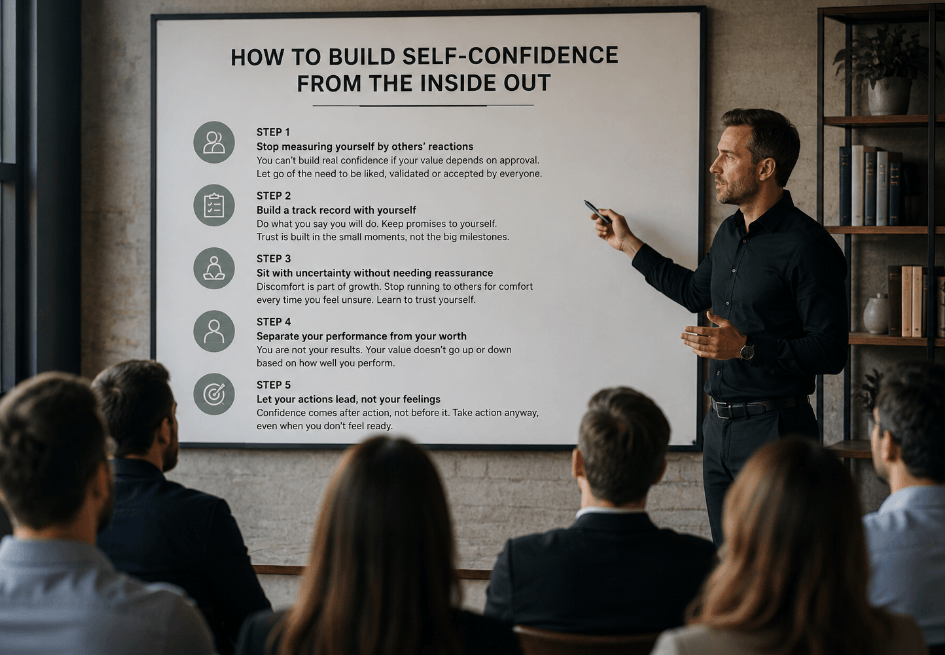
How to build self-confidence from the inside out
Step 1 – Stop measuring yourself by others’ reactions
Step 2 – Build a track record with yourself
Step 3 – Sit with uncertainty without needing reassurance
Step 4 – Separate your performance from your worth
Step 5 – Let your actions lead, not your feelings
The Silent Engine – How Genuine Confidence Works in Practice
It is extremely important that confidence becomes an internal driver rather than a reaction to external circumstances.
Because the moment your confidence depends mainly on external reactions, you slowly lose control over your internal stability.
Genuine confidence works differently.
It operates quietly in the background and shapes how you think, decide, react, and navigate difficult situations.
How self-trust changes decisions under pressure
Once your decisions come from internal stability and inner calm, it becomes much easier to operate under pressure.
Stress decreases because, internally, you begin to place things in the right perspective.
Instead of constantly reacting emotionally, you start asking yourself a much simpler question:
“What is the right thing to do?”
And then you do it without unnecessary drama.
At the same time, the constant need to justify or explain yourself slowly starts disappearing.
Because self-trust changes how you relate to pressure.
You no longer need external approval before making difficult decisions.
When confidence stopped being something I looked for and started being something I operated from
I had already been practicing law for several years when I slowly began to realize how much external reactions from others still influenced me, especially those from lawyers and judges.
That was the moment when I finally began seeking internal confidence rather than external confirmation.
In practice, this meant becoming much more decisive, firm, and confident in my opinions.
Even when judges or other lawyers disagreed with me and presented arguments against my position, I often continued to stand by my decisions, especially when I believed strongly in them.
Many of those ideas were outside standard legal thinking and outside established court practice.
As a lawyer, this always carries risk. But I was confident of my honest beliefs, and other colleagues came to me for help when they had hard cases with weak arguments or evidence. I could often find some solution that would give a firm ground to work on.
The moment you begin exploring new approaches outside established legal practice, there is always a possibility that you will be heavily punished and lose the case.
Because of that, a person needs enormous internal confidence to continue acting in accordance with their own understanding, knowledge, and experience.
At the same time, you also need to accept the possibility that you may lose and later have to honestly tell your client that the approach did not work.
The healthiest way I found to handle this was to be completely transparent.
I explained the path I believed was correct, the risks associated with it, and then allowed the client to decide whether to move forward in that direction.
Confidence and Identity – Why One Cannot Exist Without the Other
Self-confidence is deeply connected to identity.
It is connected to the essence and core of our existence, our ego, and our sense of self.
The more internally aligned and confident we become, the deeper our understanding of who we really are, what we want, and what we have actually achieved in life becomes.
Without confidence, identity often remains undeveloped or hidden underneath fear, adaptation, and external validation.
How your self-image sets the ceiling on your confidence
Your self-image quietly determines how much confidence you allow yourself to experience.
If deep inside you see yourself as weak, incapable, unworthy, or not good enough, your external confidence will always eventually hit a ceiling.
You may temporarily outperform that self-image through discipline, achievement, money, status, or external success, but internally, you will still struggle to fully trust yourself.
This is why many highly successful people still secretly feel insecure.
Because internally, they still carry an outdated image of who they are.
Over time, real confidence grows as your self-image becomes healthier, calmer, and more aligned with reality rather than fear or old conditioning.
Why confident behavior without an identity shift does not last
Many people try building confidence only through behavior.
They change posture, communication, appearance, body language, public speaking, or social skills.
And yes, those things can absolutely help externally.
But if identity underneath remains unchanged, the confidence often becomes temporary.
Under pressure, people usually return to the identity they truly believe in.
This is why someone can appear extremely confident one day and completely collapse emotionally the next after criticism, rejection, or failure.
Real long-term confidence usually requires an identity shift, not only behavioral techniques.
Knowing who you are is what makes you trust what you do
The more clearly you know who you are, the easier it becomes to trust your own decisions, actions, and life direction.
Because uncertainty about identity creates uncertainty in almost everything else.
People who do not know who they are often constantly search outside themselves for direction, validation, reassurance, and approval.
Internally grounded people operate differently.
They still make mistakes.
They still experience doubt.
But underneath those emotions, there is usually a stable internal foundation that helps them continue moving forward.
And that internal foundation is often much more important than confidence itself.
Common Things That Destroy Self-Confidence
Below are some of the most common things that slowly destroy self-confidence.
Comparison is probably one of the biggest problems today, together with perfectionism.
At the same time, people constantly live either in the past or in the future, rather than staying present.
Part of this is deeply connected to human evolution and survival, as the human mind is built to anticipate danger, uncertainty, and future threats.
But through awareness and conscious work on yourself, many of these patterns can slowly be changed.
Comparison as a confidence killer
Comparison quietly destroys self-confidence over time.
The moment you constantly compare yourself to others, you slowly stop seeing your own progress clearly.
There will always be somebody richer, smarter, stronger, more successful, or more attractive.
And if your confidence depends on winning comparisons, you will rarely feel internally satisfied.
Real confidence usually grows when you stop building your value around other people.
How perfectionism disguises itself as high standards
Perfectionism often looks positive from the outside.
People frequently confuse it with discipline, ambition, or high standards.
But underneath it is often fear of failure, criticism, rejection, or not feeling good enough.
Perfectionists usually struggle to enjoy achievement because internally, nothing ever feels fully complete.
And over time, this slowly damages self-trust.
How the mind holds onto past failure
The human mind naturally remembers painful experiences more strongly than positive ones.
Because of this, many people continue carrying old failures long after the situation itself has ended.
They begin building their identity around mistakes, rejection, embarrassment, or disappointment.
Over time, the past slowly becomes proof that they are not capable enough.
And this quietly limits confidence in the present moment.
Environments and relationships that drain self-trust
Some environments slowly destroy self-confidence without people even realizing it.
Constant criticism, unhealthy relationships, manipulation, disrespect, or emotionally exhausting workplaces can deeply affect self-trust over time.
Even highly capable people can begin to doubt themselves if they spend years in unhealthy systems.
This is why the environment matters much more than most people think.
Sometimes rebuilding confidence also requires changing the people or environments surrounding you.
How to Rebuild Confidence After a Setback
Rebuilding confidence after a setback is not simple.
But it is absolutely possible.
The fact that you are even reading and reflecting on these things already means that you are working on yourself, and that is an important step in the right direction.
What is important is not being too hard on yourself.
Real change takes time.
With internal work, self-reflection, and sometimes external help through coaching, programs, education, or support, your mind slowly begins to move toward healthier confidence and away from patterns you may have carried for decades.
The important thing is consistency.
It is less important exactly what you do and more important that you keep doing something regularly.
The bigger the gaps become between your efforts, the easier it becomes to fall back into old patterns.
Daily or weekly self-work is often the real key to long-term change.
Confidence after failure feels different from before it
Confidence rebuilt after failure usually feels very different from the confidence that comes early.
It is often quieter, calmer, and less dependent on external validation.
People who rebuild themselves after difficult periods usually stop trying to appear perfect.
Instead, they slowly develop a more realistic and stable relationship with themselves.
And very often, this becomes a much stronger form of confidence than they had before the setback happened.
Start with an honest assessment, not positive thinking
Real confidence rebuilding usually does not begin with positive thinking.
It begins with honesty.
You need to honestly look at what happened, where you made mistakes, what hurt you, and what still affects you internally.
Without that honesty, people often only place motivational thinking over unresolved problems.
Real confidence grows when people gradually stop escaping from themselves and begin to understand themselves more clearly.
When my confidence took a real hit and what helped me rebuild
My confidence was definitely damaged several times throughout life.
Usually, it was connected to my intellectual side. My sentence was:
“I’m not smart enough.”
I remember a period when I had already achieved a certain level of success inside the police, but then moved into economic crime investigations as a criminal investigator.
After around eight years of police experience, I suddenly found myself working under a superior who was extremely strict and, at least from my perspective at that time, very unsupportive toward me.
Later in life, I realized that much of this was probably connected to her own insecurity, something I only understood years later, when our relationship actually improved.
At the beginning, however, I received almost no support, guidance, or mentoring.
I had moved from traffic police to economic crime investigations, which was a completely different field. I needed help and didn’t get any.
Naturally, I expected that somebody would at least temporarily guide me until I adapted to the new environment.
That never happened.
Instead, I constantly experienced her communication as criticism, humiliation, or pressure.

Those first weeks and months were extremely difficult for me and deeply affected my confidence.
At that time, I did not yet have the understanding I have today.
But looking back now, I can see that slowly working on myself helped me stabilize internally again.
One important thing was that, over time, I stopped holding resentment toward her because I eventually recognized that she was also quite insecure.
Interestingly, once she was no longer in the leadership position, the environment improved significantly, and our relationship became much healthier.
That experience taught me something important.
Sometimes understanding another person’s insecurity can help you stop carrying anger and slowly rebuild yourself instead of remaining trapped inside resentment.
Confidence Is Rebuilt One Decision at a Time
Confidence is usually not rebuilt in one big moment.
More often, it is rebuilt quietly, through small daily actions, honest self-reflection, and learning to trust yourself again, step by step.
You do not need to become perfect.
You only need to slowly stop abandoning yourself every time life becomes difficult.