
Most of Your Life Runs on Autopilot
A habit becomes an automatism.
The vast majority of things in our lives are done according to our habits.
Human beings are naturally inclined to simplify things. The problem arises when we are unaware of this and believe we are living a creative and fulfilling life, while in reality, we are living under the unconscious guidance of our habits.
It is important to emphasize that most of our habits originate in early life.
Either we adopt them from our parents, friends, or other people in the form of specific patterns of behavior and action that later become our habits, or habits develop as a result of various defense mechanisms.
Everything described here becomes a problem primarily because it occurs unconsciously.
We ride a bicycle in a certain way, we drive a car in a certain way, we walk in a certain way, and we communicate in a certain way.
All of this happens through automatisms we never consciously chose.
And that is the key point.
We are repeating the same patterns
We believe we are deciding.
But in reality, we are repeating.

As mentioned, we would like to change some or many of our habits, such as smoking, unhealthy eating, swearing, or excessive emotional reactions, yet we are unable to do so.
Or rather, we would prefer not to have these habits, yet despite our efforts, we fail to achieve lasting change.
It may even happen that we try to change a habit for a certain period and still do not succeed.
This creates confusion.
Because on one side, there is intention.
On the other side, there is behavior.
And they do not match.
The reason is simple.
What is unconscious always wins over what is temporary.
As long as habits operate below awareness, they guide action automatically.
Not because you chose them, but because they were repeated long enough to become part of you.
And that is why change feels so difficult.
Not because you do not want it.
But because most of what you do is already decided before you even think about it.
Why You Cannot Change Your Habits
The reasons for this are very simple.
They lie in our subconsciousness and in our ego defense mechanisms, which operate on the principle of making life easier, achieving maximum results with minimal effort.
What is familiar and “ours” is the hardest to change.
When we attempt to change a habit, we immediately enter a zone of discomfort.
We step into the unknown, not knowing what will follow.
This creates anxiety, stress, and resistance.
As a result, we quickly slip back into the old habit we do not want.
At the same time, we desire good habits.
We want more movement or exercise.
Healthier nutrition.
More time in nature.
More mindfulness or meditation.
We want change.
Yet when we try to enforce these habits, we often find ourselves unable to maintain them over the long term.
For the same reason as before.
Human nature is deeply rooted in the subconscious and in existing habits.
That is why changing an internal pattern or habit appears to require a great deal of energy, time, and effort.
But the real problem is not effort.
It is the internal conflict.
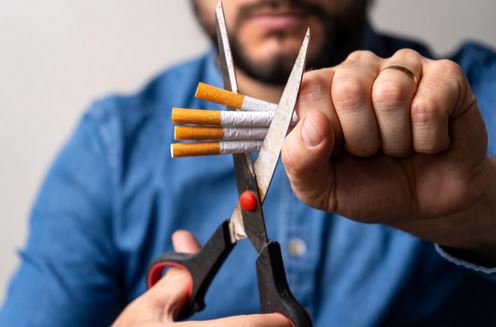
How to quit smoking?
A good example is smoking.
A person decides to quit on January first.
Motivation is high.
Willpower is strong.
The negative consequences are clear.
They stop.
For a few days, things hold.
Then thoughts begin.
How difficult this is.
How strong the craving is.
At first, motivation is still strong enough to resist.
But as the days pass, motivation declines.
Willpower weakens.
And then something else appears.
The inner dialogue
“What is all this effort even for?”
“Who is actually in control here?”
“If I want to smoke, why shouldn’t I?”
The ego steps in.
Not aggressively.
But persuasively.
It starts to build arguments.
A doctor cannot control you.
Your partner cannot control you.
No one can tell you what to do.
And slowly, thought by thought, it weakens your decision.
Until one moment appears.
“You have already gone three weeks without a cigarette.
One will not change anything.”
And this is usually the breaking point.
Because one cigarette rarely stays one.
A second follows.
Then another.
And eventually, the person returns to where they started.
The same pattern appears in dieting.
After restriction comes anxiety.
After anxiety comes compensation.
The body stores.
The mind justifies.
And the cycle repeats.
Many people have tried to change habits and failed.
Not because they are weak.
But because they approached it the wrong way.
They tried to force change quickly.
They tried to fight the habit directly.
And that is where most attempts break.
How Habits Actually Change
The basic principle of changing habits is not to change them quickly, but to replace a bad habit with a good one.
It is good to change habits slowly and over the long term.
To change a habit that someone has practiced for twenty or thirty years undoubtedly requires time.
Not days. Not weeks.
Months.
Often years.
Of course, some people succeed in a few weeks, some even in a day or literally instantaneously.
The man who quit smoking at once
I remember my neighbor.
He had been smoking for forty years.
Then one day, he was diagnosed with prostate cancer.
And in that exact moment, everything changed.
The day he left the hospital, he stopped smoking. Completely.
Not gradually.
Not with struggle.
Instantly.
What was even more striking was his reaction.
He became almost angry at people in the hospital who were still smoking, even though they had serious illnesses.
For him, it became unimaginable.
He told me himself that he could not believe two things.
First, how he had been able to smoke for so many years.
And second, how he was able to stop so quickly.
What happened inside him?
The answer is simple.
Fear.
The fear of losing his life became stronger than the pleasure of smoking.
And that is something important to understand.
People often break habits when the pain outweighs the reward.
I met him a few times after that.
He was still holding strong.
The motivation was still there.
The fear was still strong.
But a question remained.
What happens in three, five, or ten years?
Will that same intensity remain?
Or will the old habit slowly return?
In my neighbors’ case, history will tell as they say.
Desire does not disappear overnight
But one thing is true.
The desire does not disappear overnight.
The body remembers.
For years.
In eastern traditions, they are called SAMASKARAS – old patterns, memories. And they are not easy to erase.
And this is where replacement becomes critical.
If someone replaces a cigarette with something else, something healthier, that is a step forward.
If, for forty years, you held a cigarette in your hand and now you can hold a carrot, that matters.
Otherwise, the pattern finds another way.
That is why many people gain weight after quitting smoking.
They are used to holding something.
To repeat a certain action.
And that action shifts into eating.
But the most powerful transformation I have seen is this.
People who replace a habit with movement.
With sport.
My close friend did exactly that.
After thirty years of smoking, he started cycling.
I still remember our first ride.
We went up a hill.
Halfway through, he had to stop.
We turned around.
He was exhausted.
Physically and mentally.
Disappointed.
Five or ten years later, everything was different.
Today, at sixty, he rides at thirty-five kilometers per hour.

And I can barely keep up behind him.
That is not talent.
That is not luck.
That is years of consistent practice.
That is discipline.
And that is what habits do over time.
Reality is different
The majority can’t change habits in a matter of days.
People are different, and we cannot draw conclusions based on a few individuals who achieved change quickly.
It is widely known and logical.
Habits formed over years or decades cannot simply be overcome in a matter of days or weeks.
Our system is not built that way.
And even less so our mind, which constantly pulls us back into the comfort zone.
This is why the solution is not a radical change.
It is the opposite.
Planned.
Gradual.
Conscious.

A bad habit must be replaced, not just removed.
Something has to take its place.
As we discussed cycling.
So, if someone drinks too much coffee, they can switch to tea.
If someone consumes too much sugar, they can replace sweets with fruit.
If someone wants to lose weight, movement and structured nutrition must be introduced.
The key is not intensity.
It is discipline. Discipline leads to habits and habits to consistency. And that’s how you change your bad habits to good ones.
Fails will happen
At the same time, you must expect setbacks.
They are part of the process.
One cigarette after one or three months is not the problem.
The problem is repetition.
When it happens again a week later.
And again.
That is what must be prevented.
This is why habits should not be planned over three or six weeks, or ninety days.
They must be considered over months and years.
Only then can a new habit truly take root.
Disciplined activity
Discipline plays a crucial role here.
Motivation fades quickly.
And when it does, everything begins to fall apart.
Discipline is what keeps the process going.
It creates structure.
It maintains direction.
It prevents the return of the old habit.
Only after enough time passes, when the new habit fully replaces the old one, can we say that real change has happened.
How to Change Habits Successfully
At this point, the question becomes practical.
If habits are so deeply rooted, how do we actually change them?
The answer is not through force.
And it is not through motivation alone.
Most people try to change habits quickly. They rely on enthusiasm, willpower, or a burst of motivation. For a short period, it works. Then life happens. Stress appears. Energy drops. Old patterns return.
This is why lasting change requires a different approach.
One based on consistency rather than intensity.
Start Smaller Than You Think
One of the biggest mistakes people make is trying to change everything at once.
They decide to quit smoking, improve their diet, start exercising, wake up earlier, and become more productive.
All in the same week.
The result is usually frustration.
A better approach is to focus on one habit at a time.
One change.
One commitment.
One improvement that can be repeated consistently.
Small changes may seem insignificant, but over time they create momentum.
And momentum is what turns actions into habits.
Replace, Don’t Remove
Many people try to eliminate a habit without replacing it.
This rarely works.
A habit leaves a space behind.
And something usually fills that space.
That is why people often replace smoking with eating.
Or excessive screen time with another distraction.
The goal is not simply to stop a behavior.
The goal is to replace it with a better one.
A cigarette can become a walk.
An unhealthy snack can become fruit.
An evening of passive scrolling can become reading, learning, or exercise.
Replacement is often more effective than resistance.
Expect Resistance
Resistance is a normal part of change.
In fact, it is often a sign that change is actually happening.
The moment you step outside a familiar pattern, discomfort appears.
You begin to question the decision.
You start negotiating with yourself.
Old thoughts return.
Old habits call for your attention.
This does not mean the process is failing.
It means the process is working.
The key is to expect resistance instead of being surprised by it.
Focus on Consistency
Most people overestimate what they can do in a week.
And underestimate what they can do in a year.
The real goal is not perfection.
The goal is consistency.
A small action repeated for months is more powerful than a large action performed for a few days.
This is why discipline matters so much.
Motivation starts the process.
Consistency sustains it.
And consistency is what eventually transforms a behavior into a habit.
Change Your Habits, Change Your Life
We are changing the way we live.
I experienced this personally.
For a while, I followed a very strict diet.
For months, I ate almost nothing but healthy food.
My body changed.
I was in the best condition I had been in for years.
Then external events happened.
A serious health issue appeared.
And that became a reason to return to old habits.
A justified reason.
But one that brought no real benefit.
Today, I approach things differently.
Slowly.
Persistently.
If I do something that does not fully align with what I want, I do not punish myself.
I continue.
Because progress over time is what matters.
This is about accepting reality.
About developing a certain level of understanding and discipline.
And about recognizing that change is not a short process.
We become a new person.

With new habits.
Step by step.
Not quickly.
Not forcefully.
But consciously and over the long term.
Just because something is socially accepted does not mean it is a good habit.
As Richard Rohr points out, people can even become addicted to their own way of thinking.
This idea takes time to understand.
But once you see it, you begin to understand habits on a completely different level.