

What Is an Evening Routine, Really?
Before we improve it, we need to define it clearly.
What Is a Good Evening Routine?
A good evening routine is a consistent sequence of intentional actions that prepare your body and mind for recovery while reinforcing alignment with your goals and identity.
Notice what this does not mean.
It does not mean productivity stacking at night.
It does not mean cramming in more habits.
It does not mean copying someone else’s checklist.
A functional evening routine does three things:
It closes the current day.
It reduces mental and physical stimulation.
It prepares the next day.
That’s it.
Everything else is decoration.
Why Most Evening Routines Are Built Backwards
Most people design their evening routine based on aspiration.
They think:
“I want to journal for 20 minutes.”
“I’ll read 30 pages.”
“I’ll meditate.”
“I’ll stretch.”
“I’ll plan tomorrow.”
The list grows.
But by the time evening arrives, energy is at its lowest. Decision fatigue is high. Emotional residue from the day is still present. The brain is seeking relief, not optimization.
So the routine collapses.
An effective evening routine must be designed for your lowest-energy state, not your ideal self-image. If it depends on motivation, it will fail. If it depends on clarity at the end of a long day, it will fail.
Discipline at night is not about adding more effort. It is about reducing friction and stabilizing structure.
Why Most Evening Routines Fail
The keyword here is not laziness. It is a misalignment.
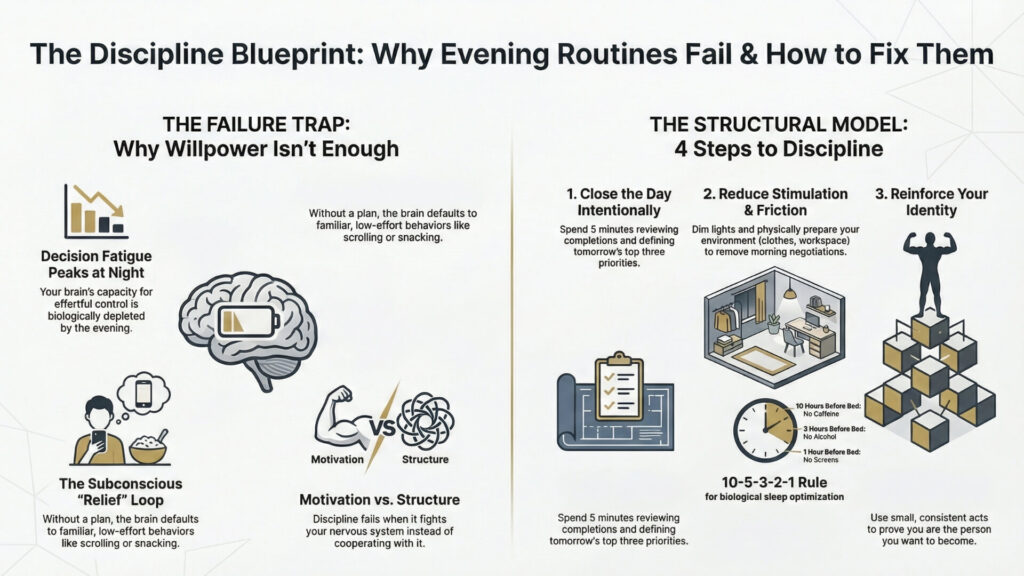
Motivation Is Lowest at Night
Throughout the day, you make hundreds of decisions. Each one draws from limited cognitive resources. By evening, those resources are depleted.
This is not a character flaw. It is biology.
Decision fatigue reduces your capacity for effortful control. The prefrontal cortex, responsible for planning and discipline, becomes less dominant. Meanwhile, the brain shifts toward comfort-seeking and reward behavior.
This is why the same person who can stay disciplined at 9 a.m. struggles at 9 p.m.
When you build your evening routine around willpower, you are fighting your nervous system. When you build it around a structure, you are cooperating with it.
The Subconscious Prefers Familiar Evenings
One of the most overlooked aspects of an evening routine is subconscious conditioning.
The subconscious mind does not prioritize improvement. It prioritizes familiarity.
If your evenings have consistently included:
Scrolling
Snacking
Background television
Late-night stimulation
Then those behaviors become embedded patterns. Not because they are beneficial, but because they are predictable.
The brain associates them with relief.
After a demanding day, the subconscious seeks something known and comforting. That comfort may not serve you long term, but it feels safe in the moment.
This is why simply deciding to “be more disciplined at night” rarely works. You are attempting to override a conditioned pattern with intention alone.
Without structural change, the subconscious wins.
Discipline Fails When It Fights Identity
Evening behavior often reveals identity statements that go unnoticed.
“I deserve this after a long day.”
“I relax with Netflix.”
“I work hard, so I unwind hard.”
“I’m not a strict routine person.”
These internal narratives shape behavior more powerfully than any checklist.
If your evening routine contradicts your self-image, you will sabotage it quietly. Not because you are weak, but because identity consistency is psychologically stabilizing.
Real discipline does not emerge from force. It emerges when your structure supports the identity you are building.
If you want to become someone who wakes up focused and aligned, your evening routine must reinforce that identity, not undermine it.
The Real Function of an Evening Routine
Most advice frames an evening routine as preparation for sleep. That is only partially true.
The deeper function of an evening routine is identity reinforcement.
Evenings Decide Tomorrow’s Discipline
You do not wake up disciplined. You wake up with the consequences of your evening.
If you close the day intentionally, prepare tomorrow in advance, and reduce mental clutter, you wake up with clarity.
If you drift through the evening reactively, you wake up negotiating with yourself.
Discipline in the morning is easier when decisions have already been made the night before.
Clothes prepared.
Priorities defined.
Phone placed away from the bed.
Mental loops partially closed.
An effective evening routine reduces the number of decisions required tomorrow. Fewer decisions mean less friction. Less friction means more consistency.
This is how discipline compounds.
An Evening Routine Reduces Cognitive Load
One of the biggest hidden drains on mental energy is unfinished loops.
Tasks not closed.
Conversations unresolved.
Plans undefined.
The brain keeps these active in the background, increasing mental noise.
A simple review ritual in the evening, even five minutes, lowers cognitive load dramatically.
Not because everything is solved, but because it is acknowledged.
Acknowledgment stabilizes the nervous system. Stability increases clarity. Clarity supports discipline.
The Biology of Evenings
To design a sustainable evening routine, you must respect biology.
What Is the 10-5-3-2-1 Rule for Sleep?
You may have heard of the 10-5-3-2-1 rule. It suggests:
10 hours before bed: no caffeine
5 hours before bed: no heavy meals
3 hours before bed: no alcohol
2 hours before bed: no work
1 hour before bed: no screens
As a framework, it is helpful. It addresses stimulation and sleep quality.
But most people struggle to follow it consistently.
Why?
Because rules without identity integration and structural support rely on willpower. And willpower is weakest at night.
The 10-5-3-2-1 rule can be a component of a healthy evening routine, but it cannot be the foundation. Without addressing subconscious habits and emotional regulation, it becomes another guideline you break and feel guilty about.
What Is the Healthiest Thing to Do Before Bed?
Many people search for the healthiest activity before sleep.
The answer is less about adding something and more about removing stimulation.
The healthiest actions before bed typically include:
Reducing light exposure
Lowering digital input
Gentle physical unwinding
Brief reflection
Preparing tomorrow’s essentials
But the most important shift is reducing cognitive load.
The brain does not need inspiration at night. It needs closure.
When stimulation decreases gradually, the nervous system transitions from performance mode to recovery mode. This shift supports both sleep quality and emotional stability.
How to Stop Scrolling at Night
One of the most common evening routine failures involves digital consumption.
Scrolling Is Emotional Regulation
Late-night scrolling is not primarily a time management issue. It is emotional regulation.
After a long day, the mind seeks low-effort distraction. Infinite scrolling provides novelty without responsibility. It creates a temporary escape from decision-making.
Removing scrolling without replacing its function often backfires.
If scrolling regulates emotional tension, eliminating it without creating another decompression strategy leaves a void.
The result? The old habit returns.
Replace, Don’t Remove
Instead of trying to eliminate scrolling through force, redesign the structure.
Create friction:
Charge your phone in another room.
Log out of distracting apps.
Set device shutdown alarms.
Create replacement:
Short walk
Warm shower
Five-minute reflection
Physical reset of your space
When you replace passive stimulation with intentional decompression, resistance decreases.
An evening routine becomes sustainable when it acknowledges emotional needs instead of denying them.
The Structural Model: How to Build an Evening Routine That Creates Discipline
Prefer to Listen?
Some ideas are easier to absorb through reflection rather than reading.
This short audio explores how to design your evening routine around your lowest-energy state, instead of relying on motivation.
If most evening routines fail because they rely on motivation, then the solution must rely on structure.
A disciplined evening routine is not built around ambition. It is built around containment.
Instead of asking, “What should I add?”, ask:
How do I close the day?
How do I reduce stimulation?
How do I prepare for tomorrow?
How do I reinforce identity?
These four functions create stability.
Let’s break this down.
How to Build an Evening Routine That Builds Discipline
If you are wondering how to build an evening routine that actually strengthens discipline rather than drains it, the answer is not adding more habits. It is designing a sequence that works with your lowest-energy state.
A disciplined evening routine closes the day, reduces stimulation, prepares tomorrow, and reinforces identity. When those four functions are present, discipline becomes a byproduct of structure rather than effort.
Step 1: Close the Day Intentionally
An open day keeps the mind active. An intentionally closed day reduces background tension.
Closing the day can be simple:
Review what was completed.
Acknowledge what remains unfinished.
Write down the top one to three priorities for tomorrow.
This process takes five to ten minutes.
The goal is not productivity. It is psychological completion.
When the brain knows that tomorrow’s direction is already defined, it relaxes. Cognitive load decreases. Sleep improves. Morning discipline strengthens.
This is where your evening routine begins, not in the bedroom, but at the desk.
Step 2: Reduce Stimulation Gradually
Many people try to shift directly from high stimulation to sleep. This creates friction.
Instead, build a transition phase.
Dim lights.
Lower digital exposure.
Avoid emotionally activating content.
If the 10-5-3-2-1 rule supports you, integrate it here, not as a rigid rule but as a structural guide.
Remember, the goal is nervous system regulation.
An overstimulated nervous system will resist sleep and seek distraction. A regulated one moves naturally toward rest.
Your evening routine must respect that shift.
Step 3: Prepare Tomorrow Physically
Discipline thrives on lowered friction.
Prepare your environment.
Lay out clothes.
Set up your workspace.
Place your phone away from the bed.
Prepare water or morning essentials.
These are small acts, but they compound.
When you remove morning decisions, you remove negotiation. When negotiation disappears, consistency increases.
This is how an evening routine builds discipline indirectly.
Step 4: Reinforce Identity
This is the most overlooked component.
Ask yourself:
What kind of person am I becoming?
If you want to become someone who is focused, aligned, and self-led, your evening routine should reflect that identity.
Not through intensity, but through consistency.
Two minutes of intentional reflection reinforces identity more powerfully than a perfect but inconsistent routine.
You are not building a habit. You are building self-trust.
Some people integrate structure better visually. This walkthrough explains the discipline blueprint in depth.
How to Break Bad Evening Habits
Many readers search for one core question:
How do I break bad habits at night?
The answer is not discipline. It is awareness plus redesign.
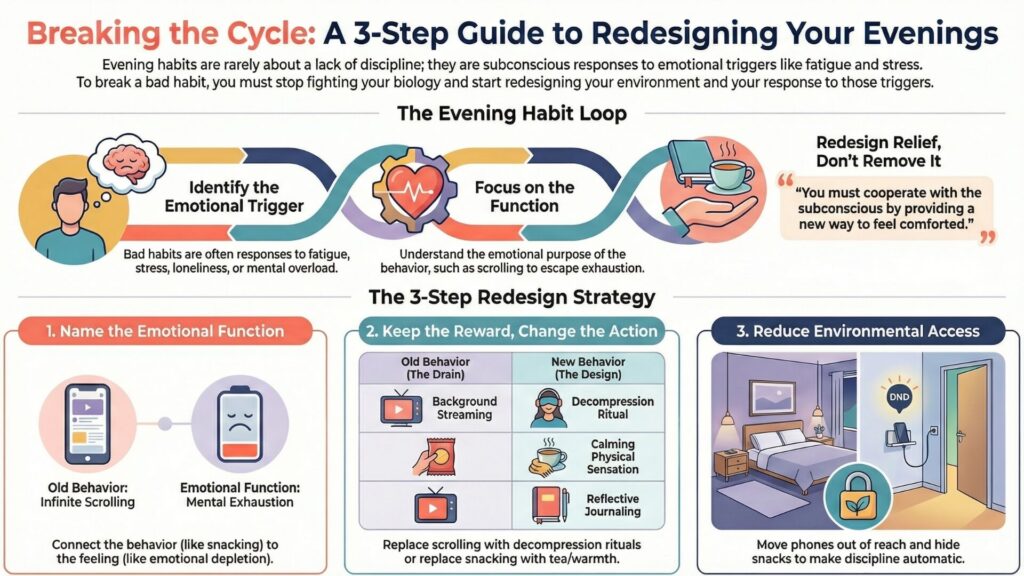
Step 1: Identify the Trigger
Every habit loop contains three components:
Trigger
Behavior
Reward
In the evening, triggers are often emotional:
Fatigue
Stress
Loneliness
Mental overload
If you only focus on stopping the behavior, you ignore the trigger.
For example:
Scrolling may follow mental exhaustion.
Snacking may follow emotional depletion.
Streaming may follow avoidance of unfinished tasks.
Breaking an evening habit requires naming its emotional function.
Step 2: Keep the Reward, Change the Behavior
If scrolling provides mental escape, replace it with a decompression ritual.
If snacking provides comfort, replace it with warmth, tea, or calming physical sensation.
If streaming provides noise that masks internal tension, try low-stimulation audio or reflective journaling.
Do not remove relief. Redesign it.
This is how you cooperate with the subconscious instead of fighting it.
Step 3: Reduce Environmental Access
Habits live in environments.
If the phone is beside your bed, scrolling is easy.
If snacks are visible, eating is automatic.
If the television is the central feature of the room, it becomes default.
Redesign the space.
Evening discipline is environmental, not heroic.
Evening Routine Ideas That Actually Work
Many people search for evening routine ideas, hoping to find the perfect checklist.
Instead of listing twenty activities, focus on categories that stabilize the system.
Cognitive Reset
Short written reflection
Planning tomorrow’s priorities
Clearing mental loops
Physical Downshift
Warm shower
Gentle stretching
Slow breathing
Environmental Reset
Tidy workspace
Prepare clothing
Organize essentials
Identity Reinforcement
Reading aligned material
Reviewing long-term direction
Brief gratitude or acknowledgment practice
The specific activity matters less than consistency and alignment.
Your evening routine should feel stable, not impressive.
How Evening Discipline Connects to Subconscious Patterns
Earlier, we discussed how the subconscious prefers familiarity over improvement.
Evenings are when that preference is strongest.
Throughout the day, external structure supports discipline. Work schedules, meetings, responsibilities.
At night, structure disappears.
Without intentional containment, the subconscious reverts to familiar patterns. These patterns are not random. They follow subconscious structures that we explained in detail in our guide on how the mind works under pressure.
This is why evening discipline is so powerful.
When you build a consistent evening routine, you create new familiarity.
The brain begins to associate calm closure with safety.
Over time, the new routine becomes automatic.
This is how discipline stops feeling forced.
It becomes identity-aligned familiarity.
What Successful People Actually Do at Night
Many ask:
What are the evening habits of successful people?
The answer is less glamorous than expected.
They close their day.
They reduce stimulation.
They prepare tomorrow.
They protect sleep.
They do not rely on motivation.
They design their evenings to protect their mornings.
Discipline is rarely dramatic. It is structural.
What Time Should an Evening Routine Start?
Another common question:
When should an evening routine begin?
There is no universal time. The key variable is not the clock, but the transition.
Your evening routine should begin when your productive output for the day is complete.
It is a psychological shift from performance mode to recovery mode.
For some, that is 8 p.m.
For others, 9:30 p.m.
The exact time matters less than consistency.
What matters is the signal.
When the routine begins, stimulation decreases.
That signal trains the nervous system.
Why Evening Routines Create Long-Term Discipline
Discipline is not intensity. It is predictability.
When evenings are structured, mornings stabilize.
When mornings stabilize, days become intentional.
When days are intentional, identity strengthens.
An evening routine is not about perfection. It is about containment.
If you miss a night, return the next one.
If the routine feels too heavy, simplify it.
The smallest consistent structure beats the perfect collapsing one.
Final Integration: The Discipline Equation
If we reduce everything to its core, building an effective evening routine comes down to one equation:
Awareness + Structure – Friction = Discipline
Awareness reveals subconscious habits.
Structure stabilizes behavior.
Reduced friction increases follow-through.
You do not need to force discipline. You need to design for it.
Evenings are not about productivity. They are about protection.
Protect your nervous system.
Protect tomorrow’s clarity.
Protect the identity you are building.
Closing Reflection
Most people try to fix their mornings.
Few realize their evenings are the real leverage point.
Your evening routine is not about sleep hacks or optimization trends. It is about aligning your lowest-energy state with your highest values.
When your structure supports who you want to become, discipline no longer feels like resistance.
It feels like continuity.
So instead of asking, “How do I become more disciplined?”, ask:
What would a disciplined person do tonight, when no one is watching?
Then build a structure that makes that answer easy.
People Also Ask
What is the healthiest thing to do before bed?
The healthiest action before bed is reducing cognitive and digital stimulation. Lower light exposure, close unfinished loops, and create a calm transition so the nervous system shifts naturally toward recovery.
Why do I lose discipline at night?
Discipline weakens at night because decision fatigue increases and subconscious habits take over. Without structure, familiar behaviors override intention.
Can an evening routine improve productivity?
Yes. A structured evening routine reduces morning friction, clarifies priorities, and lowers cognitive load, making productivity more consistent the next day.
Frequently Asked Questions About Evening Routines
What is a good evening routine?
A good evening routine reduces stimulation, prepares tomorrow in advance, and reinforces identity. It should be simple, consistent, and aligned with how your energy naturally declines at night.
How long should an evening routine be?
Fifteen to thirty minutes is enough when structured correctly. An effective evening routine focuses on closure, preparation, and nervous system regulation rather than complexity.
What time should an evening routine start?
An evening routine should begin when your productive output for the day is complete. The exact clock time matters less than consistency and the psychological shift from performance mode to recovery mode.